
Gas-discharge lamp: principles, types, history, and uses
Overview of gas-discharge lamps: how they work, main types (fluorescent, sodium, neon, metal-halide), advantages, history and environmental considerations, and comparison with LEDs.
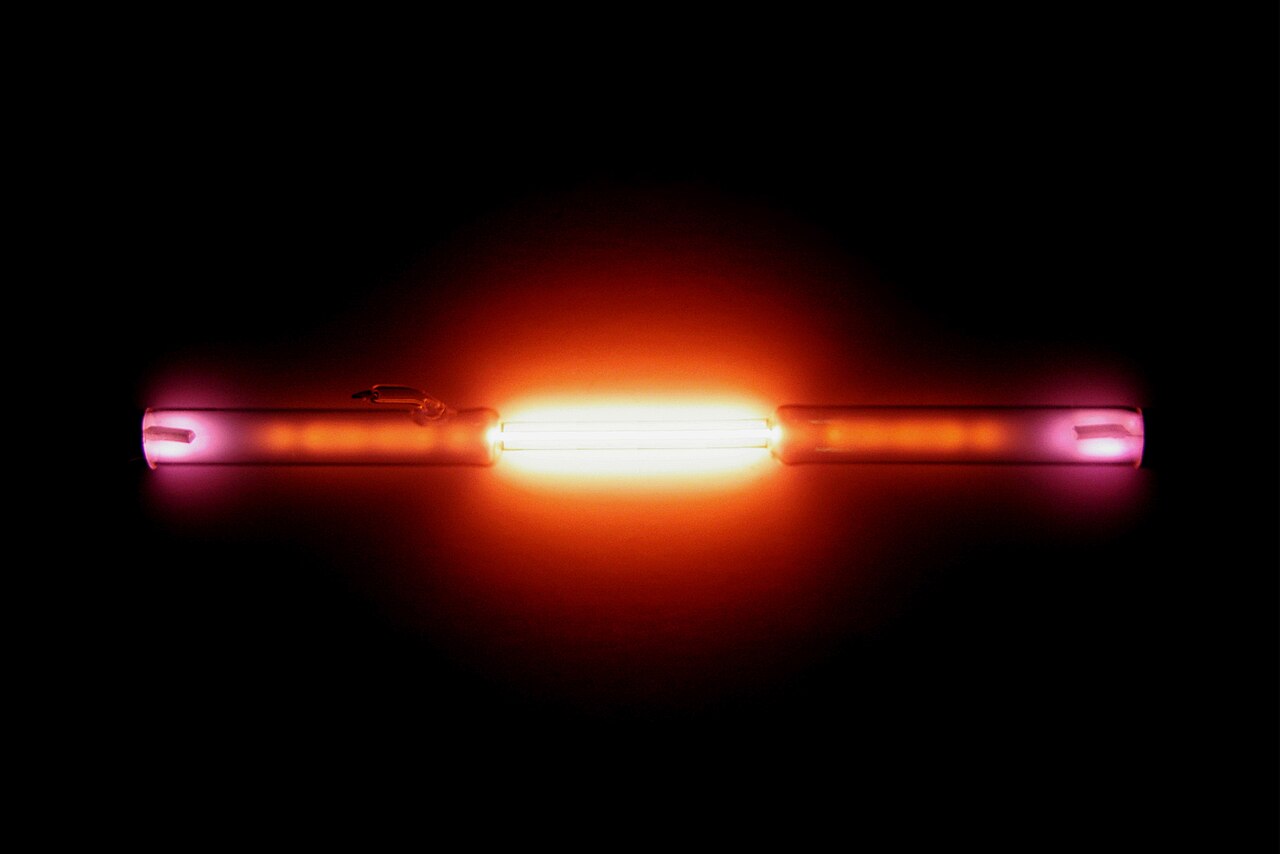
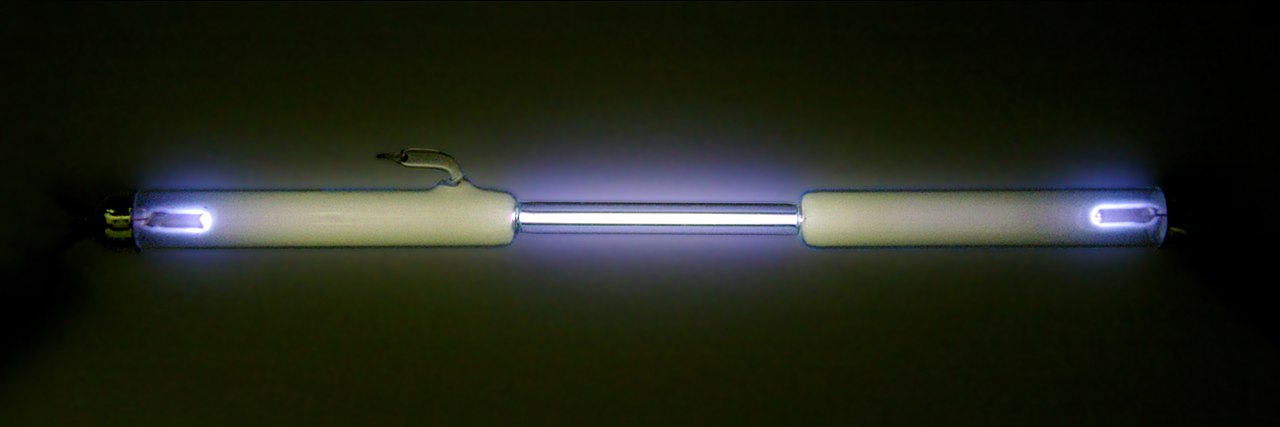
Gas-discharge lamps are a class of electric light sources in which light is produced by an electric discharge through a gas. In practice the term covers many devices commonly called lamps that rely on running an electricity-driven discharge through an ionized gas. Many designs use one or more noble gases as the primary fill; argon and neon are typical choices when a pure gas is used, and additives are mixed in to change the spectrum and efficiency.
Image gallery
10 Images




How they produce light
The basic physical process in a gas-discharge lamp involves accelerating free electrons with an applied electric current so they collide with gas atoms, molecules, or vaporized metal atoms. Collisions excite these particles to higher energy states. When the excited particles return to lower states they emit photons; that released light can be narrow-band (characteristic lines of the filling) or broader spectrum if converted by phosphors. Some lamps operate at low pressure, others at higher pressure, and the pressure and composition strongly influence color, efficiency and starting behavior.
Common types
- Fluorescent lamps — Use a low-pressure mercury discharge whose ultraviolet output is converted to visible light by a phosphor coating; widely used for interiors and office lighting. Fluorescent bulbs are familiar household examples.
- Sodium vapor lamps — Produce very efficient, often orange-yellow light. Low-pressure and high-pressure variants exist; sodium vapor lamps have been used extensively for streetlights.
- Neon and other noble-gas lamps — Neon glows red-orange and is used for signs; other neon and noble-gas mixtures yield a range of colors and are common in indicators and decorative lighting.
- Mercury and metal-halide lamps — Higher-pressure discharges containing mercury or salts such as metal halides produce intense light useful in industrial, sports and commercial settings. Some designs include sodium or other sodium-based components to tune color. References to metal additives reflect the role of vaporized metals in shaping the spectrum.
Advantages and practical characteristics
Compared with incandescent filaments, gas-discharge lamps commonly offer longer operating life and higher luminous efficacy, which is why they replaced many incandescent applications in the late 20th century. Their efficiency makes them economical where sustained, high-output lighting is needed. However, many types require auxiliary gear (ballasts) to start and regulate the discharge; some have warm-up periods or restrike delays, and color rendering varies by type.
History and technological development
Gas-discharge lighting evolved from early experiments in low-pressure gas discharges and arc lamps to a wide range of engineered products. Neon signs became popular for advertising, while fluorescent technology expanded indoor lighting. By the early 21st century the emergence of high-performance light-emitting diodes began to displace gas-discharge lamps in many roles because LEDs offered similar or better efficiency, instant start, easier dimming and reduced fragile components.
Environmental and operational considerations
Some gas-discharge lamps contain hazardous materials such as mercury, which requires careful recycling and disposal. Others may produce narrow-band spectra that hinder color recognition unless corrected by phosphors or mixed fills. Street and industrial installations valued gas-discharge lamps for reliability and output, but maintenance (ballast replacement, lamp life limits) and environmental rules have encouraged transitions to newer technologies. When choosing lighting, practical trade-offs include initial cost, total lifetime cost, color quality and environmental handling.
For further technical details, typical operating circuits, and safety guidance see reference material linked below: lamp basics, electricity and circuits, ionization concepts, gas properties, noble gases, argon, neon, mercury, sodium, metal, metal halides, electrons, current, light emission, fluorescent lamps, sodium vapor lamps, street lighting, efficiency considerations, LED comparison.
Related articles
Author
AlegsaOnline.com Gas-discharge lamp: principles, types, history, and uses Leandro Alegsa
URL: https://en.alegsaonline.com/art/37660