
Gas turbine (combustion turbine)
A gas turbine is a rotary internal combustion engine that produces mechanical power from expanding hot gases; used for power generation, propulsion, and mechanical drive applications.
A gas turbine, often called a combustion turbine, is a rotating engine that converts the chemical energy of a fuel into mechanical power via high‑temperature, high‑velocity gas flow. It is one class of internal combustion engine in which the working fluid (air) is continuously supplied and exhausted rather than working in discrete strokes. Gas turbines are valued for their high power‑to‑weight ratio and rapid start capability, and they appear in utility power plants, aircraft engines, ships, and industrial mechanical drives.
Image gallery
10 Images


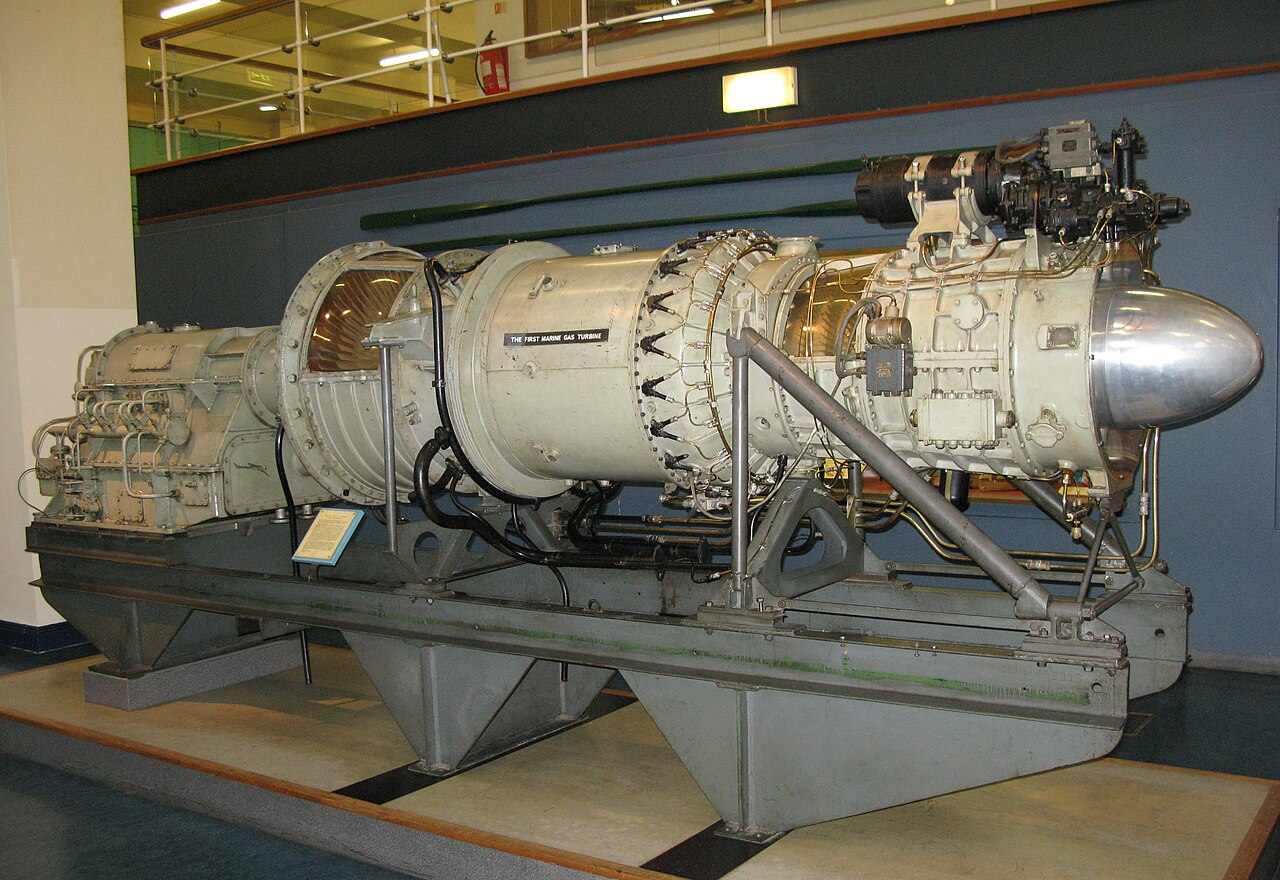


Core components and basic operation
The simplest gas turbine follows a continuous three‑stage process: compression, combustion, and expansion. These stages are assembled around a rotating shaft or shafts that carry the compressor and turbine stages.
- Compressor – Air is drawn in and compressed to a higher pressure by a rotating compressor. Many designs use axial compressors; small units sometimes use centrifugal stages. (compressor)
- Combustor – Fuel is injected and burned in a combustion chamber where heat is added at nearly constant pressure, producing hot, high‑energy gases. This chamber is commonly called a combustor.
- Turbine – The hot gases expand through turbine blades, producing torque that turns the compressor and an external load such as a generator or propeller. The turbine stage extracts useful work and then exhausts the gases. (turbine)
Variants include single‑shaft arrangements, where one turbine drives both the compressor and the output shaft, and two‑shaft (or multi‑shaft) designs that provide separate turbine stages for the compressor and the load. Two‑shaft turbines are often preferred where greater low‑speed torque or flexible speed control is required, for example in vehicles or some industrial drives. (two‑shaft and torque characteristics)
Design variations and characteristics
Gas turbines range from compact aeroderivative machines adapted from aircraft engines to heavy‑duty industrial units optimized for continuous service. Key differences include compressor type (axial vs centrifugal), number of compressor and turbine stages, cooling systems for hot parts, and materials used in high‑temperature regions. Modern designs push turbine inlet temperatures higher to improve efficiency; this requires advanced alloys, coatings, and internal cooling passages.
History and development
The concept of converting expanding gases into rotary motion dates back many decades and became practical in the 20th century as metallurgy and aerodynamics advanced. Developments in jet propulsion for aircraft stimulated intensive research; early turbojet pioneers led to powerplant and industrial adaptations. Over time, gas turbines moved from aircraft propulsion to stationary power generation and mechanical drive roles, with further efficiency gains achieved by coupling turbines to steam cycles in combined‑cycle plants.
Applications and importance
- Electricity generation: simple‑cycle peaking plants and combined‑cycle plants for higher efficiency.
- Aviation: turbine engines (turbojets, turbofans, turboshafts) provide propulsion and shaft power.
- Marine and industrial drives: ships, compressors, pumps and gas pipelines often use gas turbines for continuous high‑power operation.
- Emergency and backup power: rapid start capability makes turbines suitable for grid stability roles.
Their strengths include high power density and lower installation mass compared with reciprocating engines of similar output. Weaknesses include sensitivity to fuel quality, reduced part‑load efficiency relative to peak output, and requirements for periodic maintenance of hot section components.
Notable distinctions and environmental aspects
Important distinctions include simple‑cycle operation versus combined‑cycle (where exhaust heat drives a steam turbine), and aeroderivative versus heavy‑duty industrial machines. Common fuels are natural gas and liquid petroleum fuels; burning hydrocarbons at high temperatures produces nitrogen oxides (NOx) and carbon dioxide, so modern systems use low‑NOx combustors, catalytic or catalytic‑like techniques, and emissions control strategies to comply with regulations. Advances in materials and cooling, along with hybrid and hydrogen‑capable designs, continue to shape the technology's future.
For further technical overviews and detailed component descriptions see resources on the compressor, combustor, turbine and shaft arrangements: compressor overview, combustor details, turbine stages, and general references on internal combustion engines and shaft and torque configurations.
Questions and answers
Q: What is a gas turbine?
A: A gas turbine is a type of internal combustion engine that has a rotating gas compressor, a combustor where fuel is injected, and a turbine on the same shaft as the compressor.
Q: What are the three main parts of a gas turbine?
A: The three main parts of a gas turbine are a rotating gas compressor to compress air, a combustion chamber called a combustor where fuel is injected, and a turbine on the same shaft as the compressor.
Q: What is the purpose of the rotating gas compressor in a gas turbine?
A: The rotating gas compressor in a gas turbine compresses air in order to increase the pressure and temperature, which makes it easier to ignite the fuel in the combustor.
Q: What is the combustor in a gas turbine?
A: The combustor in a gas turbine is a chamber where fuel is injected and mixed with compressed air from the compressor. The fuel mixture is ignited, which produces hot gases that flow through the turbine.
Q: What is the purpose of the turbine in a gas turbine?
A: The turbine in a gas turbine extracts energy from the hot gases produced by the combustor, which converts the energy into rotational motion that can drive a load such as an electric generator.
Q: What is a single-shaft gas turbine?
A: A single-shaft gas turbine is a type of gas turbine where one turbine drives both the compressor and the load, such as an electric generator.
Q: What is a two-shaft gas turbine?
A: A two-shaft gas turbine is a type of gas turbine where there are separate turbines to drive the compressor and the load. Two-shaft turbines are better for driving road and rail vehicles because they can give more torque at low speed.
Related articles
Author
AlegsaOnline.com Gas turbine (combustion turbine) Leandro Alegsa
URL: https://en.alegsaonline.com/art/37671