
Anaconda Plan (Union strategy in the American Civil War)
Union strategy to blockade Southern ports and seize the Mississippi to divide and economically strangle the Confederacy, proposed by General Winfield Scott and later executed in part by Union forces.
The Anaconda Plan was an early Union strategic proposal during the American Civil War that envisioned defeating the South by choking off its resources rather than relying solely on decisive battlefield victories. It was originally proposed by General Winfield Scott, who used the metaphor of an anaconda coiling around its prey to describe a campaign of containment. The image of a constricting snake captured the idea of gradual economic and logistical pressure rather than rapid conquest.
The plan had two principal operational aims. First, enforce a comprehensive naval blockade to prevent shipments to and from key Southern ports, depriving the Confederacy of trade and supplies. Second, mount a coordinated advance along the Mississippi River to split the Confederacy geographically and hinder internal movement of troops and materiel. Together these measures were intended to isolate and weaken Southern resistance until political reconciliation became possible.
Although the plan received approval from the President Lincoln, it was initially mocked by some newspapers, politicians and military figures who favored bold, immediate campaigns. Over time the Union implemented many elements of Scott’s concept: an effective naval blockade and riverine campaigns gradually reduced Confederate capacity. The strategy placed emphasis on long-term pressure rather than instant victory.
Image gallery
4 Images
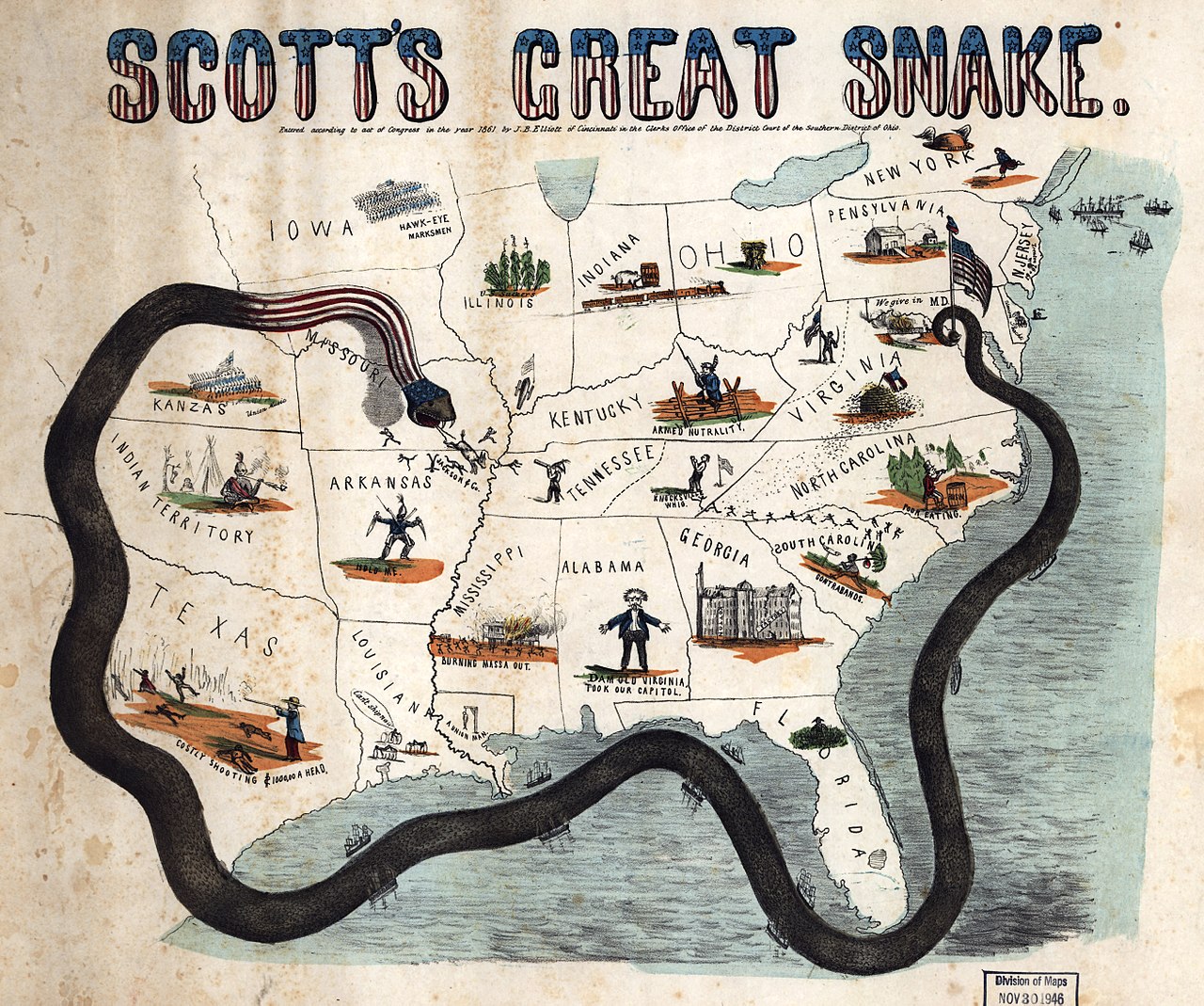


Key components and effects
- Naval blockade: Restrict Southern commerce and imports via patrolling warships and coastal operations (blockade, Southern ports).
- River operations: Control major waterways—chiefly the Mississippi River—to bisect the Confederacy and disrupt logistics (advance).
- Attrition and isolation: Apply sustained pressure so that economic exhaustion and territorial losses compel surrender to the Union.
Historians view the Anaconda Plan as influential even where it was not followed literally. Its central ideas — combining maritime power with coordinated land campaigns to strangle an adversary’s economy and sever interior lines — have shaped discussions of large-scale strategy beyond the Civil War. While the plan evolved in practice, the basic logic of containment and attrition remained a defining thread of Union strategy throughout the conflict.
Related articles
Author
AlegsaOnline.com Anaconda Plan (Union strategy in the American Civil War) Leandro Alegsa
URL: https://en.alegsaonline.com/art/3728