
Anglo‑Zulu War
A brief encyclopedia article on the 1879 conflict between the Zulu Kingdom and the British Empire, its causes, major battles, outcomes and historical legacy in southern Africa.
Overview
The Anglo‑Zulu War was a military conflict in southern Africa between the Zulu Kingdom and forces of the British Empire. The main campaign took place in 1879, although political and military aftershocks continued into the following decade. No formal mutual declaration of war preceded the invasion by British columns; fighting occurred primarily in the territory that is now part of modern South Africa.
Image gallery
10 Images


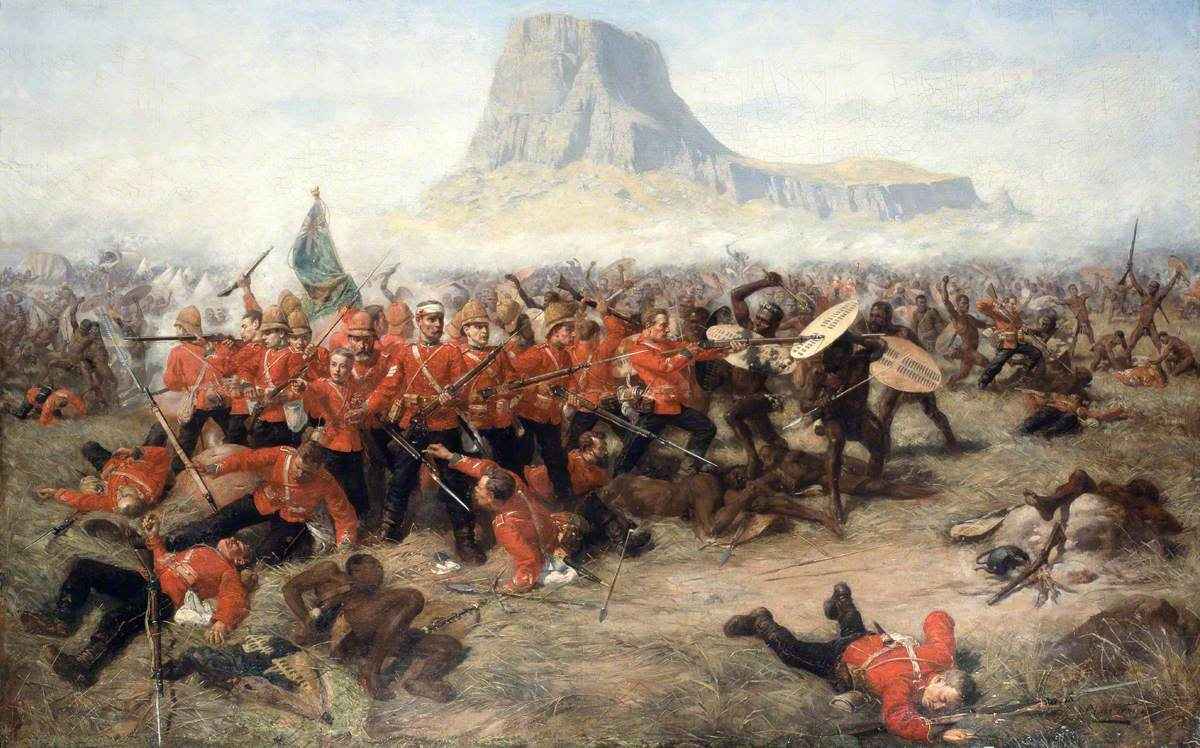


Causes and forces
The confrontation grew out of British imperial aims in southern Africa, disputes over borders and a desire by some British officials to bring independent African polities under colonial control. The British expedition was ordered by colonial authorities and commanded in the field by Lord Chelmsford. The Zulu state was led by King Cetshwayo and was organised around a highly disciplined regimental system (amabutho), noted for rapid massed attacks with spears (assegai) and cowhide shields. British troops relied on rifled firearms, artillery and formal battle formations.
Major actions
- Battle of Isandlwana (January 1879) — a decisive early victory for the Zulu, when a British column was overwhelmed.
- Defence of Rorke's Drift — a separate, much smaller action where a British garrison held a mission station against repeated Zulu assaults.
- Battle of Ulundi (July 1879) — the climactic British victory that broke the main Zulu field army and ended organised resistance in the short term.
Outcome and aftermath
The immediate result was military defeat for the Zulu Kingdom and the capture of King Cetshwayo. British authorities dismantled central Zulu authority and divided the territory into smaller chiefdoms; over subsequent years the region was absorbed into the colony of Natal and later became part of the province now known as KwaZulu‑Natal. Scholars note that although the principal fighting was concentrated in 1879, political reorganisation and occasional local violence continued into the 1880s and beyond, complicating simple date ranges for the conflict and its aftermath (1879–1880s).
Significance and legacy
The war attracted wide attention in Britain and internationally and remains a subject of military study for its tactical surprises and differences in weaponry, logistics and command. It is also an important episode in the history of colonial expansion and African resistance. Interpretations of the war have evolved: earlier British accounts emphasised military heroism, while modern histories examine imperial motives, Zulu society and the human cost of conquest. For general context and timelines see summaries of the Anglo‑Zulu War and the histories of the Zulu people and the British Empire in southern Africa; further overviews and resources are available in many public and academic collections (Isandlwana, Ulundi).
Because the conflict is entwined with regional politics, cultural memory and subsequent state formation, it continues to be commemorated, debated and reassessed by historians, descendants and local communities. For timelines, primary documents and curated exhibits consult regional archives and specialist works on nineteenth‑century southern African history (Zulu sources, South African records, KwaZulu‑Natal material).
Related articles
Author
AlegsaOnline.com Anglo‑Zulu War Leandro Alegsa
URL: https://en.alegsaonline.com/art/4202