
Union (American Civil War)
The Union was the United States federal government and the states that remained loyal during the Civil War; it opposed the Confederate states and ultimately preserved the nation and ended slavery.
Overview
The term "Union" during the American Civil War referred to the United States federal government and the collection of states that remained loyal to it. It is often called "the North" in common usage. The Union stood in opposition to the eleven Southern states that seceded to form the Confederacy. The federal government, supported by many states and millions of citizens, sought to preserve the national union and later took measures that led toward the end of slavery.
Image gallery
10 Images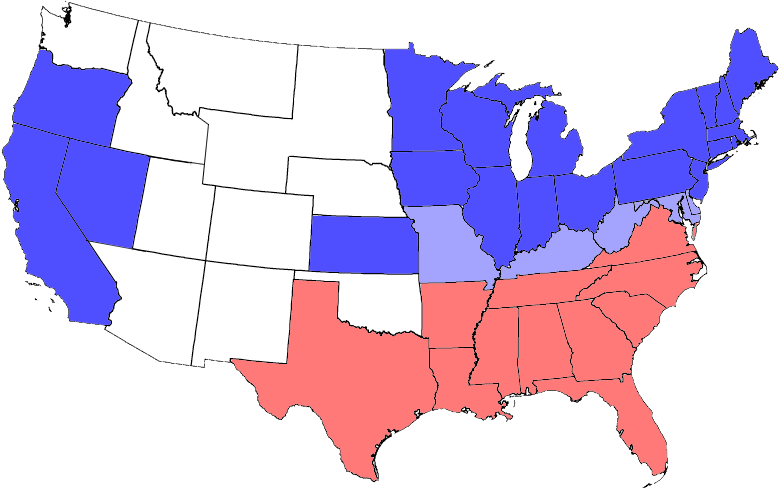


Composition and geography
The Union included a coalition of free states and a number of border states that did not join the Confederacy. Those border states—slaveholding in some cases—maintained allegiance to the federal government and provided strategic advantages. Western states such as California, Oregon, and, after its admission in 1864, Nevada, were part of the Union's territory. The region known as the Old Northwest (now largely the Midwest) also played a key role in supplying manpower and material.
Characteristics and strengths
- Economic and industrial capacity: The Union had greater manufacturing output, more developed rail networks, and more financial resources than the Confederacy.
- Population and manpower: A larger population provided a bigger pool for armies and labor supporting the war effort.
- Naval power and trade control: A stronger navy enabled blockades that limited Confederate commerce and resupply.
Leadership, policy, and wartime developments
Political leadership in Washington guided military strategy and domestic policy. Early Union strategy included isolating and constricting the Confederacy, while military campaigns sought decisive victories. Over time the federal government introduced measures such as conscription and economic policies to sustain a large, prolonged conflict. In 1863, federal policy shifted publicly toward emancipation of enslaved people, altering the war's legal and moral dimensions.
Impact and legacy
The Union's victory preserved the continuity of the federal government of the United States and ensured that secession would not dissolve the nation. The outcome led to major political and social changes, including constitutional amendments and a long period of Reconstruction. The Union era remains central to United States history and identity, and its distinctions—geographic, economic, and political—continue to shape interpretations of the conflict.
Further context
Historians distinguish between the Union as a legal-political entity and the popular shorthand "North." The role of border states, the admission of new states, and the interplay of military, economic, and social factors make the Union a complex subject for study. For readers seeking more detail, there are many accessible resources on political decisions, battlefield campaigns, and civilian life within the Union during the war.
Questions and answers
Q: What was the Union during the American Civil War?
A: The Union referred to the federal government of the United States during the American Civil War.
Q: How many states supported the Union?
A: The Union was supported by twenty free states and five border states, making a total of 25 states.
Q: Who opposed the Union during the American Civil War?
A: The Union was opposed by 11 Southern slave states.
Q: Which Western states were part of the Union during the American Civil War?
A: The Union included the Western states of California, Oregon, and (after 1864) Nevada.
Q: What region is now usually considered part of the Midwest but was included in the Union during the American Civil War?
A: States then called the "Old Northwest" and now usually thought to be part of the Midwest were included in the Union during the American Civil War.
Q: What is another name for the Union?
A: The Union has also been often called "the North", both then and now.
Q: Was the Union generally richer and more industrialized than the Confederate States?
A: Yes, the Union states were mostly richer and more industrialized.
Related articles
Author
AlegsaOnline.com Union (American Civil War) Leandro Alegsa
URL: https://en.alegsaonline.com/art/102873
Sources
- avalon.law.yale.edu : "Avalon Project - The Inaugural Addresses of the Presidents"