
Flag of Greenland (Erfalasorput)
Erfalasorput, Greenland’s red-and-white flag designed by Thue Christiansen and adopted in 1985, symbolizes ice, sea and sun and is commonly displayed alongside the Danish Dannebrog.
Overview
The flag of Greenland, known in Greenlandic as Erfalasorput (literally "our flag") and sometimes called Aappalaartoq ("the red"), is a two-colour banner created by Greenlander Thue Christiansen and formally adopted on 21 June 1985. It is widely used across Greenland and frequently displayed together with the Danish national flag to reflect Greenland's constitutional connection with the Kingdom of Denmark and its distinct cultural identity. The flag's simple geometrical composition and limited palette make it highly recognisable both locally and internationally.
Image gallery
2 Images
Design and symbolism
The basic design comprises two horizontal bands of equal height — white on the top and red on the bottom — and a large circular disk whose upper semicircle is red and lower semicircle is white. The disk is set near the centre of the flag so that the interaction between fields creates a clear contrast between land ice and sea. According to the designer's explanation, the white areas represent glaciers, the ice cap and pack ice; the red areas represent the ocean and coastal fjords; the semicircular motif evokes icebergs and the sun reflected on the water. The red-and-white palette echoes that of the Danish flag while deliberately avoiding the Nordic cross motif used by most other Scandinavian flags.
History and adoption
Interest in a distinct Greenlandic flag increased during the 1970s as political and cultural movements called for greater self-determination. A public discussion of possible flags began in the early 1970s, with several different proposals circulated and debated. After Greenland received home rule in the late 1970s, the local government invited submissions and received hundreds of designs. Thue Christiansen's red-and-white proposal won the final selection and was officially adopted on 21 June 1985. The selection process and subsequent commemorations reflected an effort to balance local identity with historical links to Denmark.
Names, use and display
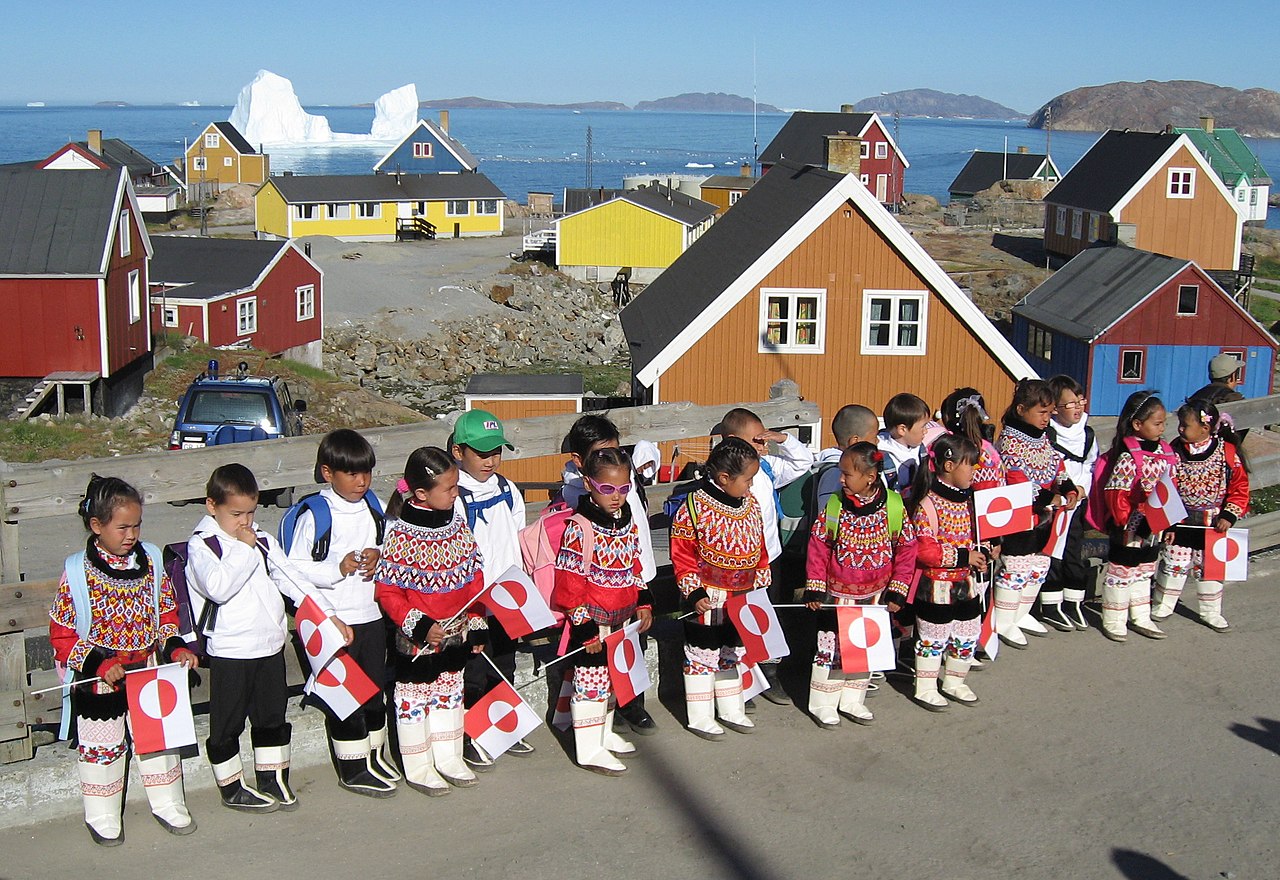
Erfalasorput is the customary Greenlandic name; Aappalaartoq is also used in everyday speech and can refer to either the Greenlandic flag or the Danish Dannebrog in certain contexts. The Greenlandic flag appears on public buildings, at cultural events, in municipal contexts and on philatelic issues. It is used in civic ceremonies, at schools and during national celebrations, and often flies alongside the Danish flag on official premises and at family homes.
Distinctive features and comparisons
Among the flags of the Nordic countries, Greenland's banner is notable for rejecting the cross form and adopting a circular motif that directly references the island's environment. The flag's design is minimalist and symbolic rather than heraldic, and it has been described as both modern and evocative. Its colours and shapes are deliberately simple to ensure visibility in harsh Arctic conditions and to convey primary associations with ice, sea and sunlight.
Commemoration and documentation
To mark anniversaries and public interest in the flag, Greenlandic institutions have issued commemorative material, explanatory leaflets and postal stamps that record the designer's comments on symbolism and the selection history. These materials, together with government publications and museum exhibits, preserve the documentary record of the flag's adoption and continuing role in Greenlandic public life.
Further reading and sources
- Dannebrog and constitutional ties
- early graphic reproductions
- use alongside the Danish flag
- official design notes
- visual description
- vernacular names and language
- comparative flag studies
- 1973 proposals and early debate
- green-and-white proposals
- alternative colour schemes
- home rule and political context
- adoption date and ceremonies
- legal adoption records
- postal commemoratives
- leaflets by the designer
- glaciers and ice symbolism
- pack ice and maritime themes
- ocean and fjord symbolism
- sun and reflection motifs
- further analysis and archives
- Designer: Thue Christiansen.
- Local names: Erfalasorput ("our flag"), Aappalaartoq ("the red").
- Adopted: 21 June 1985.
- Colours: Red and white, symbolically associated with sea, ice and sun.
Related articles
Author
AlegsaOnline.com Flag of Greenland (Erfalasorput) Leandro Alegsa
URL: https://en.alegsaonline.com/art/34798