
Flag of Denmark (Dannebrog)
The Dannebrog is a red flag bearing a white Scandinavian cross. It is famed for a medieval origin legend and is widely used in Denmark for public, private and ceremonial occasions.
Overview
The national flag of Denmark, commonly called the Dannebrog, consists of a white cross shifted toward the hoist on a red field. Its simple geometry places it among the family of Nordic or Scandinavian cross flags, a pattern shared with Sweden, Norway, Finland and Iceland. The Dannebrog is widely regarded as one of the oldest national flags still in use and occupies a central place in Danish cultural life.
Image gallery
9 Images


Design and variants
The basic motif is a white cross extending to the edges on a rectangular red field, with the vertical arm positioned closer to the hoist. Several variants exist for different purposes: a civil flag for general use, a swallow-tailed or double-tailed naval ensign for maritime and military purposes, and special royal or state banners that incorporate coats of arms or additional heraldic elements. The simple cross design links the Dannebrog to the broader tradition of the Scandinavian cross.
History and legend
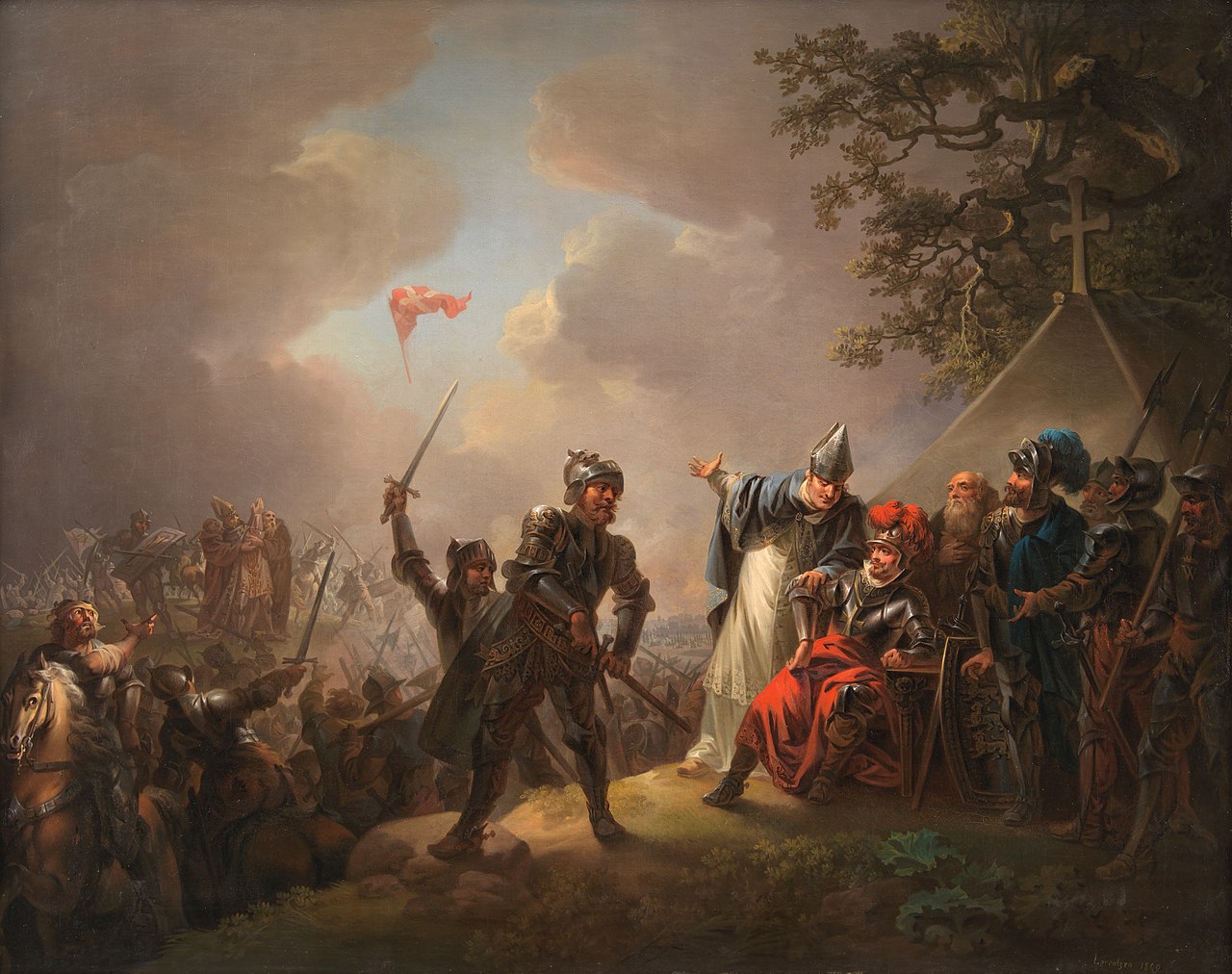
A longstanding legend says the flag fell from the sky during a battle in 1219, when Danish forces fought in what is now Estonia; that event is commemorated each year on 15 June. According to the tale, the appearance of the banner reinvigorated the Danish army and led to victory. Historians treat this account as a foundation myth rather than as literal fact: the form and use of the banner likely developed in the context of medieval warfare and Christian crusading activity in the Baltic region. The 1219 campaign is commonly described as part of the Northern Crusades and the expansion of Christianity in the area; contemporary banners used in such expeditions often carried crosses as religious emblems (battle in Estonia, crusade context).
Uses, customs and symbolism
In Denmark the Dannebrog functions not only as a state emblem but as a widely used cultural symbol. It appears at official ceremonies and on government buildings, but it is equally present at private celebrations. Danes commonly display the flag at birthdays, weddings and during Christmas festivities, where small flags may decorate cakes, tables and gifts. For many people in Denmark the banner represents conviviality and community life rather than aggressive nationalism; observers often note that the flag serves as a mark of celebration and identity for ordinary Danes.
Etiquette and notable facts
There are informal and formal customs governing flag use: prescribed flag days, rules about raising or lowering the flag, and guidelines for respectful handling. The Dannebrog’s medieval legend is commemorated annually and remains a popular element of national storytelling, while its geometric design has inspired national and regional flags across northern Europe.
References and further reading
- Design family: Scandinavian or Nordic cross flags and their spread across the Nordic countries.
- Legend vs. history: the 1219 account and scholarly views on medieval banners and crusading symbols.
- Contemporary use: the Dannebrog in daily life, celebrations, and official ceremonies.
Related articles
Author
AlegsaOnline.com Flag of Denmark (Dannebrog) Leandro Alegsa
URL: https://en.alegsaonline.com/art/34773