
Flag of Iceland
The national flag of Iceland: a blue field charged with a red Nordic cross edged in white. This article explains its design, symbolism, historical development, usage and notable variants.
Overview
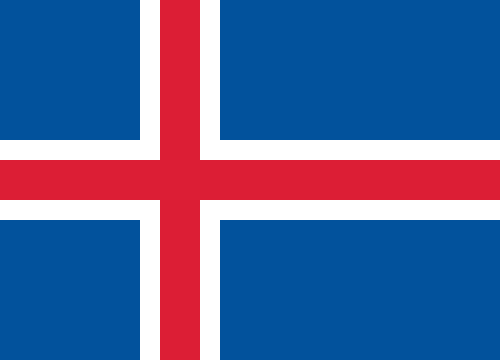
The flag of Iceland is a rectangular banner featuring a red cross with a white border set on a blue background, the cross shifted toward the hoist in the characteristic Nordic style. It functions as the primary national symbol, flown by state institutions, at public events and by private citizens. For formal guidance and official descriptions see official Icelandic sources.
Image gallery
4 Images


Design and symbolism
The flag follows the Scandinavian cross tradition, which places the vertical arm off centre to the hoist. The three colours are commonly explained in natural and cultural terms:
- Blue represents the Atlantic Ocean and Iceland's mountains and sky (blue field).
- White evokes ice and snow that cover much of the island (white fimbriation).
- Red symbolizes the island's volcanic activity and the fire beneath the surface (red cross).
History and development
The cross motif aligns Iceland with other Nordic countries that adopted similar crosses to indicate shared cultural and historical ties. The present pattern emerged in the early 20th century as Iceland moved toward greater autonomy and was formally adopted as the national flag when the republic was established. Over time the flag came to replace older banners and variants used under Danish rule.
Usage, protocol and variants
The flag is used on civic buildings, at national ceremonies and private celebrations. There are traditional customs for display: it is raised on national holidays, may be flown at half‑mast during periods of mourning, and handled with respect. Distinctive variants and ensigns have been used for state, military and maritime purposes at different times, though the basic Nordic cross design remains consistent.
Notable facts
Like other Nordic flags, Iceland's banner visually expresses regional identity through the shifted cross. Its simple, bold colours make it readily recognizable and suitable for use in many contexts, from emblems and sports uniforms to official government insignia.
Related articles
Author
AlegsaOnline.com Flag of Iceland Leandro Alegsa
URL: https://en.alegsaonline.com/art/34808