
Amblypygi — whip spiders and tailless whip scorpions
Amblypygi are an order of arachnids known as whip spiders or tailless whip scorpions. Harmless to people, they are nocturnal, flattened predators found in warm, humid habitats worldwide.
Overview
Amblypygi is an arachnid order commonly called whip spiders or tailless whip scorpions. Members of this group are characterized by a broad, flattened body and extremely elongated first pair of legs that function as sensory feelers rather than for walking. The name Amblypygi is often rendered as "blunt rump," a reference to the absence of a tail-like telson. Although their appearance can be alarming, they are generally harmless to humans.
Image gallery
10 Images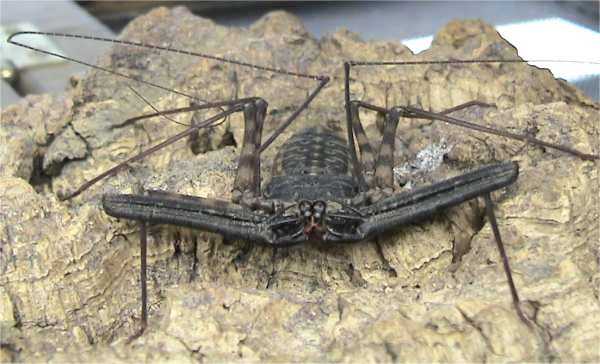


Anatomy and distinguishing features
Unlike spiders, amblypygids lack silk glands and a tail. Their body is divided into a cephalothorax and abdomen like other chelicerates, and their front limbs are modified into raptorial pedipalps and long antenniform legs used for sensing the surroundings. Key traits include:
- Raptorial pedipalps: strong, spined appendages used to seize prey.
- Antenniform legs: the first pair of legs elongated into tactile organs.
- No tail: absence of a telson distinguishes them from some related groups.
Behavior, diet, and ecology
Amblypygids are primarily nocturnal hunters that feed on small invertebrates. They rely on stealth and the reach of their pedipalps rather than venomous bites. Many species are crepuscular or strictly night-active and spend daylight hours hidden under logs, bark, rocks or inside caves. Some species inhabit soil and limestone subterranean systems, adapting to low-light conditions. Their preference for moisture and shade means they favor a humid environment and are common in warm, sheltered microhabitats.
Taxonomy and distribution
Amblypygi belong to the subphylum Chelicerata within the phylum Arthropoda. They are one of several orders in the class Arachnida. Current classifications recognize about five families, seventeen genera and roughly 155 described species. Species are predominantly found in tropical and subtropical regions around the globe, with some reaching temperate zones or living in caves and other specialized habitats.
History, research, and notable facts
Fossil and morphological studies place amblypygids as an ancient lineage of chelicerates with conservative body plans. Their unique sensory legs and complex courtship and maternal behaviors have attracted attention from behavioral ecologists. Observations show maternal care in which females carry eggs and young on their bodies until the offspring can fend for themselves.
Interaction with people
Because they neither possess medically significant venom nor aggressive tendencies, amblypygids are of limited concern to humans and are sometimes kept by hobbyists interested in exotic arthropods. In natural ecosystems they serve as predators of insects and other small animals, contributing to invertebrate community dynamics. For more detailed taxonomic or ecological information, consult specialist sources and databases available through institutional links such as order-level resources and general arachnid guides at arthropod references and phylum overviews. Additional reading on nocturnal behavior and habitat preferences can be found at subtropical fauna pages and tropical biodiversity portals, while guides to care and identification are available at chelicerate-focused sites and conservation summaries at arachnid conservation resources.
Researchers and enthusiasts frequently use regional keys and field guides to distinguish species within genera; those interested in subterranean or cave-dwelling forms may consult specialist literature on troglobitic arthropods. For behavior and sensory ecology, recent studies referenced in academic databases provide insights into antenniform leg use and intraspecific communication, and can be searched through general scientific portals such as environmental databases and curated natural history collections at museum or educational websites.
Related articles
Author
AlegsaOnline.com Amblypygi — whip spiders and tailless whip scorpions Leandro Alegsa
URL: https://en.alegsaonline.com/art/3301