
Ambulocetus — an early amphibious whale
Ambulocetus was a semi-aquatic early cetacean from the early Eocene whose anatomy links terrestrial mammals to modern whales, known from fossils found in what is now Pakistan.
Overview
Ambulocetus (literally "walking whale") is an extinct genus of early cetacean that combined features adapted for life both on land and in water. Known primarily from the species Ambulocetus natans, it lived in the early Eocene, roughly 50–48 million years ago. Its fossils were recovered from deposits in present-day Pakistan and represent one of the clearer examples of a transitional stage in whale evolution. Modern summaries often present Ambulocetus as an amphibious predator that could both walk on shore and swim effectively in shallow coastal waters (early amphibious cetacean, walk and swim).
Image gallery
10 Images
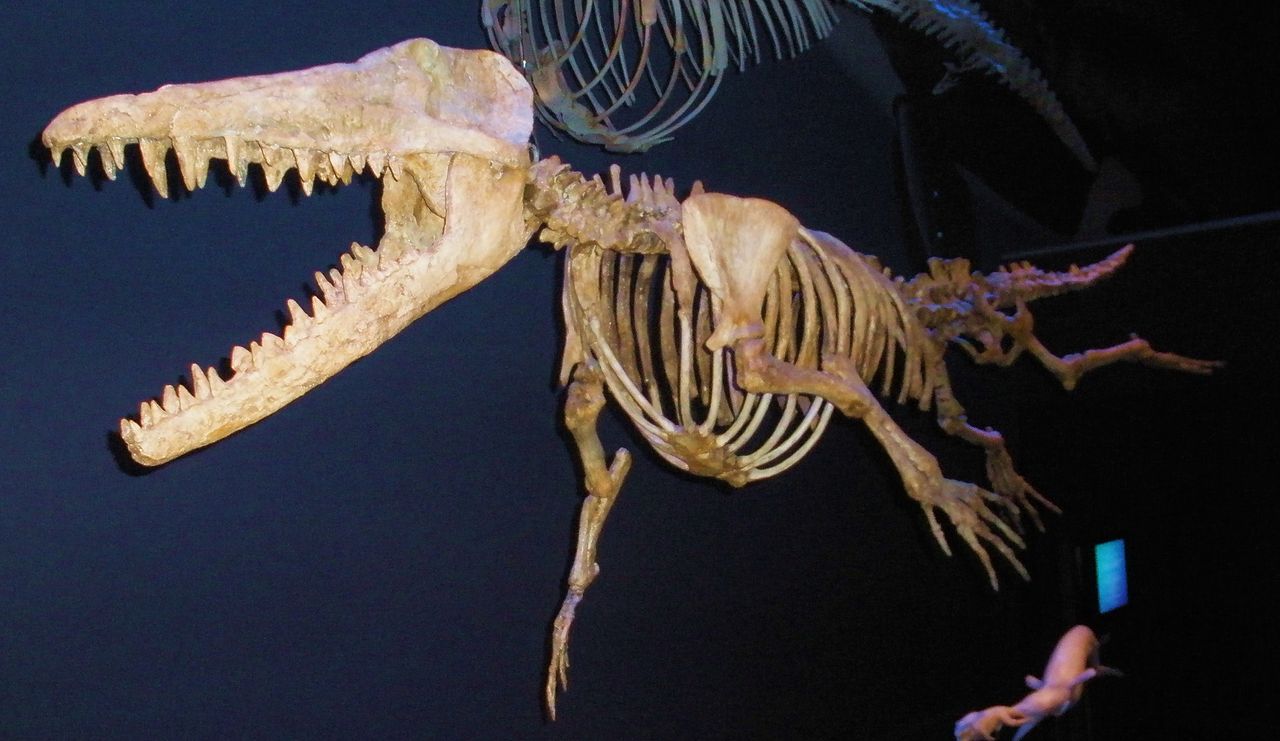

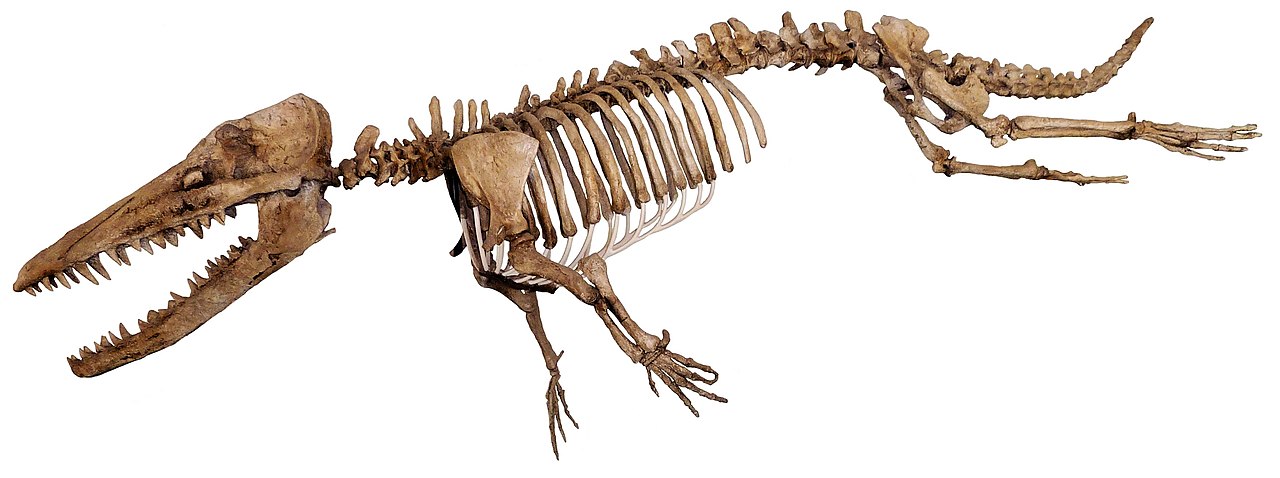


Physical characteristics
Ambulocetus combined a long, crocodile-like skull with robust limbs and a heavy body. Its anatomy shows a mosaic of traits: teeth suited for capturing prey, limb bones capable of supporting weight on land, and adaptations in the ear and skull for hearing in water. Key features included:
- Long snout and conical teeth for seizing fish and other aquatic prey.
- Powerful hind limbs with a pelvis able to transmit weight to the backbone, suggesting terrestrial locomotion was possible.
- A body and tail shaped for swimming by undulation and by pushing with the feet rather than by a fluked tail like modern whales.
- Ear specializations consistent with improved underwater hearing compared with fully terrestrial mammals.
Locomotion and diet
Reconstructions of Ambulocetus propose an ambush-style predator that hunted in shallow coastal or estuarine environments. It likely used a combination of foot-driven propulsion and body undulation to swim, and could come ashore to rest or travel. Its teeth and jaw suggest a carnivorous diet of fish and possibly other marine vertebrates. These functional inferences are based on skeletal form and comparisons with both living semiaquatic mammals and other early cetaceans.
Discovery and geological context
Fossils of Ambulocetus natans were recovered from early Eocene sedimentary rocks in Pakistan. At the time Ambulocetus lived, that region lay on the northern margin of a rapidly changing Indian subcontinent, bordering shallow seas as India drifted northward. The fossil-bearing units preserve a coastal or near-shore environment and help place Ambulocetus in a paleogeographic setting where transitions between land and sea lifestyles were possible (early Eocene, fossils, Pakistan, coastal India).
Evolutionary significance and distinctions
Ambulocetus occupies an important position in the sequence from land-dwelling artiodactyl-like ancestors to fully aquatic whales. It is often placed among early cetaceans that show intermediate adaptations: less terrestrial than genera such as Pakicetus but not as derived as later archaeocetes that developed more efficient tail-driven swimming. Ambulocetus illustrates how changes in hearing, limb structure, and locomotion evolved gradually as ancestors of modern whales adapted to marine environments.
Notable facts
- Ambulocetus is sometimes called a "walking whale" because its anatomy indicates it could move on land and in water.
- Its discovery in Eocene coastal deposits provided direct fossil evidence of transitional cetacean forms.
- Studies of Ambulocetus feed into broader questions about the timing and sequence of adaptations—such as nostril migration and development of aquatic hearing—that produced modern whales.
For further reading see general reviews of early cetacean evolution and paleontological summaries that discuss Ambulocetus in the context of other archaeocetes and Eocene marine ecosystems (overview, locomotion, age, specimens, locality, paleogeography).
Questions and answers
Q: What is Ambulocetus?
A: Ambulocetus is an early amphibious cetacean that could walk as well as swim.
Q: What does Ambulocetus mean?
A: Ambulocetus means "walking whale".
Q: When did Ambulocetus live?
A: Ambulocetus natans lived from the early Eocene (50 to 48 million years ago).
Q: Where have fossils of Ambulocetus been found?
A: Fossils of Ambulocetus have been found in Pakistan.
Q: What was the geographic location of Pakistan during the time when Ambulocetus was alive?
A: During the time when Ambulocetus was alive, Pakistan was a coastal region of India, which was then a large island in the Indian Ocean.
Q: Was Ambulocetus an exclusively aquatic animal?
A: No, Ambulocetus was an amphibious cetacean which means it could walk on land as well as swim in water.
Q: What is the significance of Ambulocetus in the evolution of cetaceans?
A: Ambulocetus is an important transitional fossil in the evolution of cetaceans as it provides evidence of the gradual adaptation of land animals to an aquatic lifestyle.
Related articles
Author
AlegsaOnline.com Ambulocetus — an early amphibious whale Leandro Alegsa
URL: https://en.alegsaonline.com/art/3320
Sources
- wikidata.org : Q132405
- species.wikimedia.org : Ambulocetus
- eol.org : 4525263
- fossilworks.org : 36660
- gbif.org : 4832333
- irmng.org : 1059445