
Despina — inner moon of Neptune
Despina is a small, irregular inner satellite of Neptune discovered in Voyager 2 images in 1989. It orbits close to the planet, shows no signs of geological activity, and is named for a mythic nymph.
Despina is one of Neptune's inner satellites and is officially designated Neptune V. It is a small, irregularly shaped moon that orbits close to the planet's equatorial plane. Because of its proximity to Neptune and its modest size it has been observed only sparsely, primarily during the flyby of the Voyager 2 space probe in 1989, when it was first identified and given the provisional name S/1989 N 3.
Image gallery
8 Images




Physical characteristics
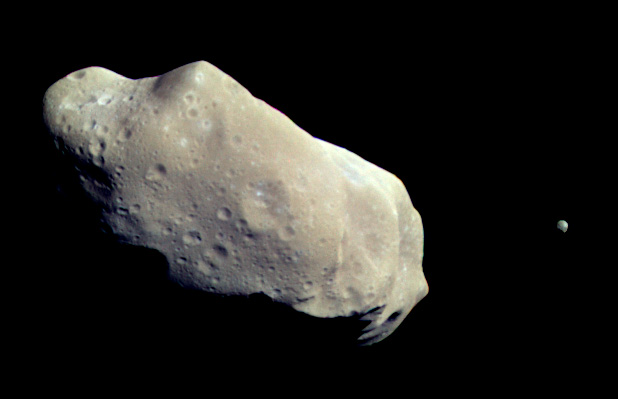
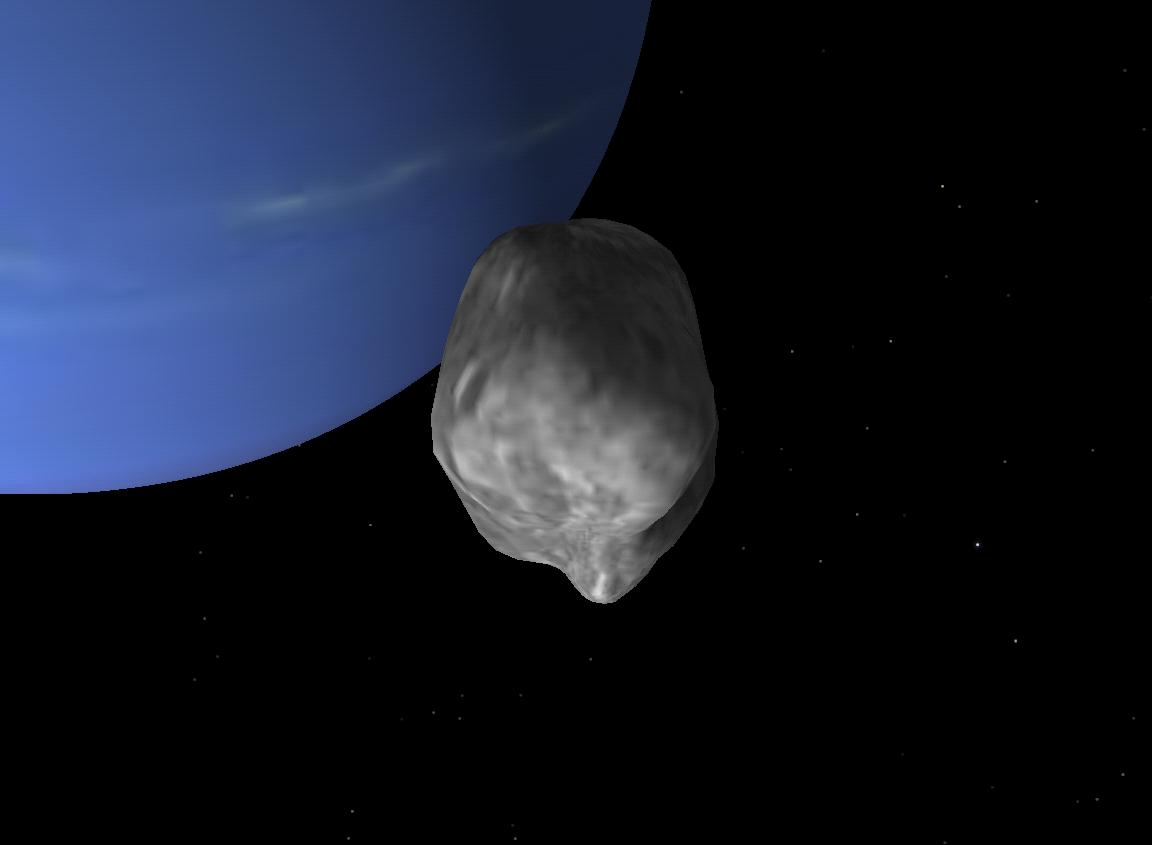
Despina is not spherical and has an irregular, blocky appearance consistent with many small moons formed or modified by collisions. Its surface shows no clear indications of recent geological activity such as volcanism or tectonics, and available images reveal a cratered, heavily scarred terrain. Like other inner satellites, it is expected to be tidally locked, presenting the same face toward Neptune.
- Shape: irregular — non-spherical
- Surface: cratered, no obvious signs of recent geological resurfacing
- Rotation: likely synchronous (tidally locked)
- Designation: S/1989 N 3, later named Despina
Discovery and name
Images returned by Voyager 2 during its Neptune encounter in late July 1989 revealed several previously unknown moons; Despina was among them. The name commemorates Despina, a nymph of Greek mythology associated with the sea and a daughter of Poseidon. The mythological connection follows the convention of naming Neptune's satellites after sea deities and figures; further background on the mythic namesake can be found via Despina (mythology).
Orbit and environment
Despina orbits well inside Neptune's system of outer moons and lies close to the planet's faint ring system. Its gravitational influence is modest but, together with nearby small moons, contributes to a dynamically complex inner region. Interactions between inner moons and ring particles are a subject of study, but Despina's specific role—if any—in shepherding or shaping rings remains not well constrained by existing data.
Observations and significance
Knowledge of Despina comes largely from the single high-resolution encounter by Voyager 2; subsequent observations with Earth-based telescopes and the space probe era instruments have provided limited additional detail. Its small size and dark, unremarkable surface make it typical of many inner satellites in the outer solar system: important for understanding Neptune's local environment and the history of collisions and accretion, but not an active world. Future missions or more powerful telescopes would be required to refine measurements of its composition, precise dimensions, and interactions with Neptune's rings and neighboring moons.
Despina remains an example of the many small, irregular bodies that populate the inner regions of giant planet systems and that inform models of satellite formation and dynamical evolution.
Related articles
Author
AlegsaOnline.com Despina — inner moon of Neptune Leandro Alegsa
URL: https://en.alegsaonline.com/art/26871
Sources
- adsabs.harvard.edu : "Sizes, shapes, and albedos of the inner satellites of Neptune"