
Draco (constellation)
Draco is a large northern constellation shaped like a winding dragon. It is circumpolar for many observers, contains notable stars and deep-sky objects, and figures in classical mythology.
Overview
Draco is a sprawling constellation in the northern celestial hemisphere whose Latin name means "dragon." It winds between several well-known northern constellations and, for many viewers at mid and high northern latitudes, never sets below the horizon. Draco is one of the larger constellations on the sky and is easily recognised by its long, looping pattern of stars.
Image gallery
7 Images




Appearance and principal stars
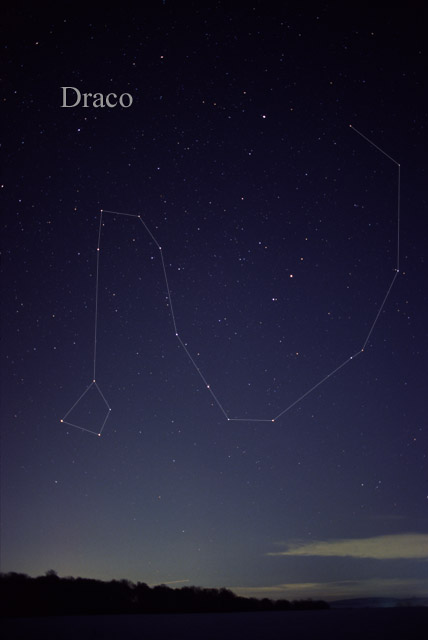
Draco's shape resembles a snake-like or coiled dragon. Its brighter stars form a long series of bends that pass between the constellations Ursa Major and Cepheus. The traditional star names include Thuban (Alpha Draconis), once the northern pole star in antiquity; Eltanin (Gamma Draconis), often the brightest; and Rastaban (Beta Draconis). These and other stars define the head, body and tail of the dragon figure used in star charts.
Deep-sky objects and satellites
Although not rich in Messier objects, Draco hosts several notable deep-sky and extragalactic targets. The Cat's Eye Nebula (NGC 6543) is a planetary nebula prized by amateur telescopes for its structure. The constellation also contains the Draco dwarf spheroidal galaxy, a faint satellite of the Milky Way, and a number of galaxy and globular cluster candidates that are of interest to observers with larger instruments.
History, myth and cultural significance
Draco has roots in many mythologies. In classical Greek tradition the dragon is often linked with Ladon, the many-headed dragon that guarded the garden of the Hesperides and was overcome by Heracles. Earlier civilizations noted the distinctive winding pattern; most famously, Thuban (Alpha Draconis) occupied the role of pole star several millennia ago and is sometimes mentioned in studies of ancient astronomy and monument alignment.
Observing Draco
Draco is best observed from northern latitudes where it remains high above the horizon for much of the year. The constellation is visible throughout the seasons but is most conspicuous in late spring and summer evenings in the Northern Hemisphere. Amateur astronomers target its planetary nebulae, faint galaxies and the Draco dwarf galaxy, while meteor-watchers note the Draconid (Giacobinid) shower that peaks in October and appears to radiate from this region of the sky.
Notable facts
- Draco means "dragon" and is one of the classical constellations recorded by ancient astronomers.
- Thuban (Alpha Draconis) served as the Earth's pole star in antiquity and was used in some early astronomical alignments.
- The constellation contains the Cat's Eye Nebula (NGC 6543) and the Draco dwarf spheroidal galaxy, a Milky Way satellite.
- Draco is circumpolar for many observers in the Northern Hemisphere, making it visible year-round.
Related articles
Author
AlegsaOnline.com Draco (constellation) Leandro Alegsa
URL: https://en.alegsaonline.com/art/28823