
Dia (S/2000 J 11): an irregular prograde moon of Jupiter
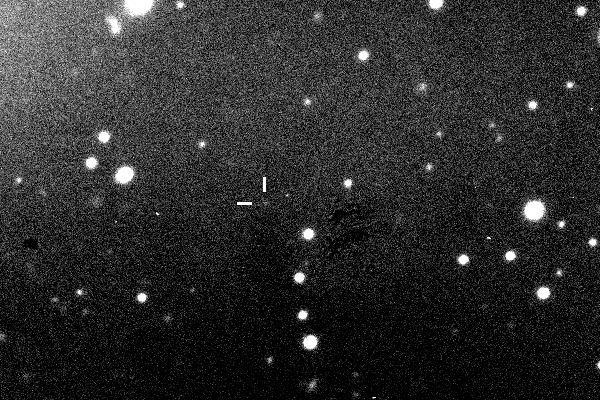
Dia is a small, irregular prograde satellite of Jupiter (S/2000 J 11), roughly 4 km across, a member of the Himalia group; discovered in 2000, lost for a time and later recovered to refine its orbit.
Dia (provisional designation S/2000 J 11) is a small irregular satellite of Jupiter. It orbits far from the planet on a prograde path and has a non-spherical shape typical of objects of its size. Dia is generally associated with the Himalia group, a cluster of prograde outer moons that share similar orbital characteristics and are believed to be fragments of a larger captured body.
Image gallery
2 Images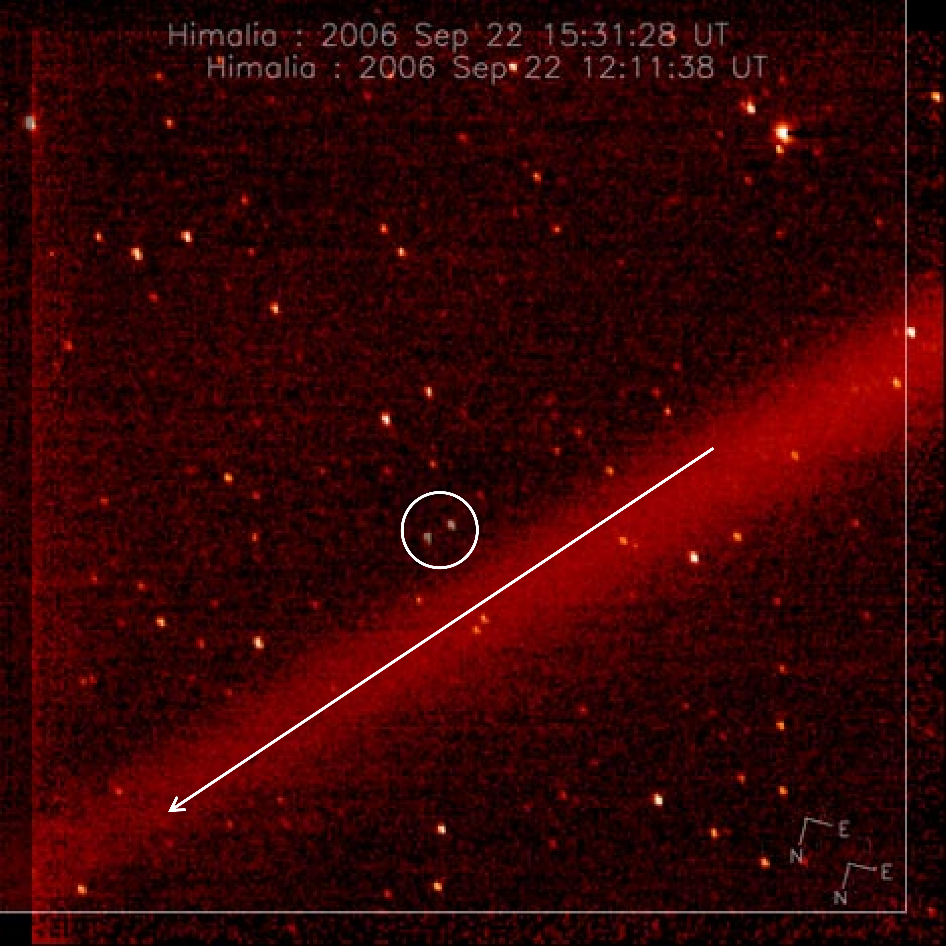
Physical characteristics
Dia is very small by planetary-satellite standards, with an estimated diameter of about 4 kilometres. At this size the body lacks sufficient gravity to pull itself into a round shape, so it is expected to be irregular. Its surface composition and albedo are poorly constrained because the moon is faint and observations require large telescopes. Spectral information for Dia is limited; studies of other Himalia-group members suggest dark, likely carbonaceous material may predominate.
Orbit and motion
Dia orbits Jupiter at an average distance of roughly 12,555,000 kilometres and completes one circuit in about 287 days. The orbit is moderately inclined to Jupiter's equator, around 28 degrees, and is noticeably eccentric, with a reported eccentricity near 0.248. These parameters place Dia among the outer irregular satellites that were most likely captured into their current trajectories rather than forming in situ within Jupiter's main satellite system.
Discovery, loss and recovery
The object was discovered in 2000 by a team of observers from the University of Hawaii led by Scott S. Sheppard. After initial observations its orbit was not well constrained and the moon was effectively "lost" for a period until additional observations recovered it and permitted a more accurate orbital solution. Such temporary loss and later recovery are not uncommon for faint, distant satellites when observational arcs are short.
Group membership and origin
Dia is commonly grouped with the Himalia family of Jovian satellites. Members of this group share similar semi-major axes, inclinations and eccentricities, suggesting a common origin. The leading hypothesis is that the group formed from the collisional disruption of a single larger progenitor that had been captured by Jupiter. Studying Dia alongside other group members helps astronomers test models of capture, collisional fragmentation and long-term dynamical evolution in the Jovian system.
Observations and scientific importance
Because Dia is small and distant, it is faint and requires sensitive instruments for detection and follow-up. Observations of such moons provide valuable constraints on the population of small bodies around giant planets, on capture processes, and on the collisional history of satellite systems. Improved astrometric tracking after recovery allows more precise orbital models, which in turn help predict future positions and assess long-term stability.
Further reading and resources
- Catalogue entry or database page for Dia
- Information about the University of Hawaii discovery team
- Profiles or publications by Scott S. Sheppard
- Discovery announcements and initial observations (2000)
- Explanations of orbital eccentricity and related orbital concepts
- Resources on the Himalia group of Jovian moons
Dia remains of interest to planetary scientists despite its small size because even modest satellites retain clues about the processes that shaped the outer regions of the Jovian system. Continued surveys and targeted observations will refine knowledge of its orbit, physical properties and relationship to neighbouring irregular moons.
Related articles
Author
AlegsaOnline.com Dia (S/2000 J 11): an irregular prograde moon of Jupiter Leandro Alegsa
URL: https://en.alegsaonline.com/art/27068
Sources
- cfa-www.harvard.edu : IAUC 7555: Satellites of Jupiter
- cfa-www.harvard.edu : MPEC 2001-A29: S/2000 J 7, S/2000 J 8, S/2000 J 9, S/2000 J 10, S/2000 J 11
- ifa.hawaii.edu : Jupiter's outer satellites and Trojans
- ifa.hawaii.edu : An abundant population of small irregular satellites around Jupiter
- cfa-www.harvard.edu : IAU-MPC NSES
- ssd.jpl.nasa.gov : NASA JPL