
Chlorofluorocarbon (CFC): chemistry, uses, environmental impact and alternatives
Chlorofluorocarbons (CFCs) are halogenated compounds once widely used as refrigerants, solvents and propellants. This article explains their chemistry, history, environmental harm and the transition to safer alternatives.
Overview
Chlorofluorocarbons, commonly abbreviated CFCs, are a class of manufactured halogenated organic compounds that were developed in the 20th century for a variety of industrial and consumer applications. Originally prized for their chemical stability and low toxicity compared with then-common refrigerants and solvents, CFCs became pervasive in refrigeration, air conditioning, foam blowing, solvent cleaning and aerosol products. For a technical summary of typical applications and properties see industrial uses.
Image gallery
8 Images





Chemical characteristics
CFCs are haloalkanes that include carbon atoms bonded to halogen atoms. Typical species contain chlorine and fluorine atoms; related families include hydrochlorofluorocarbons (HCFCs) and hydrofluorocarbons (HFCs). Where relevant, specific elements are discussed further: the carbon backbone is central to the molecule (carbon), some related compounds contain hydrogen (hydrogen) while chlorine (chlorine) and fluorine (fluorine) serve as substituents that strongly influence volatility and stability. Their inertness at ground level made them attractive, because they were much less hazardous than the earlier toxic (toxic) or flammable (flammable) alternatives.
Common uses and practical examples
- Refrigerants and air-conditioning fluids: many CFCs replaced ammonia- and sulfur dioxide–based systems in the mid-1900s; see refrigerant classifications refrigerants.
- Aerosol propellants and metered-dose inhalers: CFCs were widely used as propellants before regulatory phase-outs; historical product listings are described at aerosol applications.
- Solvents and degreasers: their stability and solvency made them useful in electronic and precision cleaning.
- Foam blowing agents and insulation manufacturing.
Environmental impact and regulatory response
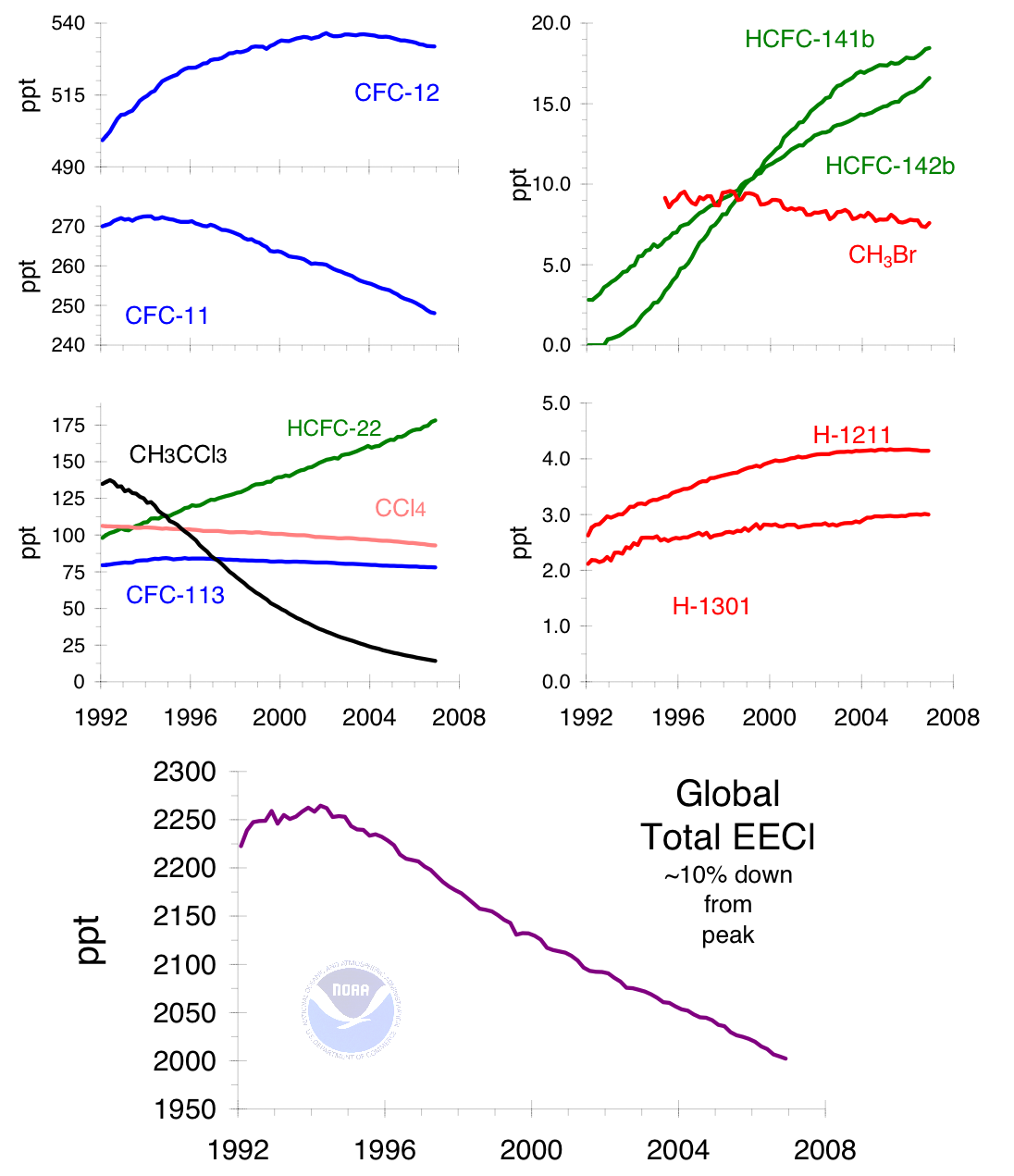
Despite favorable short-term safety profiles, scientists discovered that CFCs released to the atmosphere can reach the stratosphere where they break down under ultraviolet radiation and release chlorine atoms that catalyze the destruction of ozone. This phenomenon, commonly referred to as ozone depletion, was the primary driver of international controls (ozone depletion). CFCs also contribute to radiative forcing as long-lived greenhouse gases (greenhouse gas effects), though their ozone impact was the immediate policy concern.
Regulatory responses began in the late 1970s and culminated in multinational agreements that phased out production and use of many CFCs. Sweden was an early national adopter of bans, followed by other countries and broad international action under the Montreal Protocol and subsequent amendments.
Alternatives and current status
Following phase-out efforts, several replacement families were developed. Hydrofluorocarbons (HFCs) have been widely used as substitutes because they do not deplete stratospheric ozone (HFCs do not have the same ozone-depleting chemistry, see ozone-safe alternatives), but many HFCs have significant global warming potentials and thus raise climate concerns (climate impacts). Other replacements include hydrochlorofluorocarbons (transitional substances), hydrofluoroolefins (HFOs) and natural refrigerants such as carbon dioxide, ammonia and certain hydrocarbons, selected to balance safety, energy efficiency and environmental metrics.
Notable distinctions and further reading
CFCs are distinct from HCFCs and HFCs by their molecular composition and environmental behavior: CFCs typically lack hydrogen atoms and have high atmospheric lifetimes; HCFCs contain hydrogen and generally have lower lifetimes and ozone-depletion potential. Many nations now restrict CFCs in products and equipment, and older systems are subject to recovery and destruction rules.
For introductory material, regulatory histories and technical references, consult industry and environmental resources listed by topic: industrial uses, refrigerants, aerosol applications, elemental context carbon, hydrogen, chlorine, fluorine, historical safety comparisons toxic alternatives and flammable alternatives, environmental science ozone depletion and greenhouse gas impacts, and information on substitutes HFCs, their ozone profile ozone-safe alternatives and climate implications global warming considerations.
Related articles
Author
AlegsaOnline.com Chlorofluorocarbon (CFC): chemistry, uses, environmental impact and alternatives Leandro Alegsa
URL: https://en.alegsaonline.com/art/19896
Sources
- nytimes.com : "A novel tactic in climate fight"
- dx.doi.org : 10.1002/14356007.a06_233.pub2