
Refrigerant — properties, refrigeration cycle, uses and environmental issues
A refrigerant is a working fluid used in cooling systems. This article explains its physical properties, how it operates in the refrigeration cycle, common types, safety and environmental considerations, and typical uses.
Overview
A refrigerant is the working fluid that transfers heat in refrigeration and air‑conditioning systems. In practical equipment it circulates through a closed loop, changing phase between liquid and vapor to absorb and reject heat. The word refrigerant covers a wide range of chemical substances selected for their thermal and physical behavior, including boiling point, heat capacity and stability. Refrigerants are found in domestic devices such as air conditioners and refrigerators, as well as commercial chillers, heat pumps and industrial systems.
Image gallery
6 Images



Key properties and characteristics
Good refrigerants share several properties that make them effective and practical. These include appropriate saturation pressures at operating temperatures, high latent heat of vaporization to move heat efficiently, compatibility with system oils and materials, and chemical stability over repeated cycles. Many commonly used refrigerants are volatile at atmospheric pressure and readily change state between liquid and vapor. A typical system manipulates pressure to control boiling and condensation, which alters the refrigerant's temperature and heat transfer behavior.
The refrigeration cycle explained
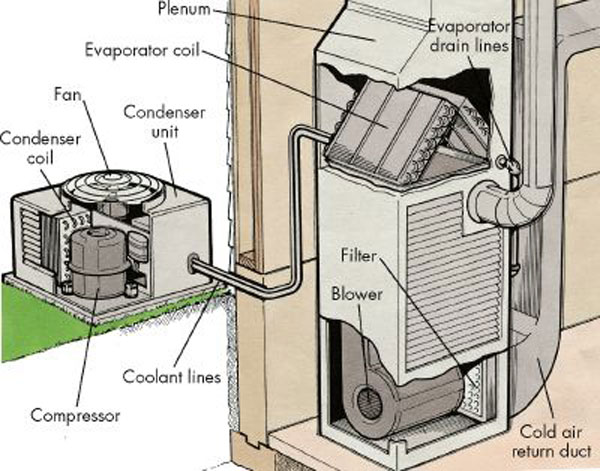
In most vapor‑compression systems the refrigerant follows a repeated four‑step path. First, low‑pressure cold vapor is drawn into a compressor where it is pressurized and heated. The hot, high‑pressure vapor then flows into a condenser where it releases heat to the surroundings and condenses into a liquid. After condensation the liquid passes through a metering or expansion device that reduces pressure and temperature; here part of the liquid boils and cools. Finally, the cold refrigerant flows through an evaporator where it absorbs heat from the space or product being cooled and returns to the compressor as vapor. Many resources illustrate this process in diagrams and component descriptions, such as introductory HVAC guides (basic phase change).
Types, history and environmental concerns
Historically, refrigerants ranged from ammonia and carbon dioxide to early chlorofluorocarbons (CFCs). CFCs and hydrochlorofluorocarbons (HCFCs) were phased down because of ozone depletion and replaced by hydrofluorocarbons (HFCs) and newer low‑GWP blends. More recent development emphasizes alternatives with lower global warming potential (GWP), including natural refrigerants like CO2 and hydrocarbons, and new synthetic mixtures. Regulatory changes and safety standards have influenced selection and system design across regions (policy and standards).
Uses, safety and practical considerations
Refrigerants are central to many applications: household refrigeration, comfort cooling, food storage, industrial process cooling and transport refrigeration. Selection depends on efficiency goals, cost, toxicity, flammability and environmental impact. Safe handling requires awareness of pressure hazards, potential toxicity and appropriate recovery and recycling practices. Service technicians follow procedures for leak detection, charging and disposal to limit emissions and ensure reliable operation (service practices).
Notable facts and further reading
Transition in refrigerant technology continues, driven by environmental regulation, efficiency targets and new refrigerant chemistry. When comparing options, consider lifecycle climate impact, compatibility with existing equipment and safety class. For more technical details, diagrams and lists of common refrigerants and their properties, see technical handbooks and standards referenced in industry literature (technical references).
Related articles
Author
AlegsaOnline.com Refrigerant — properties, refrigeration cycle, uses and environmental issues Leandro Alegsa
URL: https://en.alegsaonline.com/art/81819