
Chlorous acid (HClO2): properties, preparation, and uses
Chlorous acid (HClO2) is an unstable oxyacid of chlorine with the chlorite ion as its conjugate base; it exists mainly as transient solutions and intermediates and is a strong oxidizer.
Overview
Chlorous acid is an inorganic oxyacid of chlorine with the molecular formula HClO2. It is best described as the protonated form of the chlorite ion and is encountered primarily as a transient species in solution rather than as an isolable, pure substance. Because of its reactivity and limited stability, it is more often discussed in the context of its salts and related chlorine oxo-species than as a reagent used directly.
Image gallery
2 Images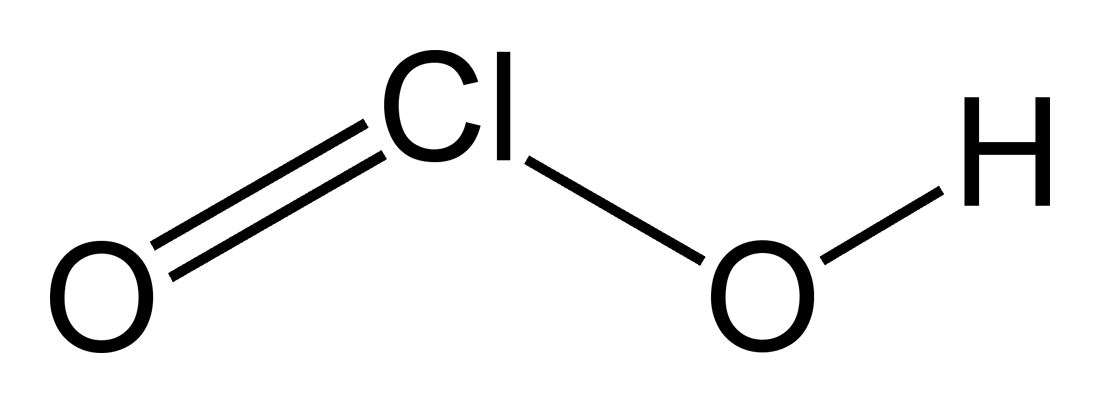

Structure and chemical behavior
The acidic species contains chlorine in an intermediate oxidation state and can donate a proton to form the ClO2− anion. Solutions of chlorous acid are prone to decomposition: they undergo internal redox (disproportionation) to give other chlorine oxyacids. The molecule is a notable oxidizing agent and reacts with a variety of organic and inorganic substrates; this reactivity is the main reason it does not persist under ordinary conditions.
Preparation and common reactions
In the laboratory, chlorous acid is typically generated in situ by acidifying a soluble chlorite salt. For example, treating a soluble chlorite or a sparingly soluble salt such as barium chlorite with a strong acid converts the chlorite into the free acid while precipitating an insoluble by-product; a classic laboratory route uses barium chlorite and sulfuric acid, producing barium sulfate as a solid and releasing chlorous acid into the solution. A description of this type of preparation can be found through general references on the compound (preparation note).
Disproportionation and related species
Chlorous acid undergoes disproportionation reactions that yield both lower and higher oxidation-state chlorine oxyacids. A common pathway produces hypochlorous acid and chloric acid as products; these related acids and their interconversions are central to understanding the chemistry of chlorine oxoacids (disproportionation, hypochlorous, chloric).
Uses, importance and safety
Because pure chlorous acid is unstable, practical applications typically involve its salts (chlorites) or downstream products such as chlorine dioxide. Chlorite salts are used in bleaching, disinfection, and as oxidants in analytical and synthetic chemistry; many commercial and water-treatment processes rely on these related compounds rather than on the free acid itself. Handling of chlorous acid and chlorite solutions requires caution: they are oxidizing and can react vigorously with organic matter or reducing agents (oxidizing hazard, compound overview).
Notable distinctions
- Chlorous acid is distinct from hypochlorous (HClO) and chloric (HClO3) acids by oxidation state and stability.
- Its conjugate base, the chlorite ion, is considerably more stable and easier to isolate as salts.
- In practice, chemistry attributed to chlorous acid is often studied by generating it transiently from chlorite salts rather than isolating HClO2.
Related articles
Author
AlegsaOnline.com Chlorous acid (HClO2): properties, preparation, and uses Leandro Alegsa
URL: https://en.alegsaonline.com/art/19902