
Catapult: history, types, and how they work
Mechanical siege engines that hurl projectiles by storing and releasing energy; covers design, principal types (trebuchet, ballista, mangonel), history, physics, and modern uses.
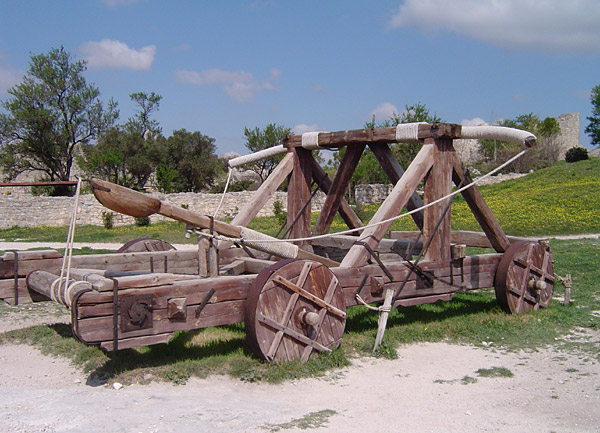
A catapult is a mechanical device designed to launch a projectile by rapidly converting stored potential energy into kinetic energy. Historically used as a machine in siege warfare, catapults were operated to hurl stones, bolts, incendiaries such as pitch or hot tar, and other payloads to damage fortifications or set structures on fire. They were often placed on elevated positions — for example on castle walls or towers — to increase range and to clear intervening obstacles.
Image gallery
10 Images



Principles and components
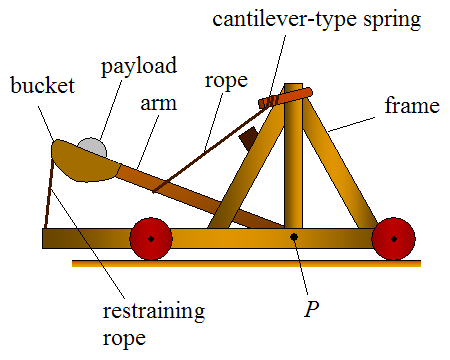
At their core catapults use energy storage and a release mechanism. Common forms of energy storage include tensioned arms, twisted ropes (torsion), or a heavy counterweight. A lever arm transmits that energy to a projectile cradle or sling, and a trigger releases the arm to accelerate the payload. The performance depends on available energy, arm length, sling efficiency, projectile mass, and launch angle; the resulting flight follows the same basic parabolic trajectory studied in physics.
Major types
- Trebuchet — uses a large counterweight to swing a long arm with a sling for high efficiency and range.
- Ballista — a giant torsion-powered crossbow that launches bolts or stones with high accuracy.
- Mangonel / Onager — typically uses torsion or tension in a single arm to throw projectiles in a high arc.
- Counterweight and tension catapults — variants that emphasize either a dropped weight or flexed timber for stored energy.
Historical development
Mechanical artillery has roots in ancient Mediterranean and Near Eastern engineering. Hellenistic and Roman armies developed bolt-throwing engines; in medieval Europe the trebuchet and mangonel became central to siegecraft during the Middle Ages. With the advent of gunpowder and cannon, traditional catapults declined in military importance, though they remained a key subject of military engineering and reconstruction by scholars and reenactors.
Uses, museums, and modern cousins
Surviving examples are preserved in many museum collections and in full-scale reconstructions used for education and experimental archaeology. Catapults also appear in classroom physics experiments, engineering projects, and recreational events such as projectile-throwing contests. A technological descendant of the catapult concept is the aircraft carrier launch system: early ships used steam catapults and modern vessels employ electromagnetic or advanced steam systems to accelerate aircraft, linking the ancient idea of stored energy to contemporary industrial applications — see aircraft carriers for context.
Distinctions and notable facts
The term "catapult" is often used broadly, but specialists distinguish trebuchets (counterweight sling launchers) from torsion-driven engines like the ballista. Catapults are valued today for the insight they give into historical engineering, material limits, and the practical application of mechanics. Practical reconstructions and demonstrations — as well as cautious mention in modern media — keep their image alive, while technical studies continue to compare energy efficiency and accuracy across designs.
For further reading about siege technology and specific machine designs, follow entries on historical siegecraft and engineering, or consult specialized collections and experimental studies linked through archival and museum resources: weapon, rocks, levers, and additional reference materials at machine-technology repositories and databases (castle studies and broader military history).
Practical reconstructions continue to inform modern understanding of range, accuracy, and material stress; as a result catapults remain an accessible bridge between ancient ingenuity and contemporary engineering education.
Related articles
Author
AlegsaOnline.com Catapult: history, types, and how they work Leandro Alegsa
URL: https://en.alegsaonline.com/art/17586
Sources
- doi.org : 10.2307/3102042
- middle-ages.org.uk : "Catapults"
- kirj.ee : "Trebuchet: A Gravity Operated Siege Engine"
- navalaviationnews.navylive.dodlive.mil : "Launch and Recovery: From Flywheels to Magnets"