
Venus de Milo
Ancient Greek marble statue of Aphrodite, found on Melos in 1820 and now in the Louvre. Renowned for its missing arms, Hellenistic style, and debated authorship.
Overview
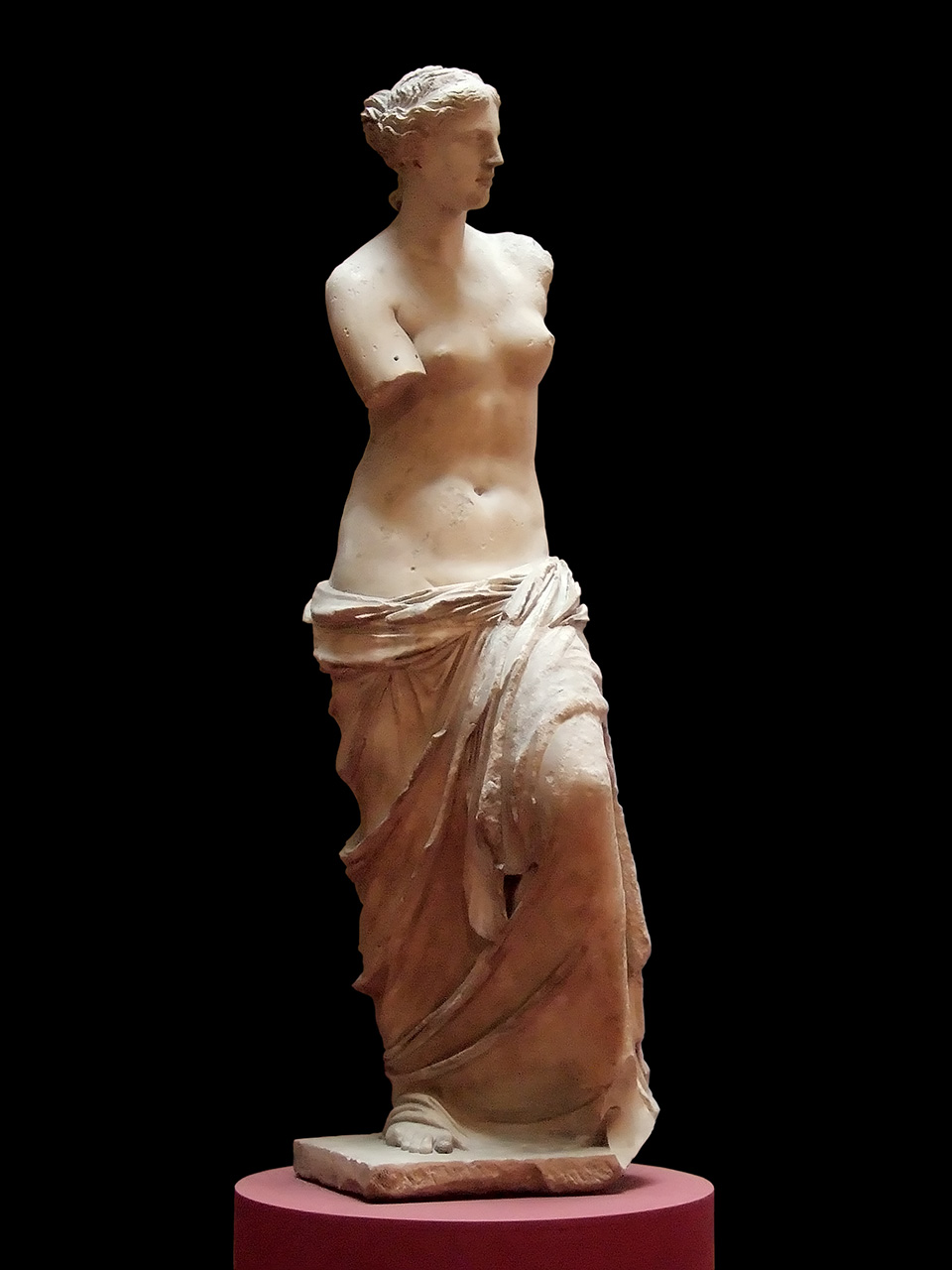
The Venus de Milo is a celebrated ancient Greek marble statue commonly identified with Aphrodite, the goddess of love. It is one of the Louvre Museum's best-known antiquities and has been a focal point of art-historical discussion since its discovery in 1820. The figure stands over two metres high and is notable for its elegant posture and the conspicuous absence of its arms, a feature that contributed strongly to its modern fame.
Image gallery
10 Images





Form and characteristics
The sculpture displays characteristics associated with late Hellenistic sculpture: a sinuous contrapposto stance, carefully modelled flesh, and a draped garment partially revealing the body beneath. Carved from marble, the statue combines naturalistic anatomy with an idealized beauty. Because the arms and certain original attributes are missing, scholars must infer the original pose and what the figure once held.
Authorship and dating
Early responses to the statue often attributed it to earlier Classical masters, but modern scholarship generally places it in the Hellenistic period. A name linked to the work in nineteenth-century records is Alexandros of Antioch, and many authorities consider this attribution plausible, though debate remains. Stylistic evidence and comparative dating usually assign the statue to the later Hellenistic centuries rather than the fifth century BCE.
Discovery and display
The Venus de Milo was unearthed on the island of Melos (Milos) in the Aegean Sea on 8 April 1820. Shortly after its discovery it was transported to France and presented to the Louvre Museum by King Louis XVIII in 1821. Since entering the Louvre collection the statue has been the subject of restorations, scholarly study, and widespread reproduction.
Importance and reception
Beyond its archaeological value, the Venus de Milo has been influential as an icon of classical beauty and as a stimulus to debates about restoration, authenticity and display. Its fragmentary condition invites speculation, which has helped to sustain public interest. Reproductions, critical essays, and popular references have made it visible far beyond specialist circles.
Further information and references
- Ancient Greek art overview
- Statue typology and materials
- Louvre Museum collection
- Museum display practices
- Aphrodite in Greek myth
- Goddess iconography
- Themes of love in antiquity
- Greek mythology general guide
- Marble carving techniques
- Measurements and scale
- Aegean archaeology
- Island of Melos (Milos) finds
The Venus de Milo continues to be studied and admired for its aesthetic qualities and as a testament to Hellenistic sculptural skill. Its incomplete state, rather than diminishing its impact, has ensured a lasting role in conversations about how modern viewers relate to the ancient past.
Related articles
Author
AlegsaOnline.com Venus de Milo Leandro Alegsa
URL: https://en.alegsaonline.com/art/104602