
Centimetre (centimeter) — unit of length
The centimetre (cm) is one hundredth of a metre and a common metric unit for everyday and scientific measurement. It sits between the millimetre and the metre and was central to the CGS system.
Overview
The centimetre (British spelling) or centimeter (American spelling) is a metric unit of length represented by the symbol cm. It equals one hundredth of a metre and is widely used where measurements need finer resolution than metres but do not require millimetre precision. As a familiar, human-scale unit, the centimetre appears often in descriptions of body dimensions, small objects, and maps.
Image gallery
1 Image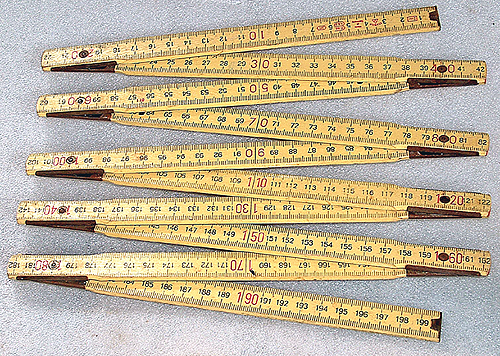
Definition and properties
By definition a centimetre is 0.01 of a metre, the SI base unit for length. The prefix "centi-" denotes one hundredth. In practice the centimetre provides a convenient compromise: larger than a millimetre yet much smaller than a full metre, it is suitable for many measurements in everyday life and some scientific contexts. The centimetre is not an SI base unit but is an accepted derived unit in the International System of Units.
History and system context
The centimetre arose from the metric tradition developed in the late 18th century as part of efforts to standardize measurements. It became the base length unit in the older centimetre–gram–second (CGS) system, which was used in physics and engineering before the widespread adoption of the metre-based SI system. Over time SI conventions favored the metre and its multiples, but the centimetre remains in common use.
Uses and examples
Centimetres are used across many domains. Typical examples include:
- Body measurements and clothing sizes (waist, inseam, height in some regions).
- Small-scale engineering drawings and diagrams where millimetre precision is unnecessary.
- Everyday objects: the width of a fingernail or the thickness of a paperback book is often on the order of centimetres.
Conversions and practical notes
Conversion between common units is straightforward: one centimetre equals one hundredth of a metre, and by international agreement 1 inch equals exactly 2.54 centimetres. When higher precision is required, measurements are given in millimetres; for larger distances metres or kilometres are preferred. For further reading on measurement units see a general entry on units of length.
Distinctions and notable facts
Though less dominant than the metre in formal science and engineering, the centimetre endures in education, printing, household contexts and some branches of physics that historically used CGS conventions. It provides an intuitive scale for many everyday tasks: roughly the width of a fingernail or the height of a small plant leaf. For background on metric usage and unit history consult resources about the CGS system and modern SI references; introductory material on related small units can be found under millimetre and general metric discussions.
Questions and answers
Q: What is a centimetre?
A: A centimetre is a unit of length in the International System of Units (SI) measurement system. It is equal to one hundredth of a metre.
Q: What is the American spelling of "centimetre"?
A: The American spelling of "centimetre" is "centimeter".
Q: What does "centi-" mean?
A: "Centi-" means "a hundredth".
Q: What is the centimetre's role in the old centimeter-gram-second (CGS) system of units?
A: The centimetre is the base unit of length in the old centimeter-gram-second (CGS) system of units.
Q: What is the centimetre typically used to measure?
A: The centimetre is usually used to measure things that are too big for millimetre but too small for metres.
Q: How long is a centimetre in relation to a metre?
A: A centimetre is one hundredth of a metre.
Q: What object is close in length to a centimetre?
A: A fingernail is close in length to a centimetre.
Related articles
Author
AlegsaOnline.com Centimetre (centimeter) — unit of length Leandro Alegsa
URL: https://en.alegsaonline.com/art/17992
Sources
- scienceworld.wolfram.com : Inch - from Eric Weisstein's World of Physics
- weathershack.com : Rain Measurement, Rain Gauge, Wireless Rain Gauge, Rain Gage, Rain Gauge Data
- unicode.org : CJK Compatibility excerpt from The Unicode Standard, Version 4.4