
Treaty of Paris (1783): Peace agreement ending the American Revolutionary War
The Treaty of Paris (1783) formally ended the American Revolutionary War, recognized U.S. independence and redistributed colonial possessions among Britain, France, Spain and the Netherlands.
The Treaty commonly called the Treaty of Paris formally concluded hostilities between Great Britain and the United States following the American Revolutionary War. Negotiated in Europe, the principal instrument between Britain and the United States was signed on September 3, 1783 in Paris and is often referenced simply as the Treaty of Paris. After signature, the document was later ratified by the American Congress of the Confederation and by the British crown; the British monarch, King George III, completed his formal approval in the months that followed.
Image gallery
8 Images

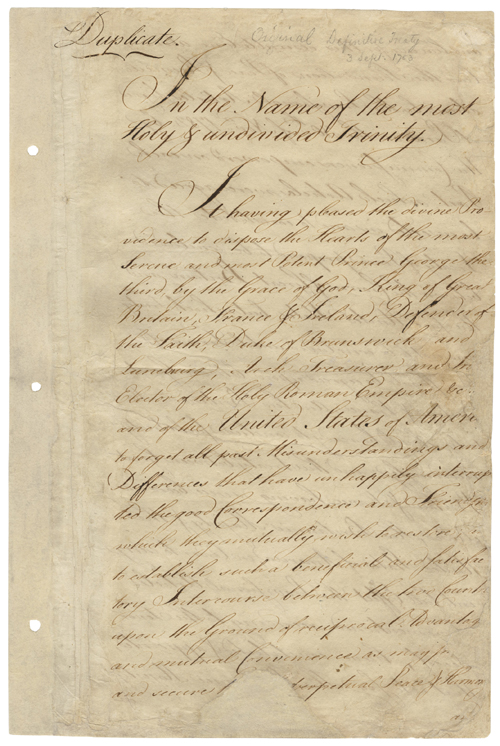


Key provisions
- Recognition of independence: Britain acknowledged the existence of the United States as a sovereign nation.
- Boundaries and navigation: The treaty set territorial limits that allowed U.S. access to lands and waterways to the Mississippi River and granted certain fishing rights off Newfoundland.
- Evacuation and property: British forces agreed to withdraw from American territory and both sides committed to the orderly exchange of prisoners and the restoration of property and rights where specified.
- Debts and loyalists: The United States agreed to recommend that states respect pre-war commercial debts and to provide fair treatment to those Americans who had remained loyal to Britain, often called loyalists, and not to persecute them.
Those negotiating the American side included prominent figures such as John Jay, John Adams and Benjamin Franklin. The British signatory instruments and associated diplomatic exchanges completed the legal end of the bilateral conflict, though enforcement and local compliance varied and some British garrisons did not depart immediately.
Parallel treaties and colonial adjustments
The peace settlement in 1783 was a package of related treaties. Britain concluded separate agreements with France, Spain and the Dutch Republic that redistributed several colonial possessions. Under these arrangements France regained or secured interests including islands such as Tobago and trading posts such as Senegal, while Spain recovered territories including Florida and acquired or retained holdings like Menorca. Spain had hoped for the return of Gibraltar but did not obtain it. The Netherlands negotiated separate terms that affected commercial access in the Dutch East Indies.
Outside Europe, changes were uneven. In parts of India, French support for local allies ceased when the European belligerents made peace. The Kingdom of Mysore, which had allied with France against British interests in India, continued to fight in the period immediately after the treaties but saw the international backing that sustained its resistance reduced.
Significance and consequences
The treaty confirmed American independence and created the international framework for the new nation's relations with European powers. It also left unresolved many regional and human consequences: Native American nations received little recognition in the agreements that determined territory, loyalists often suffered confiscation or exile despite treaty language urging restitution, and diplomatic rivalries continued in the decades that followed. The British decision to agree to generous terms for the United States reflected complex strategic aims, including the desire to limit French influence and to preserve commercial ties.
The diplomatic settlements of 1783 marked a turning point in the balance of colonial power and set the stage for further negotiation and conflict over boundaries, commerce and political influence throughout the Atlantic world.
Signed Sept. 3, 1783; American ratification followed in January and British ratification occurred in April 1784.
Related articles
Author
AlegsaOnline.com Treaty of Paris (1783): Peace agreement ending the American Revolutionary War Leandro Alegsa
URL: https://en.alegsaonline.com/art/101307
Sources
- history.state.gov : "Treaty of Paris, 1783"