
American Revolutionary War (1775–1783): Origins, Campaigns, and Legacy
Armed conflict in which Britain's thirteen North American colonies fought for independence, aided by foreign allies; resulted in the creation of the United States and wide political consequences.
Overview
The American Revolutionary War was the military conflict in which the Thirteen Colonies in North America contested British rule and ultimately secured independence. Fighting began in 1775 and continued primarily in continental North America until the decisive campaigns of the early 1780s. The colonial forces, organized as the Continental Army and supported by militia and state troops, opposed the professional British Army and its naval power. Political and diplomatic negotiations, including formal recognition by other European powers, culminated in British acknowledgement of the former colonies as an independent nation, the United States of America.
Image gallery
10 Images




Causes and political context
The conflict grew out of long‑standing tensions over governance, taxation, and legal rights. Many colonists objected to parliamentary measures imposed by Great Britain without colonial representation, and episodes such as the Stamp Act protests and the Boston Tea Party radicalized public opinion. Debates over sovereignty, local self‑government, and economic policy combined with military escalations after attempts to enforce imperial laws, producing an armed struggle between the metropolitan government and the colonial assemblies.
Key actors and factions
- Colonial leadership and forces: the Continental Congress and the Continental Army, with state militias and volunteers; prominent commanders included George Washington.
- British institutions: the crown, the British Empire government, and the British Army and Royal Navy.
- Allied powers: France, Spain and other European states provided military aid, resources, and naval forces that shifted the balance away from Britain; these partnerships were decisive at sea and in combined operations (France and Spain).
- Internal divisions: many colonists remained loyal to Britain (Loyalists), while others sought independence; Indigenous nations and enslaved people each had their own complex and sometimes conflicting responses to the war.
Major campaigns and turning points
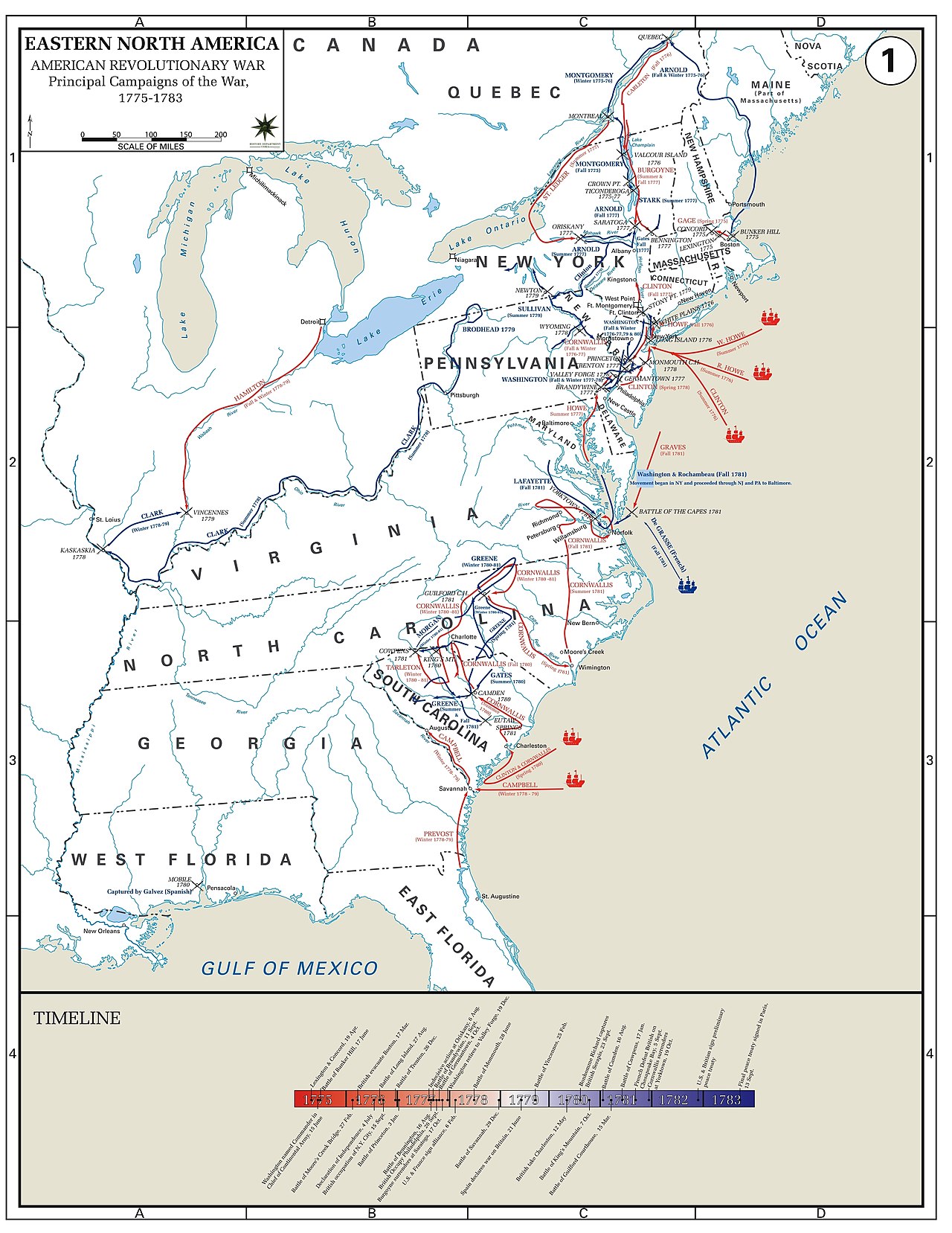
Fighting ranged from skirmishes in New England to large maneuvers in the middle colonies and the southern theater. Early engagements around Lexington and Concord and the siege of Boston set the stage; the Saratoga campaign in 1777 is widely seen as a diplomatic turning point because it helped secure French recognition and military support. The final major campaign culminated in the siege of Yorktown in 1781, where combined Franco‑American forces compelled the surrender of a large British army, leading to negotiations that ended the war.
Outcome and aftermath
The war concluded with treaties and diplomatic settlements that recognized the independence of the Thirteen Colonies, which transitioned into the first thirteen states of a new republic (13 states). The conflict prompted immediate political experiments, including the Articles of Confederation, and later the drafting of a federal Constitution. It also had global effects: it altered the balance of power among European empires, stimulated debates about rights and governance, and inspired other independence movements.
Legacy and notable facts
Historically, the Revolutionary War is studied for its military, diplomatic, and ideological dimensions. It demonstrated the impact of international alliances and logistics on insurgent success, the role of popular political mobilization, and the complexities of creating a nation from disparate colonies. The struggle involved not only regular armies but also local militias, civilian supporters, displaced loyalists, and noncombatants whose lives were profoundly affected. For introductions and deeper treatments see general references on the war (conflict overview), the colonial assemblies (Thirteen Colonies), regional studies of rebel forces, the geographic scope of operations in North America, biographies of leaders such as George Washington, and analysis of British strategy within the British Empire. For diplomatic and postwar developments consult accounts of allied intervention (France and Spain) and the formal recognition of independence (United States). Additional curated resources are listed under military, political, and social subtopics (British political context, British military records, and formation of the states).
Questions and answers
Q: Who fought in the American Revolutionary War?
A: The war was fought between Great Britain and the original Thirteen Colonies in North America.
Q: When did the American Revolutionary War take place?
A: The war took place from 1775 to 1787.
Q: Where was most of the fighting in the American Revolutionary War?
A: Most of the fighting was in North America and other places.
Q: Who led the rebel army in the American Revolutionary War?
A: The rebel army was led by George Washington.
Q: Who helped the Continental Army in the American Revolutionary War?
A: The Continental Army was helped by France and Spain.
Q: Who won the American Revolutionary War?
A: The Continental Army, aided by their allies, defeated the British Army.
Q: What happened after the American Revolutionary War ended?
A: The Thirteen Colonies declared independence from Great Britain and became the first 13 states of a new country called the United States of America.
Related articles
Author
AlegsaOnline.com American Revolutionary War (1775–1783): Origins, Campaigns, and Legacy Leandro Alegsa
URL: https://en.alegsaonline.com/art/3465
Sources
- redcoat.me.uk : American Loyalists · archive.org
- books.google.com : "The New England Historical and Genealogical Register, Volume 12"