
Dutch East Indies (Netherlands East Indies)
European colony centered on the Indonesian archipelago from VOC rule to Dutch state control; a major trading, administrative and colonial entity that evolved into modern Indonesia after WWII and independence.
Overview
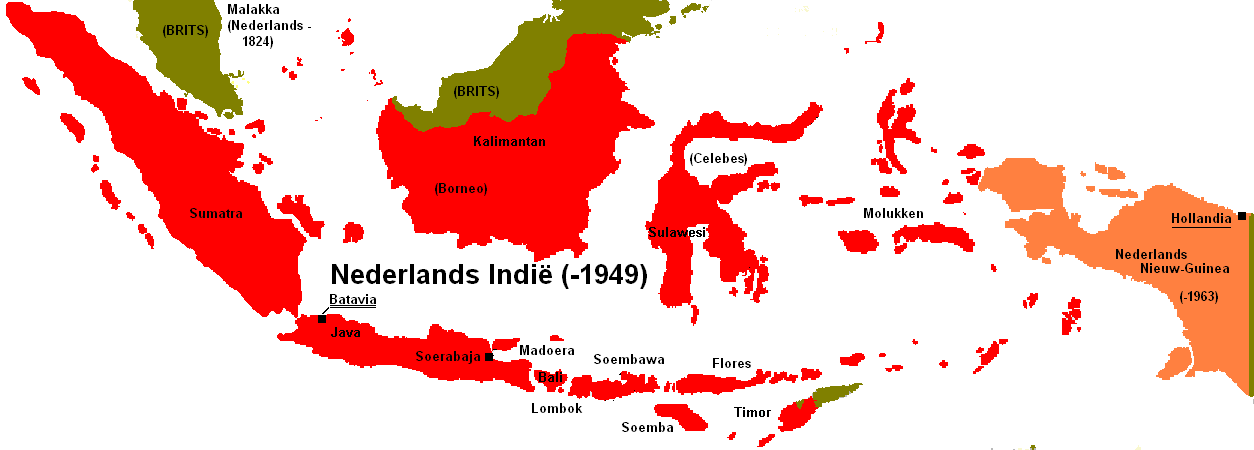
The Dutch East Indies, often called the Netherlands East Indies in English, was the name used for Dutch colonial possessions in the Indonesian archipelago. It developed from trading posts and territories established by the Dutch East India Company (VOC) and later became a formal colony administered by the Netherlands. Its territory corresponds roughly to present-day Indonesia, and its principal administrative center was the city of Batavia (now Jakarta).
Image gallery
10 Images





Formation and administration
The VOC founded a network of forts, ports and alliances across the islands during the 17th and 18th centuries to control trade, especially spices. After the VOC was dissolved at the turn of the 19th century, its possessions were taken over by the Dutch state and reorganized as the colonial administration known as the Dutch East Indies. Over the 19th century the colony expanded in territory and centralised its government, which combined European officials with locally recruited intermediaries.
Economy and society
The colony's economy was built on trade and agricultural exports. Commodities such as spices, sugar, coffee and later tobacco and rubber were important. A series of policies and systems—ranging from company monopolies to state-run cultivation schemes—shaped production and labour relations. Diverse societies lived under colonial rule: indigenous kingdoms and peasant communities, immigrant merchants and planters, Chinese and Arab trading communities, as well as European administrators and settlers.
Conflict, reform and growing nationalism
Colonial rule involved periodic violent confrontations, local resistance and international rivalries. Notable 19th-century reforms altered governance and economic policy, while the early 20th century saw the rise of modern Indonesian nationalism, political movements and cultural revival. These developments set the stage for the dramatic events of the mid-20th century.
World War II and decolonisation
During World War II, Japanese forces occupied the archipelago, displacing Dutch authority and disrupting colonial structures. After Japan's surrender in 1945, Indonesian leaders proclaimed independence on 17 August 1945 in the Indonesian declaration of independence. A diplomatic and military struggle followed between the Indonesian republicans and the returning Dutch, resulting in negotiations and international pressure. The Netherlands formally transferred sovereignty after a period of conflict and negotiation; this process included the eventual Dutch recognition of sovereignty.
Legacy and significance
The Dutch East Indies left a lasting imprint on Indonesia's administrative boundaries, legal institutions, infrastructure and economic patterns. Colonial languages, mission activity, plantation economies and urban centres like Batavia/Jakarta shaped subsequent development. The transition from VOC trading posts to a modern colonial state and finally to an independent nation illustrates broader themes of global trade, imperial governance and 20th-century decolonisation.
- Origins: VOC trading network strengthened Dutch presence.
- Administration: Dutch state rule after VOC collapse.
- Economy: Export agriculture, plantations, and trade monopolies.
- End of colonial rule: Japanese occupation, proclamation of independence, and negotiated transfer of sovereignty.
For further reading and primary sources, consult archival collections and scholarly treatments of colonial Indonesian history and decolonisation movements. See also regional studies on culture, trade and the legal changes introduced during colonial administration. Additional institutional histories and timelines are available through academic and national archives via links such as Dutch sources and regional repositories (colonial records, Indonesian perspectives).
Important names, places and events associated with this history include the VOC, Batavia/Jakarta, various regional conflicts and uprisings, the era of economic reforms, the wartime Japanese occupation, and the post‑1945 independence movement and international negotiations that concluded colonial rule.
Related articles
Author
AlegsaOnline.com Dutch East Indies (Netherlands East Indies) Leandro Alegsa
URL: https://en.alegsaonline.com/art/29349