
Treaty of Shimonoseki (1895)
The 1895 treaty that ended the First Sino-Japanese War, redefining East Asian borders and influence by ceding territories, recognizing Korean independence, and imposing reparations on the Qing dynasty.
Overview
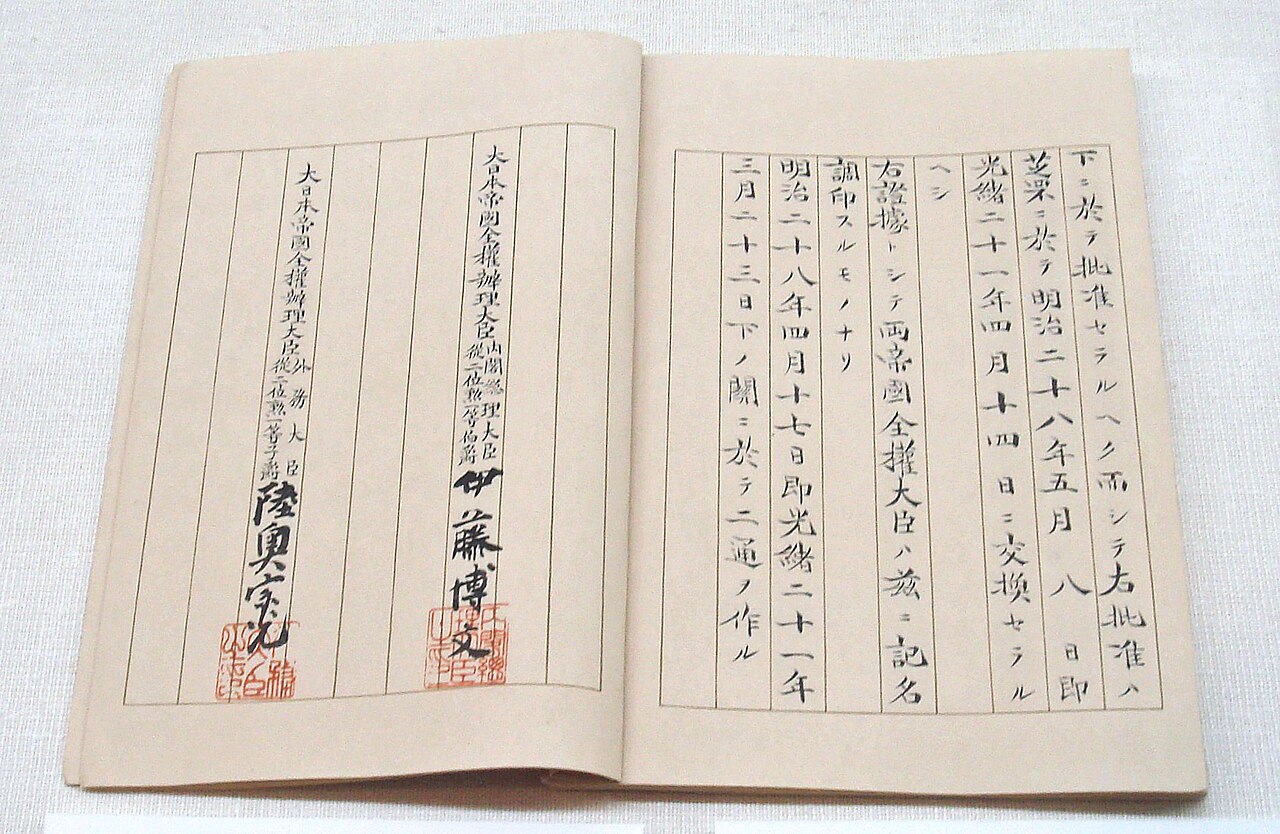
The Treaty of Shimonoseki concluded hostilities between Qing China and Meiji Japan after the conflict of 1894–1895. Signed at Shimonoseki in 1895, it formalized Japan's military gains and reshaped regional relations in East Asia. The treaty is often cited for its territorial transfers, reparations, and diplomatic consequences.
Image gallery
8 Images




Names and signatories
The agreement is known in Chinese as the Chinese name and in Japanese as the Japanese name. It was negotiated between representatives of the Qing government and the Empire of Japan, with formal signature taking place at Shimonoseki in 1895. The Qing dynasty itself is discussed in contemporary accounts under the Qing, while the wider conflict is dated from 1894 into 1895.
Main terms and provisions
- Cession of territorial holdings to Japan, including island territories and strategic ports.
- Recognition of the independence of Korea, altering its status vis‑à‑vis China.
- Payment of a large indemnity by the Qing government to Japan.
- Opening of additional Chinese ports and rights for Japanese commerce and residence.
Historical context
The treaty followed decisive Japanese victories in the First Sino-Japanese War (First Sino-Japanese War) and reflected Japan's rapid modernization and growing naval power. For China, the agreement was one of several 19th‑century setbacks that exposed internal weaknesses and contributed to calls for reform.
Consequences and significance
In the short term, the treaty greatly expanded Japanese influence and control over strategic islands and sea lanes. International reaction included pressure from other powers that altered some outcomes shortly afterward. In the longer view, the treaty accelerated Japan's emergence as a major regional power and deepened Chinese domestic crises that would unfold into further political change.
Notable facts and distinctions
Although the treaty granted important gains to Japan, some of its provisions were modified or affected by subsequent diplomatic interventions and agreements. Scholars note the document as a turning point in East Asian diplomacy and a clear marker of the shift in balance between Japan and Qing China.
For further reading and primary document references, see annotated collections and archival materials linked by academic libraries and national archives.
Chinese name | Japanese name | Qing dynasty context | Shimonoseki | 1895 date | First Sino-Japanese War | 1894–1895
Related articles
Author
AlegsaOnline.com Treaty of Shimonoseki (1895) Leandro Alegsa
URL: https://en.alegsaonline.com/art/101314