
Transit of Venus: rare planetary crossing of the Sun
A transit of Venus occurs when Venus passes directly between Earth and the Sun. These events are rare, last hours, follow a 243-year cycle, and played a key role in measuring the astronomical unit and developing transit science.
Overview
A transit of Venus occurs when the planet passes directly between Earth and the Sun so that Venus appears as a small dark disk moving across the solar face. This alignment is an astronomical syzygy and a type of partial occultation of the Sun. When visible, a transit typically takes several hours from first to last contact and is observed as a slow, steady crossing that can be recorded by telescopes or projected safely for public viewing. For a general definition see transit of Venus and for planet details see Venus.
Image gallery
9 Images





Geometry and frequency
Venus orbits closer to the Sun than Earth, so transits can happen only when Venus is near the points where its orbital plane crosses Earth's orbital plane (the nodes). Because Venus’s orbit is tilted by a few degrees relative to Earth’s, exact alignments are infrequent. Transits occur in a repeating pattern spanning 243 years: they come in pairs separated by eight years, and each pair is followed alternately by long gaps of about 121.5 years and 105.5 years. For background on orbital mechanics see planetary motion and observational contexts at Earth–Sun–planet geometry.
Historical significance
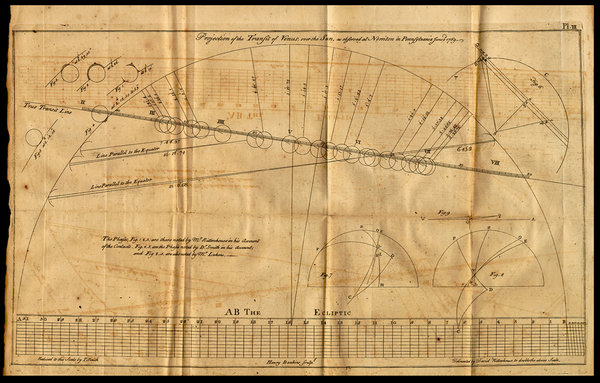
Transits of Venus have had outsized historical importance. In the 17th century, Jeremiah Horrocks predicted and observed the 1639 transit, the first recorded sighting of the phenomenon. In the 18th century, Edmond Halley proposed using transits to determine the solar parallax and so measure the astronomical unit (AU). International expeditions were mounted to distant sites to observe the 1761 and 1769 transits with widely separated vantage points; one famous voyage was the expedition of Lieutenant James Cook aboard HMS Endeavour to Tahiti in 1769 (Cook, HMS Endeavour). Later, the 1874 and 1882 transits were observed with photography and spectroscopic methods. Several historical accounts and expedition reports survive and are reprinted in modern collections (historical records).
Scientific uses and modern relevance
Historically the principal goal of coordinated transit observations was to determine the AU by measuring parallactic shifts in Venus’s apparent path from different latitudes. Those measurements, while challenging, led to improved estimates of the scale of the solar system. The development of radar ranging and spacecraft navigation in the 20th century supplanted transit-based measurements, but transits remain scientifically useful for studying the solar limb, atmospheric scattering, and observational techniques used in detecting and characterizing extrasolar planets by the transit method. Modern public and professional observations, such as the well-covered transits of 2004 and 2012, contributed to outreach and to refining photometric and spectroscopic methods for faint signal detection (astronomical context, 2012 broadcast).
Observing a transit and notable effects
When Venus crosses the solar disk it appears as a small, round, dark spot. The visual appearance can be affected by atmospheric turbulence and instrumental effects; a historically important optical artifact known as the "black-drop" effect complicated precise timing of contact points and is now understood to arise from a combination of atmospheric seeing, telescope diffraction and limb darkening of the Sun. Observers must never look directly at the Sun without approved solar filters; safe methods include projecting the Sun’s image or using certified solar viewing glasses or filters designed for telescopes (astronomical unit measurements, parallax techniques).
Dates, rarity and notable facts
Transits are rare but predictable. Recent occurrences were 8 June 2004 and 5–6 June 2012; these were the only transits in the 21st century. The next pair will occur in December 2117 and December 2125. Each transit provides opportunities for education, historical reflection and calibration of observational techniques. For collections, primary sources and expedition narratives see archival materials and curated summaries (definition, Venus, orbital details, Earth–Sun geometry, historical records, astronomical context, 2012 broadcast, AU, parallax, Cook, Endeavour).
Related articles
Author
AlegsaOnline.com Transit of Venus: rare planetary crossing of the Sun Leandro Alegsa
URL: https://en.alegsaonline.com/art/101161
Sources
- venustransit.nasa.gov : "2012 Transit of Venus"