
Venus — the second planet and Earth's often-contrasted sibling
An overview of Venus: its position, physical properties, atmosphere, rotation and orbit, exploration history, and why it differs from Earth despite similarities in size.
Overview
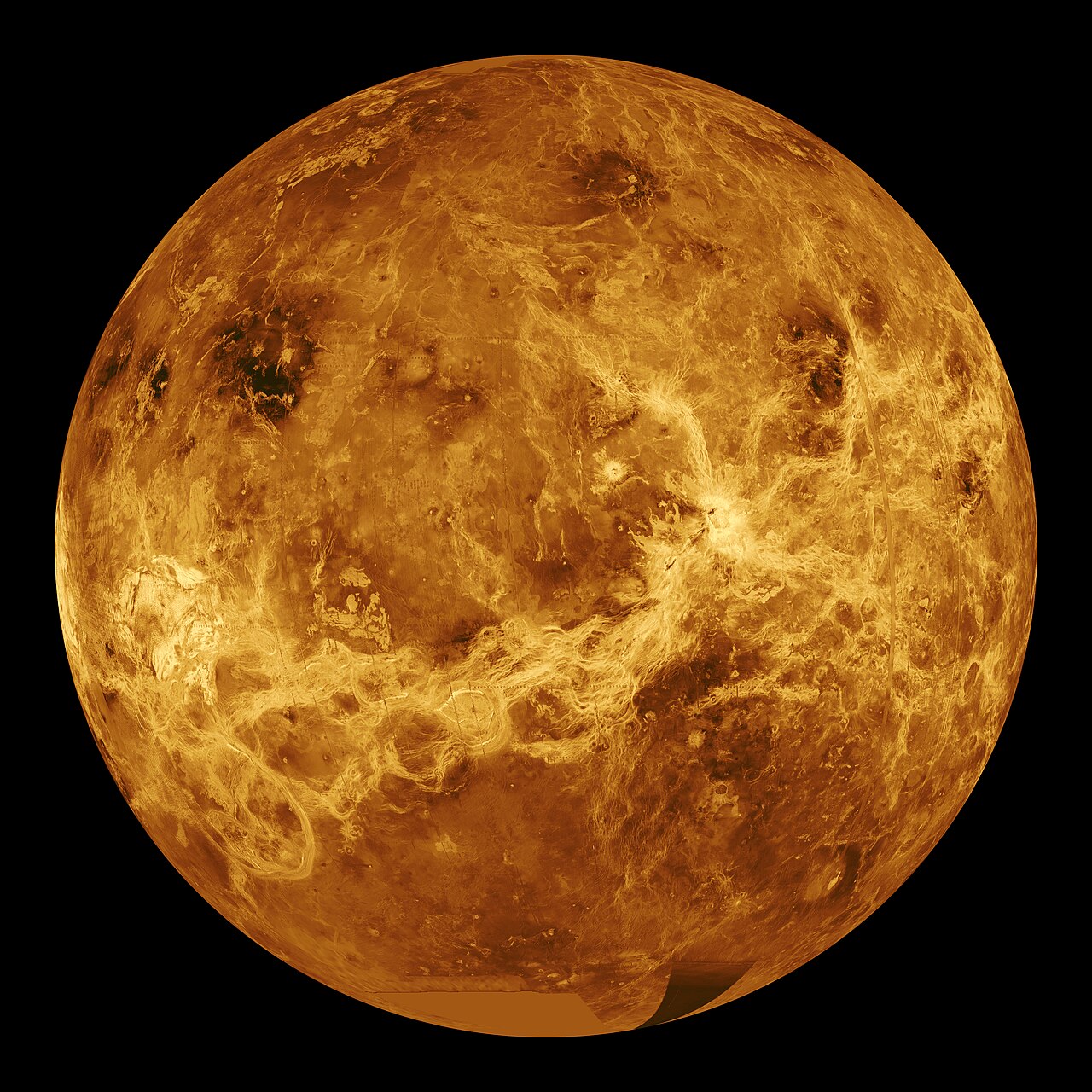
Venus is the second planet from the Sun and one of the four terrestrial worlds of the inner Solar System. Visible to the naked eye since antiquity, it is bright enough to be the brightest natural object in the sky after the Moon, earning the popular names "morning star" and "evening star" depending on its elongation from the Sun. The planet was known to early civilizations and later took the name of the Roman Romans' goddess of love and beauty: Venus (goddess).
Image gallery
10 Images


Physical characteristics
Venus is a terrestrial planet with a dense, rocky surface similar in basic structure to Earth and other planets of the inner Solar System. Its size and mass are comparable to Earth's, which is why it is often called Earth's "sister planet"; surface gravity is similar enough that objects would weigh roughly the same as on Earth (gravity comparison). Unlike Earth, however, Venus lacks a global magnetic field strong enough to shield its atmosphere from the solar wind.
Atmosphere and climate
The atmosphere of Venus is dominated by carbon dioxide with thick, reflective clouds composed largely of concentrated sulphuric acid. These clouds obscure direct optical view of the surface and drive an extreme greenhouse effect that raises surface temperatures to levels hotter than the melting point of lead. Surface pressure is enormous compared with Earth's—roughly 92 times greater at ground level—making the environment hostile to life as we know it (pressure). The presence of sulphuric acid droplets and other chemical species means the cloud layers are corrosive and toxic (poisonous).
Rotation, orbit, and notable facts
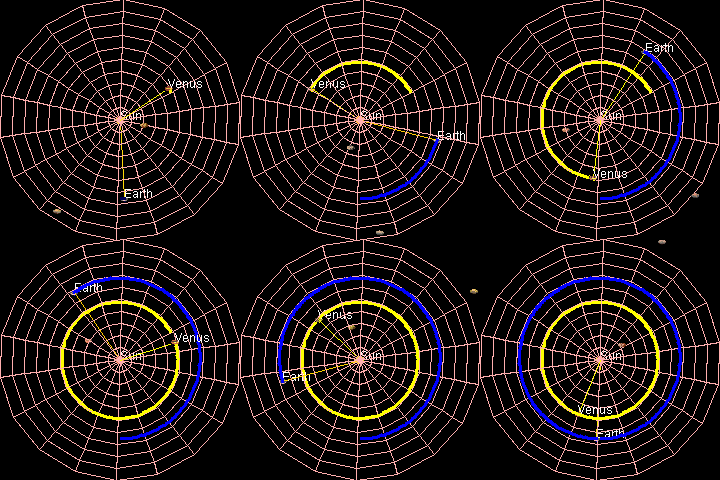
Venus completes an orbit around the Sun in about 225 Earth days, but its rotation on its axis is unusually slow and retrograde: a single sidereal day lasts about 243 Earth days and the planet spins in the opposite direction to most other planets. Because of this combination, a solar day (sunrise to sunrise) on Venus differs from both the sidereal day and its orbital period. Venus has no natural satellites; it is one of only two planets without moons, the other being Mercury. It also comes closer to Earth than any other planet at their nearest approaches (proximity to Earth).
Exploration and discovery
Observations of Venus date back millennia, but modern scientific study began with telescopic observations and later spacecraft missions. Radar mapping and space probes revealed a surface dominated by volcanic and tectonic features, with vast plains, highland regions, and numerous volcanoes. Instruments have probed the atmosphere, surface conditions and composition, and the planet's interaction with the solar environment. Notable mission programs and craft have returned data that transformed understanding of the planet from a possible wet world to the extreme greenhouse state seen today.
Importance, comparisons and cultural impact
Venus is central to studies of planetary climates and habitability because it demonstrates how a runaway greenhouse effect can transform a planet that is otherwise Earth-like in size and composition. Its bright appearance has inspired myth, art and astronomy across cultures. Scientists compare Venus and Earth to learn how divergent evolutionary paths can be driven by atmosphere, solar proximity and geologic activity. While extreme on the surface, the upper cloud layers of Venus have been discussed in speculative studies as environments less hostile than the surface, though the sulphuric acid and atmospheric chemistry pose major challenges to any notion of life or easy exploration.
Key points and missions
- Orbital period: ≈225 Earth days; rotation: ≈243 Earth days, retrograde (position, spin).
- Atmosphere: mainly CO2 with corrosive sulphuric acid clouds and extreme pressure.
- No moons; comes particularly close to Earth (Mercury shares the no-moon trait).
- Exploration continues with orbiters, landers and radar mapping to refine knowledge of geology and atmosphere.
For further reading on its orbit, atmosphere, history and missions consult specialized sources and mission pages linked through institutional repositories and scientific literature (Sun relations, planet class, cultural history, visibility, surface nature, inner system context, naming, mythology, gravity notes, chemical hazards, common nicknames, pressure data, comparative planets, visibility facts, cloud chemistry, close approaches, atmospheric composition, basic position, rotation direction).
Questions and answers
Q: What is the second planet from the Sun?
A: Venus is the second planet from the Sun.
Q: How long is a year on Venus compared to Earth?
A: The year length of Venus is 225 Earth days, which is much shorter than a year on Earth.
Q: What type of planet is Venus?
A: Venus is a terrestrial planet because it has a solid, rocky surface like other planets in the inner Solar System.
Q: How was Venus named?
A: The ancient Romans named it after their goddess Venus, goddess of love and beauty.
Q: Is there life on Venus?
A: Until the late twentieth century many thought there might be life there, however due to its thick atmosphere made up mostly of carbon dioxide with clouds of sulphuric acid (a chemical that is poisonous to life), it makes it difficult for any form of life to exist.
Q: Does Venus have any moons?
A: No, out of all 8 planets in our Solar System, only Mercury and Venus have no moons.
Q: What direction does Venus spin in compared to other planets? A: Unlike most planets in our Solar System, which spin clockwise or eastwardly around their axis,Venus spins very slowly counterclockwise or westwardly around its axis.
Related articles
Author
AlegsaOnline.com Venus — the second planet and Earth's often-contrasted sibling Leandro Alegsa
URL: https://en.alegsaonline.com/art/104614
Sources
- planetary.org : "Venus Looks More Boring Than You Think It Does"
- ssd.jpl.nasa.gov : "Planets and Pluto: Physical Characteristics"
- windows.ucar.edu : "The Atmosphere of Venus"
- filer.case.edu : "Venus - an overview"
- hypertextbook.com : "Temperature on the Surface of Venus"