
Trojan asteroid
Small bodies that share a planet's orbit near the stable L4 and L5 Lagrange regions; best known around Jupiter and studied as remnants of early Solar System formation.
Overview
Trojan asteroids are small bodies that co-orbit with a larger planet near the two stable Lagrange regions located about 60° ahead of and behind the planet in its path around the central star. The most familiar example is the swarm associated with Jupiter, which share Jupiter's orbit about the Sun. Rather than sitting exactly at a mathematical point, these objects librate around the Lagrange points and remain confined to those neighborhoods for long timescales.
Image gallery
4 Images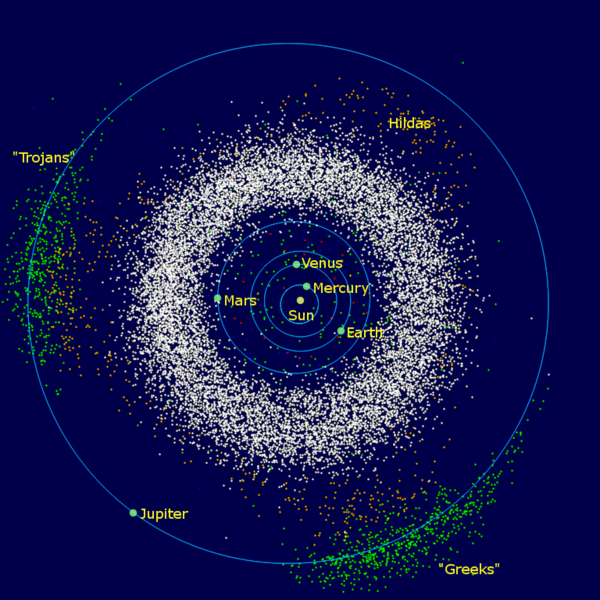


Characteristics
Trojans typically follow paths called "tadpole" orbits centered on the L4 and L5 regions; in some cases other co-orbital behaviours such as horseshoe orbits arise. Their stability depends on the mass ratio between the primary (the star) and the secondary (the planet) and the gravitational influence of other bodies. Trojans are usually small, irregular in shape and can be dark and primitive in composition, traits that suggest they are leftover building blocks from early planetary formation.
Distribution and history
The first known Jupiter Trojan, 588 Achilles, was identified in the early 20th century, and subsequent discoveries revealed two broad swarms—one leading and one trailing the planet. Over time astronomers found Trojan populations associated with other planets as well. Today, documented examples exist near several planets, demonstrating that Trojan-type stability is a common outcome in multi-body systems.
Examples and notable populations
- Jovian Trojans: the largest and best-studied group, occupying two clouds ahead of and behind Jupiter.
- Martian Trojans: a small number of asteroids share Mars' orbit.
- Earth and Neptune also have known co-orbital objects with Trojan-like behaviour.
Scientific importance and missions
Because many Trojans appear to be relatively unchanged since the Solar System's youth, they are valuable records of early conditions and processes. Spacecraft missions have been planned or launched to visit Trojan targets to study their composition, structure and origins in situ; such missions aim to clarify how small bodies contributed to planet formation and how material was redistributed across the nascent system. For readers seeking more technical background on the equilibrium points that permit Trojan motion, see the discussion of Lagrange points.
Related concepts
Trojans are one class of co-orbital objects; others include horseshoe orbiters and quasi-satellites. Their naming convention in the Jovian clouds has a cultural twist: discoverers often assign names drawn from the Trojan War tradition, historically separating names between the two swarms. For further general information on small bodies and asteroid populations, consult summaries of asteroids and planetary dynamics resources on planetary co-orbital phenomena.
Questions and answers
Q: What are Trojan objects?
A: Trojan objects are objects that orbit 60° ahead (L4) or behind (L5) a more massive object.
Q: Where can Trojan asteroids be found?
A: The best known example of Trojan objects are the asteroids that orbit ahead or behind Jupiter around the Sun.
Q: Do Trojan objects orbit exactly at one of the Lagrange points?
A: No, Trojan objects do not orbit exactly at one of either Lagrange points, but do remain close to it, appearing to slowly orbit it.
Q: What is the largest group of asteroids known to move around the Sun?
A: The largest group of asteroids known to move around the Sun are those with the planet Jupiter.
Q: How many groups of Jovian Trojans are there?
A: There are two groups of Jovian Trojans, one group on each side of Jupiter.
Q: What is the central object that Trojan objects are in orbit around?
A: Trojan objects are in orbit around an even more massive central object.
Q: What is the difference between L4 and L5 positions?
A: L4 positions are 60° ahead of the more massive object, while L5 positions are 60° behind the more massive object.
Related articles
Author
AlegsaOnline.com Trojan asteroid Leandro Alegsa
URL: https://en.alegsaonline.com/art/101619
Sources
- nature.com : "Planetary science: The Trojan is out there"
- ui.adsabs.harvard.edu : 2011NatPh...7..592W
- doi.org : 10.1038/nphys2061
- nature.com : "Earth's Trojan asteroid"
- ui.adsabs.harvard.edu : 2011Natur.475..481C
- doi.org : 10.1038/nature10233
- minorplanetcenter.org : "List of Martian Trojans"
- minorplanetcenter.org : "List of Neptune Trojans"
- arxiv.org : Preprint
- space.com : "Neptune may have thousands of escorts"
- space.com : "First Asteroid companion of Earth discovered at last"
- bbc.co.uk : bbc.co.uk/news/science-environment-14307987