
HMS Endeavour — Cook's bark of exploration (1768–1771)
HM Bark Endeavour was the coal collier turned Royal Navy exploration vessel commanded by James Cook on his first Pacific voyage (1768–1771); famed for the transit of Venus, charts of New Zealand and Australia, and its later loss.
HMS Endeavour, often called HM Bark Endeavour, was a small British naval vessel notable for its 1768–1771 voyage under Lieutenant James Cook. Originally built in 1764 as the collier Earl of Pembroke, she was purchased and refitted by the Royal Navy in 1768 for a scientific and exploratory mission. The expedition combined astronomical observation, natural history collecting and hydrographic surveying; it produced some of the first accurate European charts of New Zealand and the east coast of Australia and carried a team of scientists and artists who recorded new plants, animals and indigenous peoples.
The ship was a sturdy collier adapted for long ocean passages: a broad-beamed wooden hull, shallow draught and capacious hold made her suitable for carrying coal, provisions and scientific stores. Converted for the Admiralty, she was described in contemporary records as a bark (or barque) rigged vessel — a configuration that balanced cargo capacity and handling ease with a small naval complement. The voyage carried naval officers and a civilian scientific retinue led by the naturalist Sir Joseph Banks, whose botanical collections and patronage greatly influenced European science.
Image gallery
9 Images


Voyage and route
- Departure and coordinates: left England and is associated in later accounts with locations marked at specific coordinates.
- Service: sailed under the authority of the Royal Navy.
- Command: helmed by Lieutenant James Cook.
- Primary destinations included Australia and New Zealand.
- Broad theatre: operations took place across the Pacific Ocean.
- Route to the Pacific passed southward around Cape Horn.
- Scientific aim: reached Tahiti to observe the transit of Venus.
- Early Pacific calls included several Polynesian islands where formal claims were sometimes recorded; European awareness of the region had earlier been opened by explorers such as Abel Tasman.
- First Australian landfall on the east coast was at what is now Botany Bay.
- The ship later struck coral on the Great Barrier Reef and was repaired near what became Cooktown.
- On the homeward leg the vessel put in at Batavia for heavy repairs.
- Returned to Europe via the Cape of Good Hope.
- Final homeward arrival was at an English port such as Dover.
- Following the exploration voyage she later served in logistics to places including the Falkland Islands.
- During the conflict era she was requisitioned for service in the context of the American Revolutionary War.
- Fragments and recovered pieces from the wreck, including cannons, have been exhibited.
- An anchor reputedly from the ship is among items displayed in maritime collections.
Cook's first voyage blended navigation, diplomacy and natural history. The expedition observed the 1769 transit of Venus from Tahiti, a measurement intended to improve the calculation of the Earth–Sun distance; it then carried out extensive coastal surveys. In New Zealand the party charted both main islands and established contact and exchanges with Māori communities; along the Australian coast the Endeavour's charts and Cook's journals recorded geography, indigenous peoples and many plants new to European science.
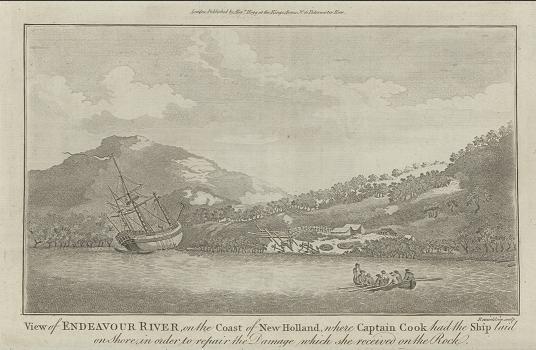
Not all of the voyage was smooth. In June 1770 the Endeavour ran aground on a coral shoal on the Great Barrier Reef and was badly holed. Cook and the crew managed to careen and refloat her, beaching for repairs on the mainland at a river that later took the ship's name in popular memory; repairs were completed enough to enable passage to Batavia (today's Jakarta) for thorough shipwright work. After a long circuit via the Cape of Good Hope the expedition back in England in 1771 ended a voyage of almost three years.
After returning to Britain the vessel remained in naval service for a time, carrying stores and personnel, and was eventually sold into commercial use. During the American conflict she was employed as a troop transport and in 1778 was lost in Narragansett Bay, Rhode Island. The exact location of her final wreck has not been definitively confirmed by archaeologists, but period relics and items attributed to the Endeavour—such as several iron guns and a large anchor—are conserved and displayed in museums around the world.
Legacy and replicas
The Endeavour's legacy is cultural, scientific and maritime: Cook's charts improved navigation across the South Pacific, botanical and ethnographic collections enriched European knowledge, and the voyage accelerated later exploration and contact. Interest in the ship and her story led to the construction of a full-size working replica launched in 1994, which is berthed for public display and sail-training and is associated with maritime museums that interpret the original voyage for contemporary audiences. The name Endeavour remains in public memory through place names, monuments and ongoing historical research into the voyage, the people aboard, and their encounters with the peoples of the Pacific.
Questions and answers
Q: What is the name of the ship commanded by Lieutenant James Cook?
A: The ship was called HMS Endeavour, also known as HM Bark Endeavour.
Q: When did HMS Endeavour set sail from Plymouth?
A: HMS Endeavour set sail from Plymouth in August 1768.
Q: What was the mission of HMS Endeavour?
A: The mission of HMS Endeavour was to explore the Pacific Ocean and search for Terra Australis Incognita (the unknown southern land).
Q: Where did HMS Endeavour first anchor off after leaving Tahiti?
A: After leaving Tahiti, HMS Endeavour first anchored off New Zealand.
Q: What is now known as Botany Bay, which was reached by the crew of HMS Endeavour in April 1770?
A: Botany Bay is now known as an area on the east coast of Australia that was reached by the crew of HMS Endeavour in April 1770.
Q: How long were they able to stay at this location for repairs to be made to her hull?
A: They were able to stay at this location for seven weeks so that basic repairs could be made to her hull.
Q: Where did she limp into port after running into Great Barrier Reef near Cape Tribulation?
A: After running into Great Barrier Reef near Cape Tribulation, she limped into port in Batavia in the Dutch East Indies for more substantial repairs.
Related articles
Author
AlegsaOnline.com HMS Endeavour — Cook's bark of exploration (1768–1771) Leandro Alegsa
URL: https://en.alegsaonline.com/art/44576
Sources
- commons.wikimedia.org : HM Bark Endeavour (ship, 1764)