
Triton — Neptune's largest moon
Triton is Neptune's largest moon, notable for its retrograde orbit, icy surface, active geology, tenuous nitrogen atmosphere and likely origin as a captured Kuiper Belt object; studied mainly by Voyager 2.
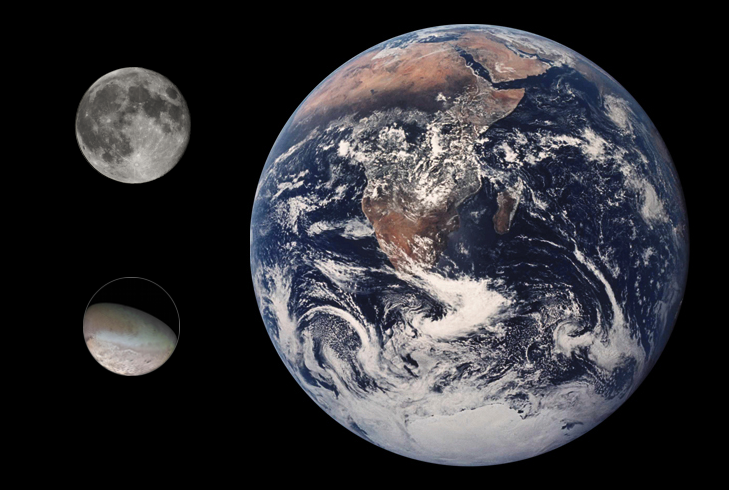
Overview: Triton is the largest natural satellite of Neptune and one of the larger moons of the Solar System, often listed among the seventh-largest moons. It is slightly smaller than Earth's Moon and distinguished by a retrograde orbit, meaning it revolves around Neptune in the opposite direction of the planet's rotation. That retrograde motion is a key clue that Triton did not form in place but was captured.
Discovery: Triton was discovered on 10 October 1846 by the British astronomer William Lassell, shortly after Neptune itself was identified by observers including Johann Galle and Heinrich d'Arrest. The discovery belongs to the period of active 19th-century planetary astronomy and helped establish the system of named satellites around the outer planets; see related accounts in histories of British astronomy and 19th-century surveys of the outer Solar System (discovery context).
Composition and surface: Triton's bulk composition is a mixture of volatile ices and rock. Its surface shows deposits of molecular nitrogen, water ice, and smaller amounts of methane and carbon monoxide. Imaging from the only close spacecraft encounter revealed large smooth plains, ridged and fractured terrains, and unusual ‘‘cantaloupe’’ terrain in places. Many regions have relatively few impact craters, implying a geologically young surface in parts.
Temperature and volatiles: Voyager 2 measurements indicate an extremely low surface temperature around −235 °C; at these temperatures nitrogen and other volatiles are solid except where sublimation or thermal processes are active. Seasonal sunlight changes and local albedo contrasts can drive sublimation and deposition of frost, creating visible streaks and patterns on the surface.
Atmosphere and activity: Triton supports a tenuous, cold atmosphere dominated by nitrogen with trace methane. During the Voyager 2 flyby, dark plume-like features rising tens to hundreds of kilometres were seen; these are interpreted as jets of nitrogen gas entraining dark material, possibly driven by seasonal heating beneath a translucent ice layer. The atmosphere is far thinner than Earth's but can support hazes and wind-driven redistribution of frost.
Orbit, origin and interior: Triton's retrograde, inclined orbit and its physical similarities to some trans-Neptunian objects support the hypothesis that it was captured from a heliocentric orbit, likely from the Kuiper Belt. Capture would have required loss of orbital energy and probably produced strong tidal heating early in its history, which could explain past internal activity and resurfacing. Some models allow for a possible subsurface layer of liquid (a subsurface ocean) maintained by radiogenic heating and residual tidal heat, though direct evidence is limited and the idea remains uncertain.
Magnetospheric interactions: Triton does not appear to have a strong intrinsic magnetic field like a planet, but it interacts with Neptune's magnetosphere and is embedded in a complex plasma environment. Spacecraft data show signatures of plasma and induced effects related to Triton's thin ionosphere and the larger magnetospheric context.
Exploration and observations: The principal in situ source of detailed information about Triton is the Voyager 2 flyby in 1989 (Voyager 2 data), which returned the highest-resolution images and direct measurements to date. Since that encounter, ground-based telescopes and space telescopes have monitored Triton for changes in brightness, atmospheric pressure and seasonal phenomena, but no other spacecraft has performed a close rendezvous. Mission concepts to return to the Neptune–Triton system have been proposed to study geology, volatile cycles and potential habitability more directly.
Image gallery
10 Images





Significance
- Triton provides a natural laboratory for studying capture dynamics and the evolution of captured satellites.
- Its active surface processes at extremely low temperatures challenge and inform models of cryovolcanism and volatile transport.
- Because it may preserve material characteristic of the outer Solar System, Triton is of interest for studies of composition and the history of trans-Neptunian bodies.
Further reading and related topics
Questions and answers
Q: What is Triton?
A: Triton is the largest moon of the planet Neptune and the seventh-largest moon in the Solar System.
Q: When was Triton discovered?
A: Triton was discovered by the British astronomer William Lassell on October 10, 1846, just 17 days after Neptune itself was discovered by the German astronomers Johann Gottfried Galle and Heinrich Louis d'Arrest.
Q: Is Triton believed to be a captured Kuiper Belt object?
A: Yes, it is believed that Triton is a captured Kuiper Belt object.
Q: How cold is the surface temperature of Triton recorded as being?
A: The surface temperature of Triton has been recorded as -235°C (-391°F) by Voyager 2.
Q: Does Triton have its own magnetic field or atmosphere?
A: Yes, it has both its own magnetic field and a faint trace of an atmosphere.
Related articles
Author
AlegsaOnline.com Triton — Neptune's largest moon Leandro Alegsa
URL: https://en.alegsaonline.com/art/101592
Sources
- solarsystem.nasa.gov : "NASA: Solar System Exploration: Planets: Neptune: Moons: Triton"
- bbc.co.uk : "BBC Home: Science: Space: Solar System: Moons: Triton"
- adsabs.harvard.edu : adsabs.harvard.edu/abs/1989A&A...219L..23C
- adsabs.harvard.edu : adsabs.harvard.edu/abs/2007Icar..192..135S