
Transiting Exoplanet Survey Satellite (TESS)
NASA space telescope launched in 2018 to survey bright nearby stars for transiting exoplanets, using wide-field cameras to produce an all-sky catalog of planet candidates for follow-up study.
The Transiting Exoplanet Survey Satellite (TESS) is a NASA-led space mission created to discover planets beyond the Solar System by monitoring the slight dimming of starlight that occurs when a planet crosses in front of its host star. TESS was developed to focus on relatively bright, nearby stars so detected planets can be more readily characterized with ground- and space-based follow-up. More information from the mission team is available at the official mission page.
Image gallery
10 Images



Design and survey strategy
TESS carries multiple wide-field cameras that together observe large swaths of the sky in a stepwise pattern of overlapping sectors. The satellite repeatedly images each sector for several weeks before moving to the next, enabling it to build light curves for hundreds of thousands of stars. This sector-based, near all-sky approach complements earlier, deeper surveys by targeting brighter targets that are optimal for radial-velocity and atmospheric follow-up.
- Optical setup: a set of four identical wide-field cameras designed to deliver high-precision photometry across a broad sky area.
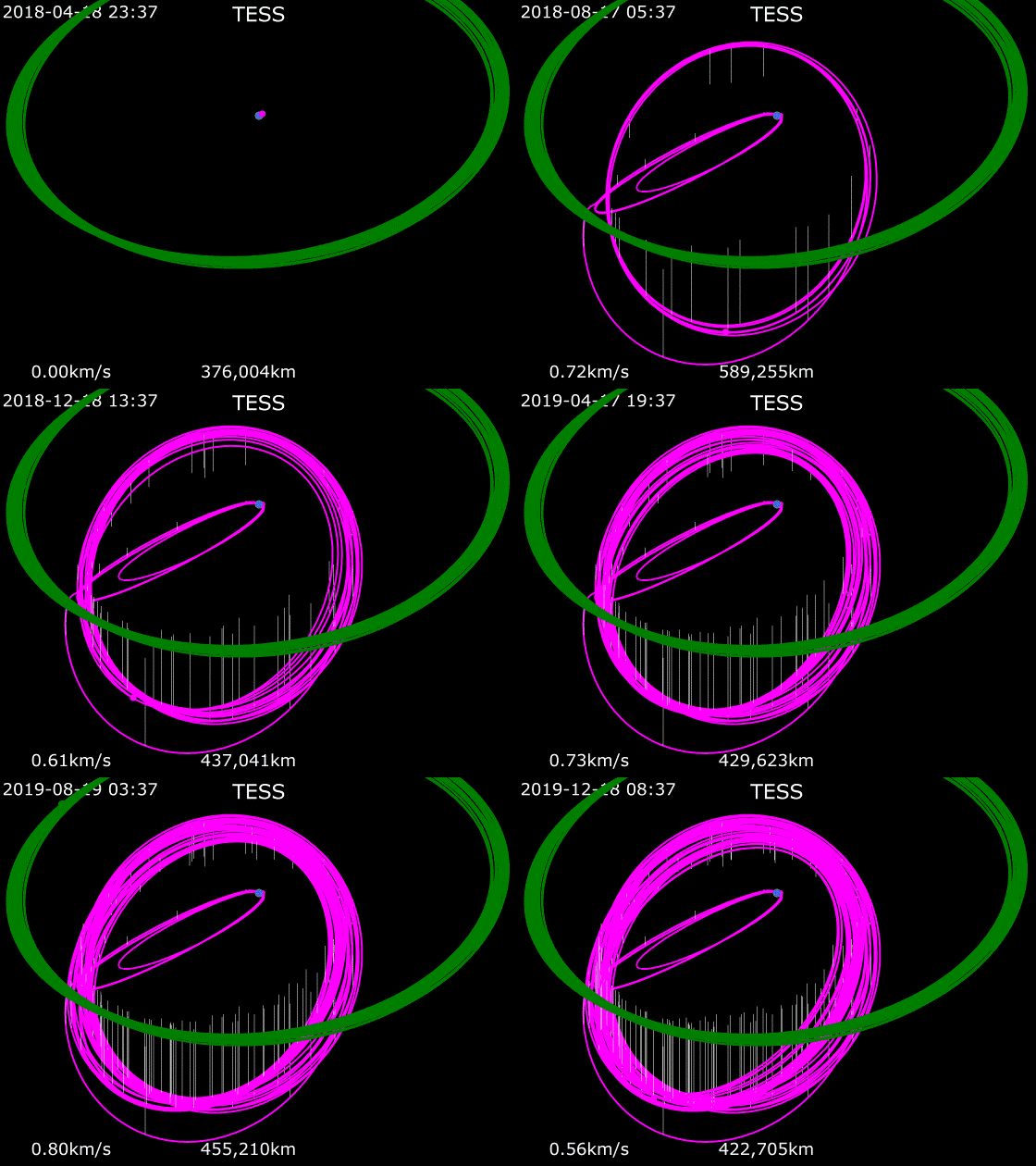
- Orbit: a highly stable, elliptical high-Earth orbit chosen to provide long, uninterrupted observation intervals and thermal stability while minimizing Earth occultations.
- Data products: calibrated light curves, full-frame images, and lists of candidate transits released regularly to the public.
History and launch
TESS was selected and developed through NASA programs focused on exoplanet discovery and was launched on April 18, 2018. The satellite rode to space on a SpaceX Falcon 9 vehicle; details about the launch provider are available via the launch contract pages at SpaceX. The liftoff site was the Cape Canaveral Air Force Station launch complex. The publicly reported launch services contract value was US$87 million.
Scientific impact and discoveries
During its primary and extended operations, TESS has produced thousands of candidate signals (often labeled as TESS Objects of Interest, or TOIs) and contributed to the confirmation of many planets spanning a wide range of sizes and orbital periods. Some discoveries include small, potentially rocky planets and larger sub-Neptune and giant planets, and a few systems of special interest have been prioritized for atmospheric study by other observatories. One notable example of a small planet identified in TESS data received broad attention as a nearby, temperate world suitable for further study.
Data access, follow-up, and legacy
TESS follows an open-data philosophy: mission data and candidate lists are rapidly shared with the scientific community and the public, enabling a broad program of ground- and space-based follow-up that includes precise mass measurements and atmospheric characterization. The mission has accelerated exoplanet discovery by providing a large, bright-star target list that complements deeper surveys. Researchers and citizen scientists continue to mine TESS datasets, and long-term archives ensure the observations remain a resource for future exoplanet research and comparative planetology. General resources and outreach information can be found through NASA and affiliated archives, such as the mission portal at NASA's TESS site and related program pages describing exoplanet science more broadly.
TESS illustrates how a targeted, wide-field survey can transform a field: by prioritizing bright, nearby stars it has opened pathways for follow-up characterization that were difficult with earlier surveys, extending our understanding of planet demographics, formation, and the prospects for atmospheric study of small worlds.
Questions and answers
Q: What is the Transiting Exoplanet Survey Satellite?
A: The Transiting Exoplanet Survey Satellite is a planned NASA space telescope designed to search for planets outside of the Solar System.
Q: When was TESS launched?
A: TESS was launched on April 18, 2018.
Q: Who launched TESS?
A: TESS was launched on a SpaceX Falcon 9 Full Thrust rocket.
Q: Where was TESS launched from?
A: TESS was launched from the Cape Canaveral Air Force Station.
Q: How much was the launch services contract for TESS?
A: The total value of the launch services contract for TESS is US$87 million.
Q: Who was awarded the launch services contract for TESS?
A: SpaceX was awarded the launch services contract for TESS in December 2014.
Q: What kind of planets is TESS designed to search for?
A: TESS is designed to search for planets outside of the Solar System, which are called exoplanets.
Related articles
Author
AlegsaOnline.com Transiting Exoplanet Survey Satellite (TESS) Leandro Alegsa
URL: https://en.alegsaonline.com/art/101162