
Trifid Nebula (M20): Overview, Structure, and Observing Guide
The Trifid Nebula (M20) is a mixed emission, reflection and dark nebula in Sagittarius about 5,200 light-years away, notable for its three dust lanes, active star formation, and visibility to small telescopes.
Overview
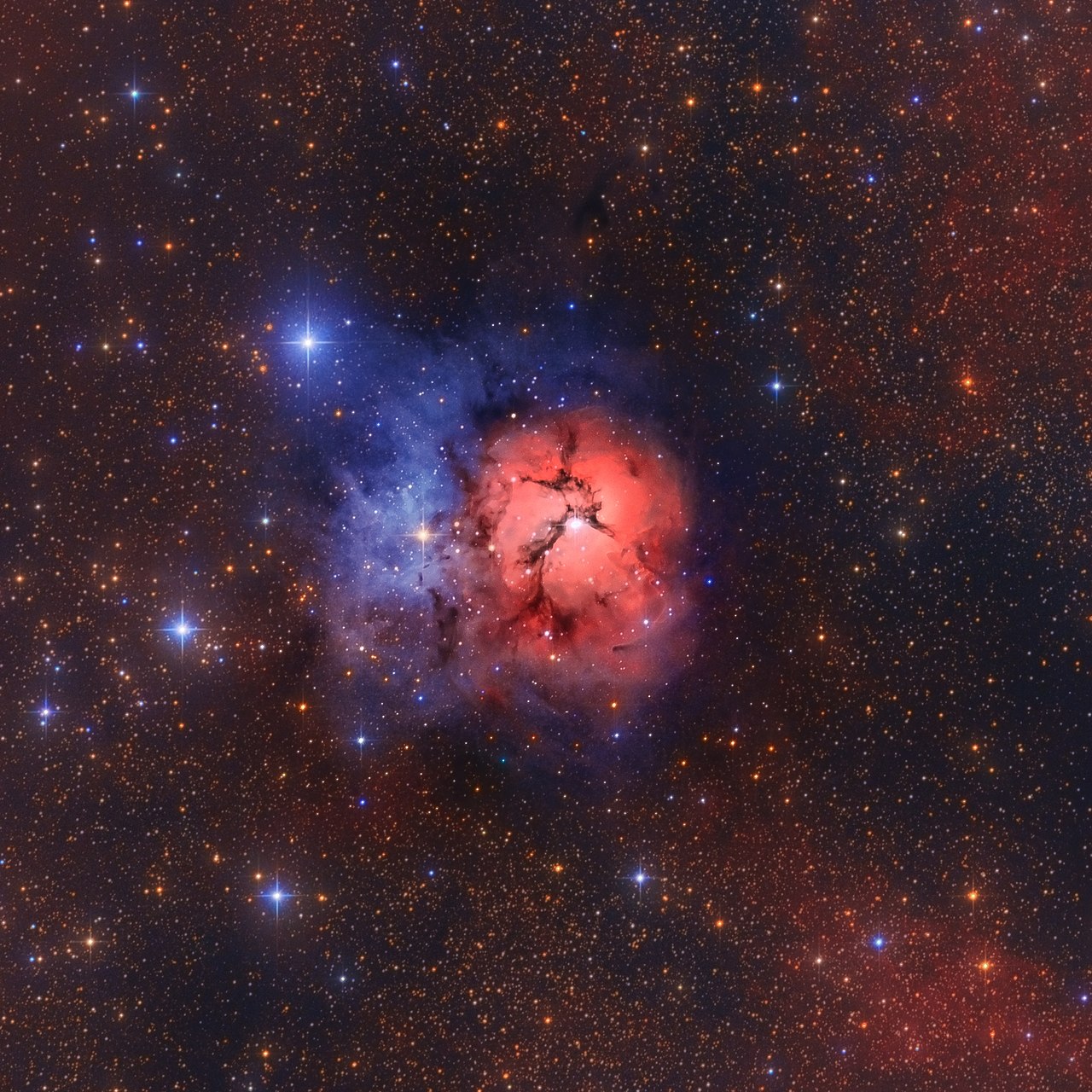
The Trifid Nebula is a striking and well-known deep-sky object notable for three dark lanes that appear to divide the glowing cloud into lobes. It combines glowing gas and dust in a single field: the red emission from ionized hydrogen, blue reflection from dust scattering starlight, and conspicuous dark filaments. The object is commonly cataloged as Messier 20 (M20) and lies in the direction of the constellation Sagittarius. It is roughly about 5,200 light‑years from Earth and is compact enough to be a favorite target for amateur astrophotographers.
Image gallery
10 Images






Structure and composition
The Trifid is a mixed nebula: an emission nebula where ultraviolet radiation from hot young stars ionizes hydrogen, a reflection nebula where dust scatters starlight, and a complex of dark lanes that cut across the bright regions. At its heart is a small cluster of bright, young stars whose radiation sculpts the surrounding gas into pillars and cavities. Within the nebula astronomers find protostars, compact dense clumps (sometimes called Bok globules), and regions of ongoing star formation.
- Emission component: glowing hydrogen and other ionized gases.
- Reflection component: blue light from dust-scattered starlight.
- Dark lanes: cooler, dense dust that obscures the background glow.
- Associated cluster: young stellar population that energizes the nebula.
Discovery and study
The nebula has been observed since the 18th century and was cataloged by Charles Messier. Since then it has been the subject of detailed photographic and spectroscopic study. Modern telescopes — both ground-based and space observatories — have revealed jets, shock fronts, and newly formed stars embedded within the cloud. Observations across visible, infrared, and radio wavelengths help distinguish the hot ionized gas from cooler dust and molecular material.
Importance and what it shows astronomers
The Trifid is important because it presents multiple astrophysical processes in one view: ionization by massive stars, dust scattering, and the early stages of star formation. Studying its structure helps astronomers learn how young stars influence their environment, how dense clouds fragment to form new stars, and how stellar winds and radiation shape nebular morphology. The combination of emission, reflection, and dark features also makes the Trifid a textbook example for teaching about interstellar medium processes.
Observing the Trifid
Under dark skies the Trifid is bright enough to be seen with the naked eye as a faint smudge in good conditions and becomes an attractive target through binoculars and small telescopes. Through larger amateur instruments and long-exposure photography the red and blue regions become prominent and the dividing dust lanes are revealed. For scientific study, infrared and radio observations penetrate the dust to reveal embedded protostars and molecular structure, while optical spectroscopy measures the composition and motions of the ionized gas — techniques commonly applied by professional observatories and space telescopes.
For general reference and observing charts consult introductory guides and catalogs that summarize the Trifid's coordinates, brightness, and seasonality. Further technical details are available in specialized literature and online databases maintained by astronomical institutions (H II region resources provide background on the ionized-gas physics).
Whether seen visually, photographed with a small telescope, or imaged by large observatories, the Trifid Nebula remains one of the most accessible and instructive star-forming regions in our galaxy, offering both striking aesthetics and valuable scientific insight.
Additional resources and imagery can be found through observational archives and outreach pages that compile multiwavelength studies and historical notes (emission nebula overview, distance references).
Related articles
Author
AlegsaOnline.com Trifid Nebula (M20): Overview, Structure, and Observing Guide Leandro Alegsa
URL: https://en.alegsaonline.com/art/101499