
The Last Supper (Leonardo da Vinci)
Leonardo da Vinci’s The Last Supper is a late‑15th‑century mural in Milan depicting Jesus and the twelve apostles at the moment a betrayal is revealed; notable for composition, technique, and complex conservation history.
The Last Supper is a celebrated painting by Leonardo da Vinci that depicts the biblical Last Supper, the scene in which Jesus tells his disciples that one of them will betray him. Executed at the end of the fifteenth century, the work occupies the end wall of the refectory at Santa Maria delle Grazie in Milan, Italy. It is admired for its psychological depth, its use of perspective to focus on Christ, and the way gestures and expressions tell a momentary drama.
Image gallery
10 Images
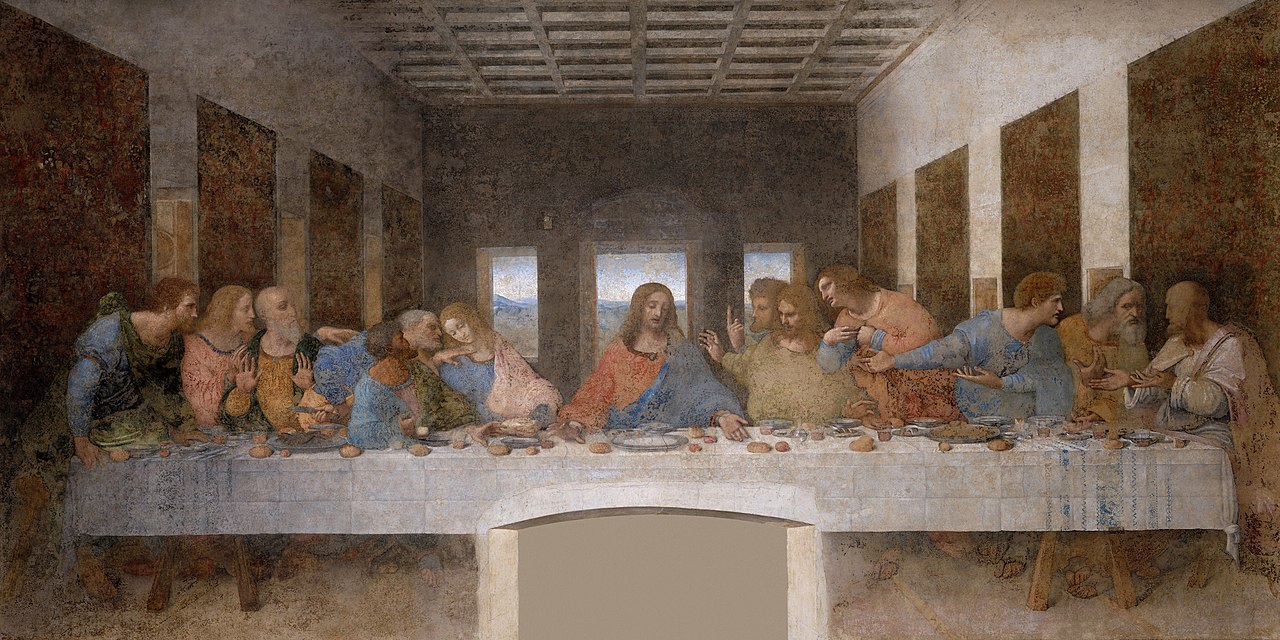


Description and composition
Leonardo arranges the apostles in four groups of three around the seated Christ, creating a dynamic narrative by means of facial expression, posture and hand gestures rather than by ornate detail. Christ sits at the center, framed by an architectural window and by a carefully calculated vanishing point directly behind his head. The arrangement forms triangles and rhythmic lines that guide the viewer’s eye, while each apostle reacts differently to the announcement of betrayal: Judas is shown in a withdrawn posture, often interpreted as clutching the coins; Peter leans forward and gestures protectively; the youthful figure beside Christ is traditionally identified as John.
Technique and dimensions
Unlike a true fresco, Leonardo experimented with a mixed technique, applying tempera and oil on a ground prepared on the dry wall, so he could work more slowly and achieve subtle gradations of tone and detail. This approach allowed refined modeling of faces and drapery but left the surface vulnerable to humidity and flaking. The mural measures roughly 460 × 880 cm and was designed to be seen from the refectory’s longitudinal axis, giving the composition its theatrical immediacy.
Commission, dating and context
The commission was part of a broader program of decoration at the Dominican convent of Santa Maria delle Grazie. Leonardo began work on the composition around 1495 and completed it by 1498, although he did not work continuously on the piece and left preparatory studies and drawings that reveal his planning and experiments with poses, light and perspective.
Conservation and modern treatment
From soon after its completion the mural experienced paint loss and deterioration. Its experimental technique, combined with environmental factors and early, sometimes harmful attempts at preservation, contributed to progressive decay. The refectory suffered damage during later centuries, including during wartime, and the painting has been the subject of several conservation campaigns. A major, much‑publicized restoration undertaken in the late 20th century sought to stabilize the surface and recover original passages while acknowledging that much of the present appearance reflects both original paint and later retouching. Visitors today are admitted under controlled conditions to reduce humidity and light exposure.
Interpretation, influence and debates
The Last Supper is a milestone of Renaissance art, studied for its compositional clarity, narrative economy and the psychological realism Leonardo achieved. It has generated theological and artistic readings and has been copied and reinterpreted across centuries. At the same time, speculative theories claiming hidden messages or coded elements continue to attract public attention; mainstream scholarship treats such claims cautiously and emphasizes evidence grounded in historical, technical and stylistic research.
Facts and public access
- The work is a mural located in the dining hall of Santa Maria delle Grazie in Milan, Italy.
- It illustrates the Biblical Last Supper and the announcement of a traitor by Jesus.
- Leonardo began his execution around 1495 and finished by 1498, working in a non‑fresco technique to allow greater subtlety.
- Its fame rests on compositional innovation, expressive characterization and a long, complex conservation history.
The Last Supper remains central to studies of Leonardo’s methods and Renaissance narrative art. Ongoing research in conservation science and archival scholarship continues to refine understanding of how Leonardo worked and how best to preserve one of the period’s most influential images.
Related articles
Author
AlegsaOnline.com The Last Supper (Leonardo da Vinci) Leandro Alegsa
URL: https://en.alegsaonline.com/art/98313