
Bell‑Beaker culture (Beaker phenomenon)
Late Neolithic–Early Bronze Age cultural phenomenon in much of Western Europe (c. 2800–2200 BC), known for bell-shaped pottery, characteristic burials and debated origins involving exchange, migration and social change.
The Bell‑Beaker complex—often called the Beaker phenomenon or Beaker culture—refers to a suite of archaeological traits that spread across large parts of Western Europe in the late Neolithic and Early Bronze Age (roughly 2800–2200 BC, and in parts of Great Britain until about 1900 BC). Scholars use the term to describe recurring combinations of pottery, funerary practices and personal objects rather than asserting a single, uniform ethnic group. For this reason some authors prefer expressions such as the Beaker phenomenon.
Image gallery
3 Images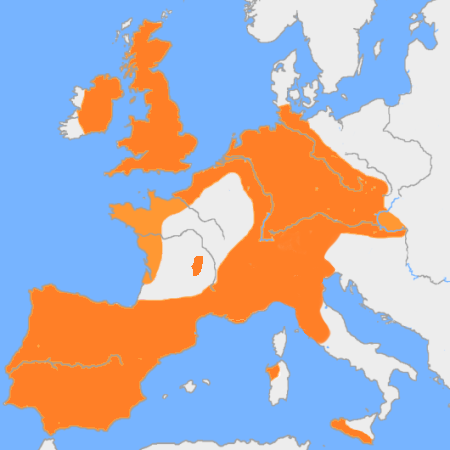
Distinctive material culture
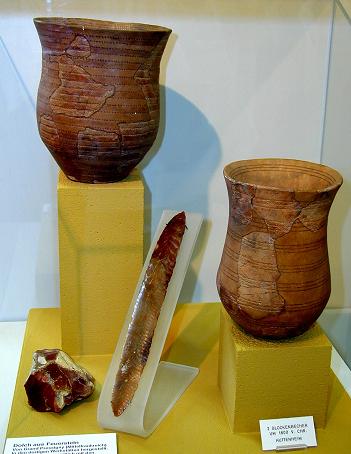
The most recognizable artifact is the bell‑shaped beaker vessel, often decorated with geometric impressions or cord impressions and usually treated as a marker of social identity. Finds associated with the Beaker horizon also include copper and early bronze objects, flint arrowheads, wrist‑guards and ornate personal ornaments that were frequently interpreted as prestige goods. Early commentators such as Paul Reinecke coined the German term Glockenbecher (bell‑shaped cup), while other European researchers working in places like Italy and Czechoslovakia had used similar labels.
Burial practices and social signals
Burial rites linked to the Beaker horizon show considerable regional variety but also several recurring features. Bodies were commonly placed in a crouched or foetal posture—sometimes described as an embryonic position—and frequently accompanied by a beaker and other grave goods. In some western areas people continued to use existing megalithic tombs and caves as places of deposition; in other areas stone cists or small barrows are typical. The orientation of the corpse has been recorded as different for males and females in some assemblages: women with heads to the south and feet to the north, arms to the right; men with the opposite orientation, so both face east when interred. Western burials are often found in megalithic contexts or caves, and many tombs show local adaptations of a broader Beaker repertoire.
Geography, chronology and settlements
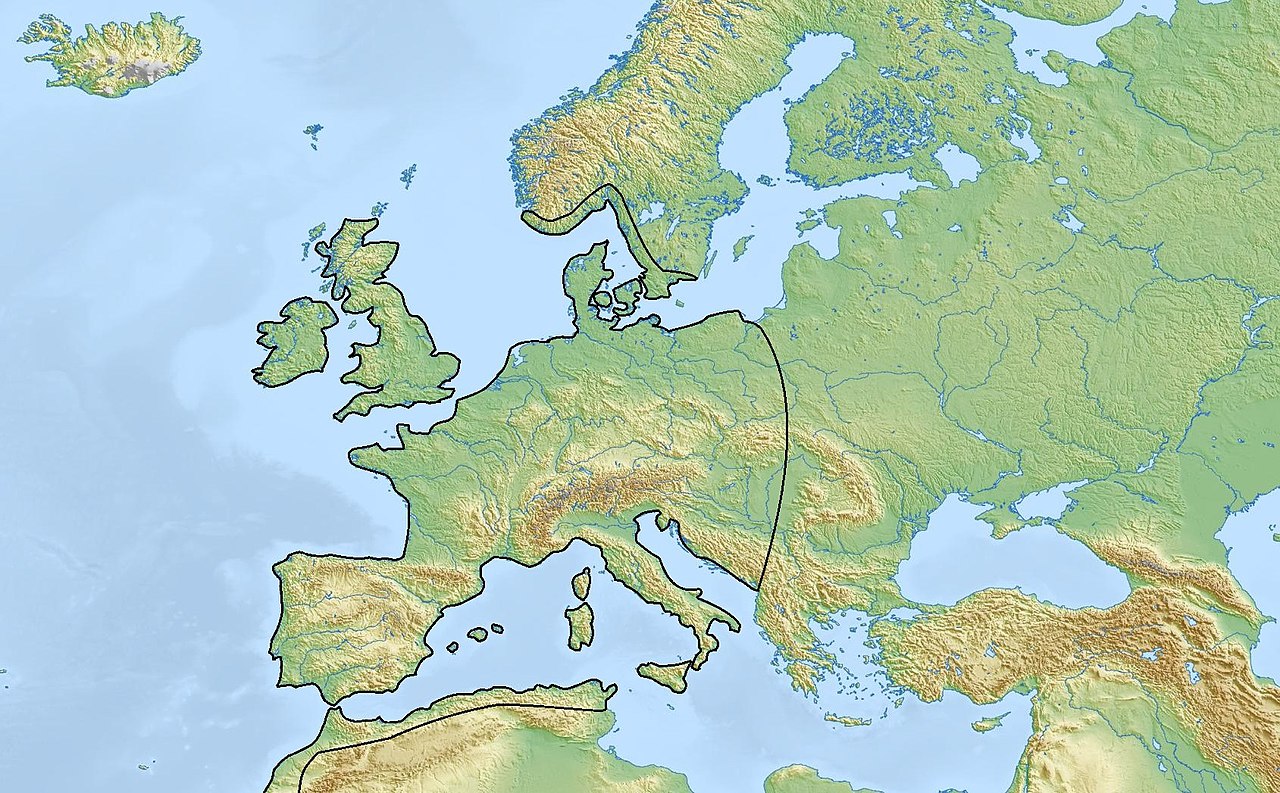
The Beaker phenomenon appears along an extensive Atlantic and continental axis, from the Iberian Peninsula and Atlantic façade to central and northern Europe. Chronology and regional development vary: some areas show an earlier adoption, others a later persistence. Evidence for permanent settlements associated specifically with Beaker assemblages is relatively sparse; notable contemporaneous sites include excavations at Knowth in Ireland and limited settlement evidence from parts of Switzerland. This scarcity has contributed to different interpretations about whether Beaker traits spread chiefly by movement of people, exchange of ideas, or elite networks.
Origins, interpretations and later research
Interpretations have evolved. Early 20th‑century scholars debated whether the Beaker complex represented migrations, missionary movements (as suggested by V. G. Childe in broader terms) or a social fashion carried by elites. Gordon Childe proposed that Beaker people brought new technologies such as early copper working to some regions. Some archaeologists prefer the neutral label Glockenbecherphänomen to avoid implying a single culture. Recent ancient DNA research has added nuance: in some regions the appearance of Beaker material culture coincided with significant changes in ancestry, suggesting movement of people; in others, local adoption of Beaker forms appears to have been more cultural than demographic. The Beaker horizon also interacted with neighbouring groups such as the Corded and other late Neolithic cultures, notably the Corded Ware tradition in parts of northern Europe.
Legacy and significance
Today the Bell‑Beaker phenomenon is important for understanding social change in prehistoric Europe: it marks shifts in burial practice, the spread of new objects and technologies, and complex patterns of interaction over long distances. Because it combines shared traits with strong regional variation, the Beaker horizon continues to be central to debates about identity, mobility, and cultural transmission in prehistory.
- Key features: bell‑shaped pottery, metalwork, characteristic graves and regional adaptation.
- Notable ideas: migration vs. diffusion vs. elite transmission; genetic studies now inform the debate.
- Further reading: introductory surveys and regional reports accessible through specialist portals and museum collections linked to Beaker finds such as those published by national archaeological services (overview, regional summaries).
Related articles
Author
AlegsaOnline.com Bell‑Beaker culture (Beaker phenomenon) Leandro Alegsa
URL: https://en.alegsaonline.com/art/9801