
Swarm (collective animal grouping behavior)
A swarm is a dense aggregation of animals that move or act together. Often used for insects, the concept applies to birds, fish and has inspired robotics and computing models.
A swarm refers to a large, often dense aggregation of individual organisms that behave or move collectively. The term is commonly applied to groups of animals that coordinate without central control. Swarming emphasizes local interactions and simple behavioral rules that produce large-scale patterns, such as synchronized motion, rapid formation changes, or sudden dispersal.
Image gallery
8 Images


Characteristics
Swarming groups usually show a few recurring features: many individuals in close proximity, alignment of movement, rapid information transfer across the group, and emergent responses to predators or resources. This phenomenon is most frequently described for insects, especially flying or migratory species, but the same principles appear in other taxa.
Examples and importance
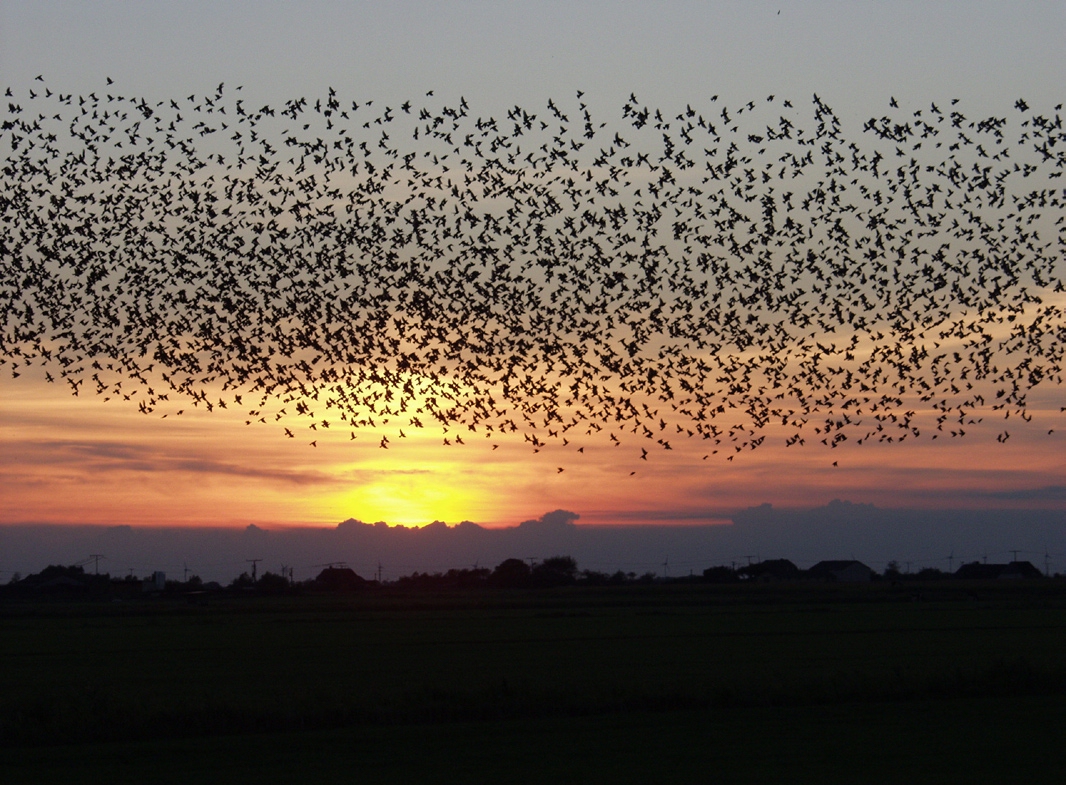
Classic examples include outbreaks of locusts that form massive traveling bands, dense schools of fish that turn as a unit to evade predators, and murmurations of birds that create shifting, cloud-like shapes. Swarms can be beneficial—improving foraging success or predator avoidance—or harmful, when pests damage crops or spread disease.
Researchers study swarms to understand ecological dynamics and to inspire engineered systems such as swarm robotics and distributed computing, where many simple agents achieve complex tasks through local interaction.
While many vertebrate groups form coordinated aggregations, terminology matters: mammals that travel in large coordinated groups are usually called herds, a distinction that reflects differences in social structure and movement patterns rather than a strict biological divide.
Related articles
Author
AlegsaOnline.com Swarm (collective animal grouping behavior) Leandro Alegsa
URL: https://en.alegsaonline.com/art/95434