
Swordfish (Xiphias gladius): biology, fisheries, and notable facts
Swordfish (Xiphias gladius) are large, open‑ocean predators known for their distinctive bill, importance to commercial and sport fisheries, and specialized adaptations for hunting and vision.
Overview
Swordfish (Xiphias gladius) are large, pelagic predatory fish found in temperate and tropical oceans worldwide. They are the sole living members of the family Xiphiidae and are widely recognized for their long, pointed rostrum or "sword." Swordfish are valued both as a sport fish and a commercial species for their firm, meaty flesh. Because of their size and wide-ranging habits they are often studied in fisheries biology and ocean ecology.
Image gallery
10 Images


Physical characteristics
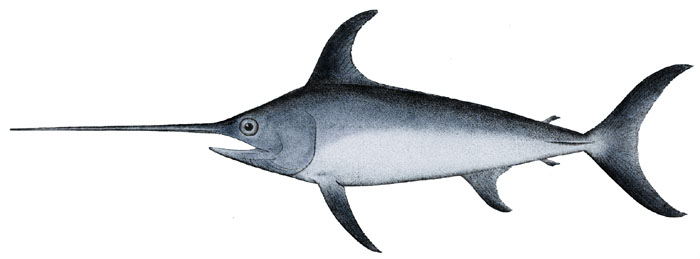
Swordfish have an elongated, rounded body that becomes more streamlined with age. Their most distinctive feature is the flattened bill, which can be used to slash or stun prey; see the description of the long, flat bill. Juveniles display a tall, sail-like dorsal fin that reduces as individuals mature. Adults lose most teeth and scales and develop thick, dense flesh suited for powerful swimming. A specialized heat-generating organ behind the eyes helps maintain eye and brain temperature, improving vision in deep, cold waters.
Behavior and ecology
Swordfish are opportunistic predators that feed on squid, fish, and other midwater animals. They often perform diel vertical migrations, remaining at depth during daylight and rising nearer the surface at night to feed. Their rostrum and speed are important hunting tools: scientists have documented slashing and disabling strikes, followed by capture. Swordfish range widely, crossing ocean basins in search of prey and suitable water temperatures.
Human use and cultural importance
- Sport and recreational fishing: swordfish are prized gamefish for their size and fighting ability; a historic angling record of 1,182 lb (535.15 kg) taken off Chile in 1953 remains notable (record).
- Commercial fisheries: harvested by longline, harpoon, and drift-net methods for steaks sold worldwide.
- Culinary and health notes: swordfish steaks are popular but can contain elevated mercury levels, so consumption guidelines apply for pregnant women and young children.
Conservation, management, and notable facts
Populations of swordfish are managed through international and regional fisheries measures to control catch, reduce bycatch, and conserve breeding stocks. Their migratory nature complicates management across jurisdictions. Etymologically, the scientific name combines Greek and Latin roots meaning "sword," reflecting the animal's most obvious characteristic. For general biological context and species details see sources on large pelagic marine fish.
Swordfish continue to be a focus of research into large-pelagic predator ecology, physiology of thermal adaptation, and sustainable fisheries practices. Their combination of distinctive anatomy, broad oceanic distribution, and economic importance makes them a prominent species in both science and seafood markets.
Questions and answers
Q: What is a swordfish?
A: A swordfish is a large fish with a long, flat bill.
Q: What are some characteristics of swordfish?
A: Swordfish are elongated, round-bodied, and lose all teeth and scales by adulthood.
Q: Why are swordfish popular among sport fishers?
A: Swordfish is a popular sport fish.
Q: What was the International Game Fish Association's all-tackle angling record for a swordfish, and where was it from?
A: The International Game Fish Association's all-tackle angling record for a swordfish was a 1,182 lb (535.15 kg) specimen taken off Chile in 1953.
Q: Do swordfish belong to a family of fish?
A: Yes, swordfish are the sole member of their family Xiphiidae.
Q: Are swordfish known for their teeth?
A: No, swordfish lose all their teeth by adulthood.
Q: Do swordfish have scales?
A: No, swordfish lose all their scales by adulthood.
Related articles
Author
AlegsaOnline.com Swordfish (Xiphias gladius): biology, fisheries, and notable facts Leandro Alegsa
URL: https://en.alegsaonline.com/art/95564
Sources
- iucnredlist.org : Xiphias gladius
- flmnh.ufl.edu : flmnh.ufl.edu
- elasmo-research.org : Haulin' Bass.
- epa.gov : epa.gov
- nature.com : Swordfish heat their eyes for better vision
- current-biology.com : Warm Eyes Provide Superior Vision in Swordfishes
- fda.gov : FDA Consumer:Mercury In Fish:Cause For Concern?