
Swift (bird): aerial specialist of the family Apodidae
Swifts (family Apodidae) are highly aerial insectivorous birds with long wings and tiny feet. They nest on vertical surfaces, include species that use saliva-built nests, and some spend months largely on the wing.
Swifts are a group of birds in the family Apodidae known for exceptional aerial ability and a lifestyle that is closely tied to flight. They belong to the order Apodiformes, which also contains treeswifts and hummingbirds. Most swifts are slim, with long, pointed wings and short tails that suit fast, agile flight and efficient gliding. Their feeding, migration and much of their resting behavior take place while airborne, and this strong association with the air sets them apart from superficially similar passerines such as swallows.
Image gallery
4 Images
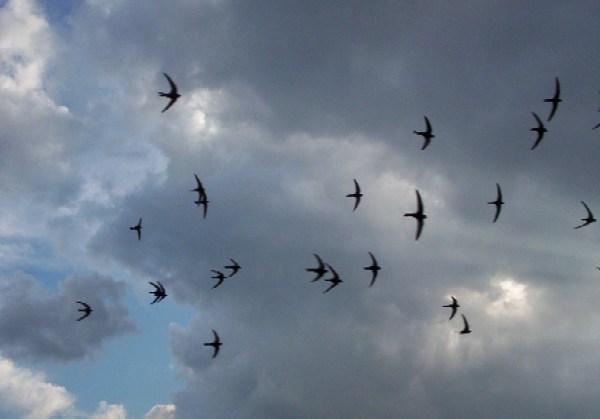


Appearance and flight adaptations
Swifts have a distinctive silhouette: long, narrow wings, a short bill and a wide gape to catch insects in flight. Their bodies are lightweight and their wing muscles and feather structure are adapted to rapid flapping and maneuvering. A notable trait is the small, weak feet; the genus name Apus derives from the Ancient Greek for "without feet," reflecting the reduced legs. These feet are well suited to clinging to vertical surfaces but poor for walking or perching on horizontal branches. In many species the toes are directed to aid clinging, and the legs are used mainly for holding position at nest sites or in crevices.
Behavior, diet and foraging
Swifts are aerial insectivores that capture a wide variety of flying prey, including flies, midges, beetles, winged ants and small spiders carried on the wind. They often feed in flocks, forming loose or dense aggregations that follow insect swarms or exploit favourable foraging areas. Many species spend long stretches of time aloft outside the breeding season, with individuals recorded remaining on the wing for extended periods; research into their sleep, navigation and energy use during these journeys has been an active field of study. Swifts are generally highly social, roosting and migrating in groups.
Nesting and reproduction
Most swifts nest on vertical cliffs, rock faces, inside caves, in crevices or on buildings, using sites that provide a secure vertical surface. They attach nests to walls, under eaves, inside chimneys or on exposed cliff ledges. Some species use plant material, feathers and saliva to build a cup-shaped nest; a few tropical swiftlets (often called edible-nest swiftlets) construct nests primarily of hardened saliva, a material that in some regions is harvested for culinary uses. Nest site choice and availability strongly influence local populations, and renovation or loss of older buildings can remove important nesting opportunities. Typical clutches are small, and both parents often participate in feeding chicks.
Migration, lifespan and movement
Many swift species are long-distance migrants. For example, several Palearctic species travel between temperate breeding areas and wintering grounds in sub-Saharan Africa or southern Asia, undertaking seasonal journeys that cover thousands of kilometres. Migration timing and routes vary by species, and swifts may travel in large moving flocks. Longevity records show that some individuals survive many years in the wild, though lifespan and survival rates depend on species, threats and environmental conditions.
Distinctions, ecological role and conservation
- Distinctions: Swifts differ from swallows by having proportionally shorter legs, a tendency to cling to vertical surfaces rather than perch on wires, and a body shape specialized for continuous flight.
- Ecological role: As aerial insect predators, swifts help reduce populations of flying insects and can act as indicators of insect abundance and ecosystem health.
- Human interactions: Some species adapt well to buildings and urban environments, whereas others depend on natural cliffs or traditional structures. Edible-nest swiftlets have cultural and economic value in some regions because of their saliva-built nests.
- Conservation concerns: Threats include loss of nesting sites through building renovation, decline in aerial insect prey linked to land-use change and pesticides, collisions with man-made structures, and disturbance at colonies. Conservation actions focus on protecting nest sites, maintaining suitable foraging habitats and monitoring populations.
- Typical sites: Common nest and roost sites include cliffs, caves, old buildings and other vertical surfaces such as rock faces and walls; many species rely on secure vertical attachment sites for nests (cliffs and walls are typical).
Swifts continue to attract interest because of their extraordinary flight capabilities, unusual leg morphology and varied relationships with human environments. Ongoing study of their migration, physiology and response to environmental change improves understanding of aerial ecology and helps inform conservation measures for these remarkable birds.
Questions and answers
Q: What is a swift?
A: A swift is a bird in the family Apodidae.
Q: What is the order of swifts?
A: The swift is in the order Apodiformes with treeswifts and hummingbirds.
Q: What is special about the way swifts fly?
A: Swifts are very good at flying and spend all of their time in the air.
Q: Where does the name "apus" come from?
A: The scientific name for the swift (apus) comes from the Ancient Greek word απους, apous which means "without feet".
Q: Why are swifts' feet so small and weak?
A: Swifts have very small, weak feet because they primarily use them to hold on to vertical places, not for walking on the ground.
Q: Can swifts fly up if they land on the ground?
A: Yes, although it is often thought that if they land on the ground, they cannot fly up again, but that is not true. They can take off but with difficulty.
Q: What type of places do swifts use their feet to hold on to?
A: Swifts use their feet to hold on to vertical places such as the wall of a house or a cliff.
Related articles
Author
AlegsaOnline.com Swift (bird): aerial specialist of the family Apodidae Leandro Alegsa
URL: https://en.alegsaonline.com/art/95517