
Salamandridae — true salamanders and newts
Salamandridae is a family of amphibians that includes true salamanders and newts. This article summarizes their appearance, life cycles, distribution, notable genera, ecological roles, and conservation issues.
Overview
The Salamandridae are a family of amphibians that includes both what are commonly called true salamanders and the newts recognized by their often aquatic life stages. Members of this family belong to the order Caudata (also called Urodela) and are distributed across much of the temperate Northern Hemisphere. For a concise taxonomic summary see family summary.
Image gallery
10 Images


Characteristics and life cycle
Salamandrids typically have moist, permeable skin, a tail retained throughout life, and four limbs of roughly equal size. Many species show bright aposematic coloration and secrete toxins from skin glands as a defense. Reproduction generally involves internal fertilization by spermatophore transfer rather than external spawning. Larvae are aquatic with gills; some species undergo metamorphosis to a terrestrial adult form, while others remain paedomorphic and retain larval traits. For identification keys and life history details see life history.
Distribution and diversity
Salamandridae occur across Europe, Asia, the northern edge of Africa and North America. Historically the number of described species and genera has changed with taxonomic revisions; older accounts reported about 74 species in 20 genera, while modern treatments vary as new molecular studies refine relationships. Regional checklists and genus lists are available through resources such as taxonomic listings and regional faunas.
Notable genera and examples
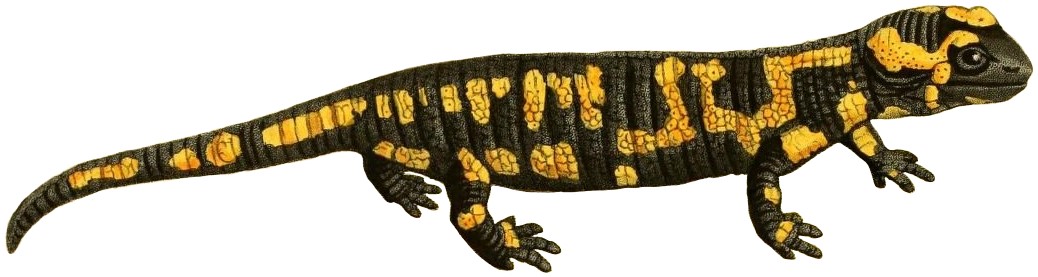
- Salamandra — includes the fire salamander known for its black-and-yellow pattern.
- Triturus and related genera — crested newts with conspicuous breeding crests in males.
- Cynops and Notophthalmus — small, often brightly colored newts from Asia and North America.
For genus-level information and species accounts see genera overview and species accounts.
Ecology, research and conservation
Salamandrids occupy both aquatic and terrestrial habitats and often serve as indicators of wetland health. Some species produce powerful neurotoxins (for example in the genus Taricha), a subject of ecological and evolutionary study including predator–prey dynamics. Salamandrid populations face threats from habitat loss, pollution, invasive species and emerging diseases. Notably, chytrid fungi and other pathogens have caused declines; conservation guidance and monitoring programs are discussed at conservation resources and disease monitoring.
History and notable facts
Fossil and molecular data place Salamandridae well within caudate evolution, with diversification through the Cenozoic linked to changing climates and land connections. Their varied life histories and regenerative abilities have made them important models in developmental biology and toxicology. For further reading and scholarly references consult evolutionary reviews, research summaries, and public reference pages at educational portals.
Related articles
Author
AlegsaOnline.com Salamandridae — true salamanders and newts Leandro Alegsa
URL: https://en.alegsaonline.com/art/86399