
Salp — a barrel-shaped, free-swimming tunicate of the open ocean
Salps are gelatinous, barrel-shaped tunicates that swim by jet propulsion, filter microscopic plankton, form large blooms (notably in the Southern Ocean), and influence ocean carbon cycling.
Salps are gelatinous, barrel-shaped marine animals belonging to the pelagic tunicates (class Thaliacea). Their simple, transparent bodies and drifting lifestyle often lead to comparisons with jellyfish, but salps are chordates and thus more closely related to vertebrates. They occur singly or in long, slipping chains and are common in open-ocean waters worldwide. Salps use rhythmic contractions of their muscular body walls to pump water through their bodies, producing thrust and drawing food through internal filters in a single integrated flow.
Image gallery
10 Images


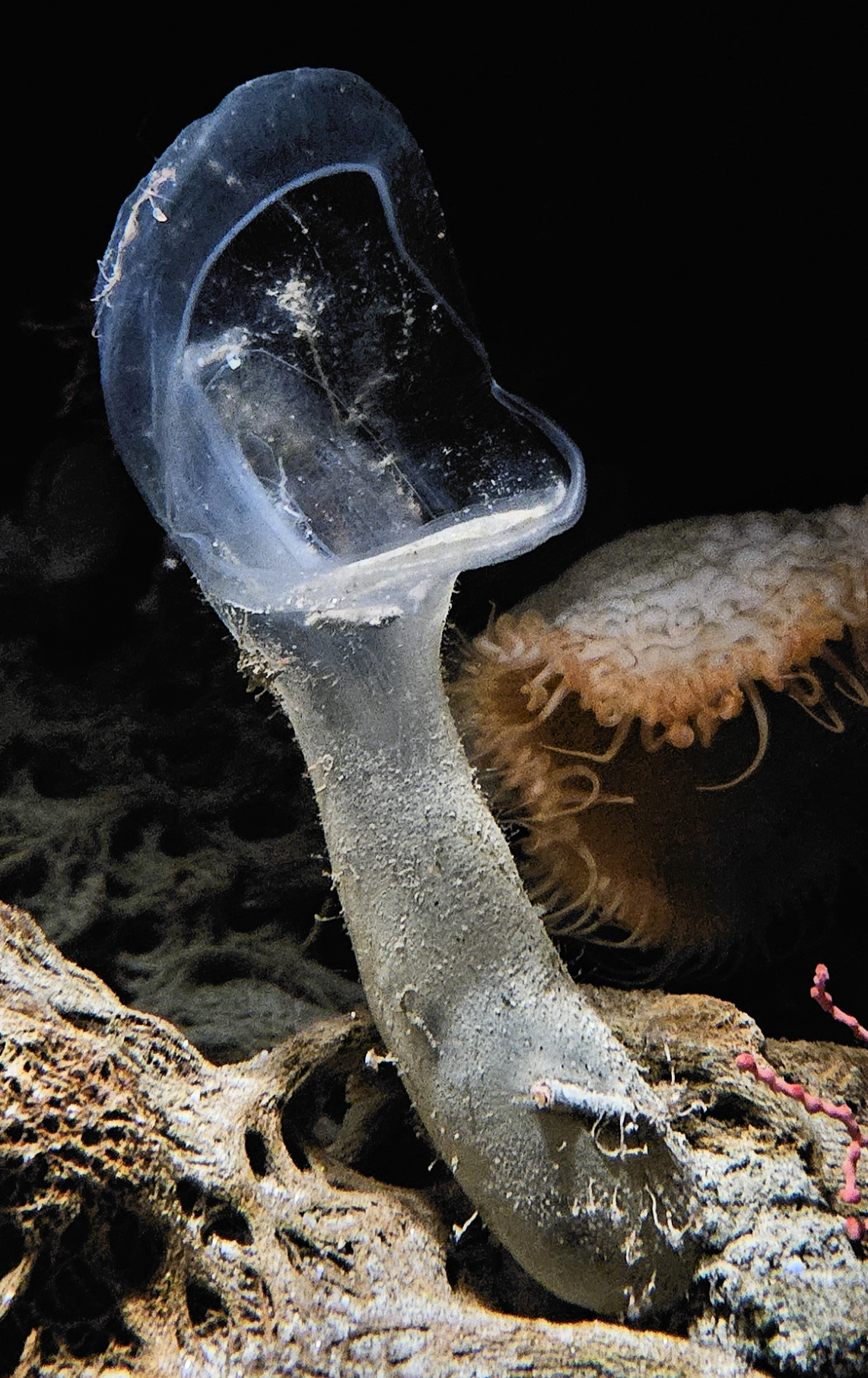
Description and distinguishing features
Typical salp anatomy is compact and efficient: a cylindrical, gelatinous tunic surrounds a body with an oral siphon at the front and an atrial siphon toward the rear. Inside, a pharyngeal basket or mucous net traps microscopic food particles. Bands of muscle encircling the body contract to expel water through the atrial opening. The expelled water provides propulsion while fresh water carrying suspended plankton and detritus is drawn through the feeding apparatus. Despite their simple appearance, salps possess features that identify them as members of the tunicates and thus as part of the broader chordate group.
- Shape: translucent, barrel-like or cylindrical, often with clear internal structures visible.
- Feeding: filter feeding using a mucous net or pharyngeal basket to capture phytoplankton and small particles.
- Locomotion: efficient jet propulsion produced by rhythmic body contractions.
- Social form: solitary oozooids or clonal chains (blastozooids) that can reach considerable lengths.
Feeding, locomotion and physiology
The water flow generated by a salp serves two purposes at once: it powers locomotion and carries food through the internal filtering structures. Cilia and mucus transport trapped particles to the digestive tract. Salps can feed on a wide range of particle sizes, from tiny phytoplankton cells to small suspended detritus. Their locomotion is noteworthy in biomechanics because the jet system is energetically efficient at the small scales where salps operate, making them a subject of study for biological and engineering research.
Reproduction and life cycle
Salps exhibit an alternation of generations: a solitary asexually reproducing form (the oozooid) produces a chain of genetically identical blastozooids. These chains may break apart, and individual blastozooids mature and reproduce sexually, releasing gametes into the water. This alternating pattern and the potential for rapid clonal growth allow salp populations to increase quickly when conditions — especially phytoplankton availability — are favorable.
Distribution, blooms and ecological role
Salps occur in all oceans and are often most conspicuous in nutrient-rich, cooler waters. Large aggregations and blooms are especially notable in the Southern Ocean around Antarctica, where they can in some years rival or exceed local populations of krill. Because salps graze on microscopic algae and produce dense, rapidly sinking fecal pellets and discarded mucous feeding nets, they can export significant amounts of carbon and organic matter from surface waters to the deep sea. This makes them important contributors to the oceanic biological carbon pump and to vertical fluxes of marine snow.
Predators, interactions and human interest
Salps are preyed upon by a variety of animals, including fish, sea turtles and some seabirds. Their blooms can affect food-web dynamics by competing with other plankton grazers for food or by providing alternative food sources. Scientists study salps for their unusual life cycle, their efficient jet propulsion, and their role in carbon cycling and ecosystem responses to climate variability. Observations of salp populations can provide indicators of changing ocean conditions and shifting distributions of plankton communities.
Taxonomy, evolution and chordate relationships
As tunicates, salps are part of a lineage that shares key developmental features with other chordates. Tunicates are important in evolutionary studies because molecular and developmental evidence places them as close relatives of vertebrates (vertebrates), despite their simple adult morphology. Salps and other thaliaceans differ from benthic tunicates in being fully pelagic and often exhibiting complex reproductive strategies that combine asexual cloning and sexual reproduction.
Observation, sampling and research methods
Researchers study salps using net tows, visual surveys, and imaging systems deployed from ships or autonomous vehicles. Laboratory experiments examine feeding rates, reproductive timing, and swimming mechanics, while oceanographic studies link bloom events to nutrient availability, water temperature, and phytoplankton composition. For background reading on related groups and anatomy, entries on tunicates, basic dorsal structure and the nerve cord provide useful context for understanding salp biology and their place in animal evolution.
Overall, salps are a striking example of how a simple body plan and an integrated feeding–locomotion system can produce both ecological success and scientific interest across disciplines ranging from taxonomy and ecology to biomechanics and biogeochemistry.
Questions and answers
Q: What is a salp?
A: A salp is a planktic tunicate that is barrel-shaped.
Q: How does a salp move?
A: A salp moves by contracting its body, which pumps water through its gelatinous body.
Q: What is the feeding process of a salp?
A: A salp pumps water through its internal feeding filters and feeds on phytoplankton.
Q: Where are salps commonly found?
A: Salps are common in all seas, but there are more in the Southern Ocean (near Antarctica), where they may form enormous swarms, often in deep water.
Q: How do salps compare to krill in terms of abundance?
A: Salps are sometimes even more abundant than krill in the Southern Ocean.
Q: Do salps resemble jellyfish?
A: Yes, salps look similar to jellyfish due to their simple body form and behaviour.
Q: What is the difference between salps and jellyfish?
A: In fact, salps are chordates and have a dorsal nerve cord, which means they are related to vertebrates, animals with backbones.
Related articles
Author
AlegsaOnline.com Salp — a barrel-shaped, free-swimming tunicate of the open ocean Leandro Alegsa
URL: https://en.alegsaonline.com/art/86535
Sources
- doi.org : 10.1111/j.1469-7998.1983.tb05071.x
- dailymail.co.uk : "Now that's a jelly fish!"
- divediscover.whoi.edu : "Dive and Discover: Scientific Expedition 10: Antarctica"