
Salamandroidea (advanced salamanders): overview and significance
Salamandroidea is the suborder of 'advanced' salamanders, united by internal fertilization, diverse life histories, and a near-global distribution. This entry summarizes their traits, families, fossils, ecology, and conservation.
Salamandroidea is a major suborder of salamanders commonly called the "advanced" salamanders. Members share derived anatomical and reproductive features that distinguish them from more basal groups. They occur across most of the world, with native populations absent from Antarctica, large parts of the southern Sahara and most of Oceania. Diversity is highest in temperate forests and in moist landscapes where their permeable skin and varied respiratory strategies are supported.
Image gallery
5 Images


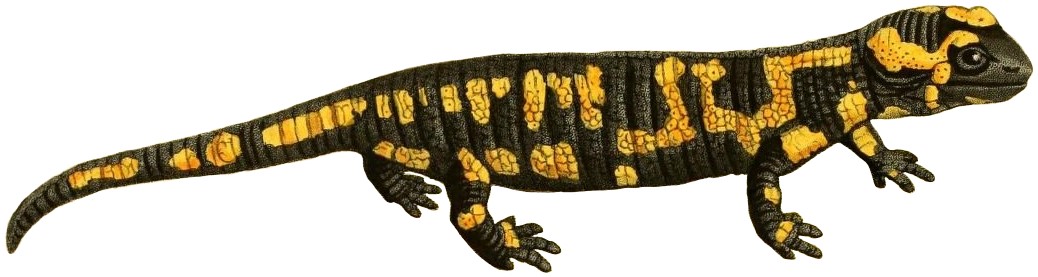

Key characteristics
Salamandroids show wide variation in form and life history, but several traits are typical. Most have four well-developed limbs and a tail, a skeletal architecture reflecting more derived vertebrae and skull features, and reproductive anatomies adapted for internal fertilization. Some families include lungless species that respire through the skin and mouth lining, while others retain juvenile traits into adulthood (paedomorphosis).
Reproduction and development
Internal fertilization distinguishes the group: males commonly deposit a spermatophore, a packet of sperm, which a receptive female picks up with her cloaca. Sperm can be stored in specialized cloacal structures until eggs are laid. This reproductive mode permits a range of breeding strategies, from aquatic larvae to direct development within terrestrial eggs, and has allowed salamandroids to colonize diverse habitats.
Families and representative groups
- Plethodontidae — lungless salamanders, the largest family, mostly terrestrial and abundant in the Americas.
- Salamandridae — newts and true salamanders, many with complex life cycles including aquatic adult stages.
- Ambystomatidae — mole salamanders; includes model organisms such as the axolotl (Ambystoma mexicanum).
- Proteidae — aquatic, often paedomorphic species with external gills, such as mudpuppies and the olm in some classifications.
- Amphiumidae, Dicamptodontidae, Rhyacotritonidae — smaller families with regional importance and specialized habits.
Distribution, habitat and ecology
Salamandroids occupy a wide range of habitats including streams, lakes, caves, wetlands and moist terrestrial environments. Many are nocturnal predators feeding on invertebrates and small vertebrates and act as both predators and prey within food webs. Because of their permeable skin and dependence on moist microhabitats, they are sensitive to habitat alteration, pollution and hydrological changes.
Fossil record and evolution
Fossils attributed to salamandroid lineages date back to the Jurassic, indicating an ancient diversification. Early fossils from formations such as the Tiaojishan beds show that derived salamander features were present by the Late Jurassic, providing a deep timeframe for the evolution of their distinctive anatomy and life histories.
Conservation and human relevance
Many salamandroid species face threats from habitat loss, introduced species, pollution and emerging diseases such as chytridiomycosis. Several species serve as important subjects in developmental biology and regenerative medicine because of their tissue-regeneration abilities. They are also used as bioindicators to monitor ecosystem health because their skin and life cycles integrate aquatic and terrestrial conditions.
For taxonomic summaries and introductory overviews see taxonomic overview. Regional field guides and distribution data are available at regional resources. Fossil and paleontological information can be consulted via paleontology pages. Conservation status and action plans are summarized on conservation portals. Reproductive biology and spermatophore studies are discussed in specialist reviews at reproduction studies. Comparative anatomy and specimen databases are listed at anatomy collections. For recent syntheses and scholarly reviews see scholarly reviews.
Questions and answers
Q: What is Salamandroidea?
A: Salamandroidea is a suborder of salamanders known as the advanced salamanders.
Q: Where are the members of Salamandroidea found?
A: The members of Salamandroidea are found worldwide except for Antarctica, Southern Sahara, and Oceania.
Q: How do all members of Salamandroidea reproduce?
A: All members of Salamandroidea use internal fertilization.
Q: How does fertilization occur in female salamanders?
A: The female is fertilized by a spermatophore, which is a sperm-containing cap put by the male in her cloaca.
Q: Where is the sperm stored in female salamanders after fertilization?
A: The sperm is stored on the roof of the cloaca until it is needed at the time of egg laying in female salamanders.
Q: What is the age of the earliest known Salamandroidea fossils?
A: The earliest known Salamandroidea fossils are from the Tiaojishan Formation and are dated to the late Jurassic period about 157 million years ago.
Q: What is the origin of Salamandroidea?
A: The origin of Salamandroidea is believed to date back to the late Jurassic period about 157 million years ago, which is when the earliest known fossils were found.
Related articles
Author
AlegsaOnline.com Salamandroidea (advanced salamanders): overview and significance Leandro Alegsa
URL: https://en.alegsaonline.com/art/86400
Sources
- livingunderworld.org : "Caudate families (newts & salamanders)" · web.archive.org
- doi.org : 10.2307/3226814
- jstor.org : 3226814
- dx.doi.org : 10.1073/pnas.1009828109
- pnas.org : pnas.org/content/early/2012/03/07/1009828109.full.pdf html?sid=6985d282-7203-4add-aa17-1a…