
Powys Castle — medieval fortress, country house and terraced gardens near Welshpool
Powys Castle is a fortified medieval residence and stately home in Mid Wales, noted for its red sandstone siting, extensive terraced gardens and long association with private families and the National Trust.
Overview
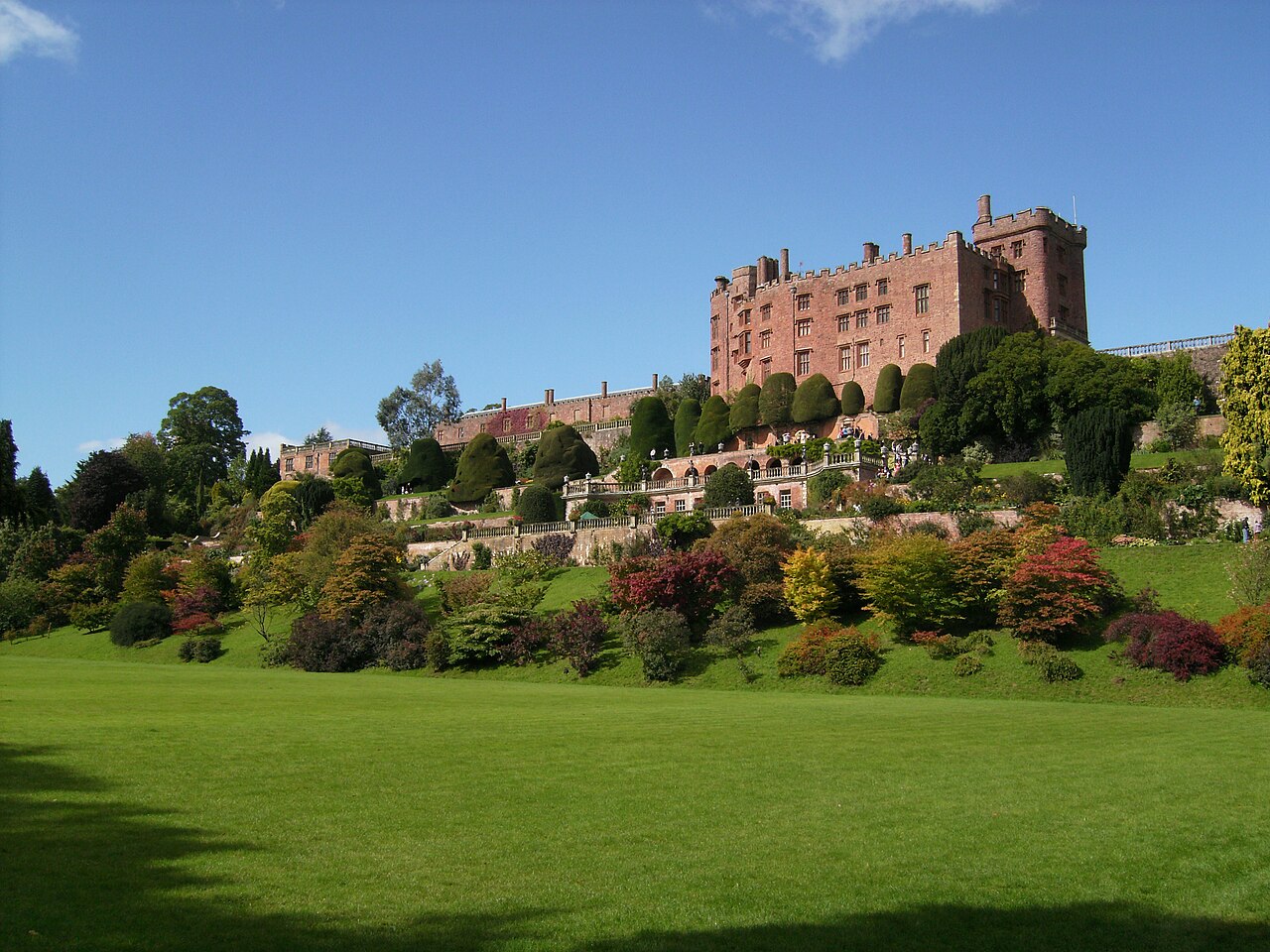
Powys Castle sits above the Severn valley near the town of Welshpool in the county of Powys. It combines features of a defensive stronghold and a grand country house: massive curtain walls and towers stand alongside reworked living apartments and showrooms from later centuries. The site is famed for its dramatic position on a red sandstone outcrop and for gardens laid out on steep terraces.
Image gallery
10 Images


Setting and construction
The castle is constructed predominantly of local sandstone, formed from the regional New Red Sandstone. That rock unit was deposited during the late Permian and early Triassic periods, and gives the building its warm, rust-coloured appearance. Perched on a rocky promontory, the complex blends an armored medieval plan with later domestic additions, creating a layered architectural character.
Architectural character and interiors
Externally, Powys Castle reads as a fortress with battlements, towers and an inner courtyard. Internally the rooms were adapted over centuries to serve as a family home: there are reception rooms, bedchambers and service areas that reflect changes in taste and wealth. The interiors house a varied assemblage of furniture, textiles and ceramics accumulated by successive occupants, offering insights into the domestic life of a country household rather than a purely military fortification.
Gardens, terraces and landscape
The castle is best known for its formal gardens that descend in terraces from the building into parkland. High clipped hedges, formal parterres, topiary and broad viewing platforms create theatrical perspectives framed by the castle massing. A walled garden and surrounding deer park are part of the wider designed landscape, while carefully managed lawns and specimen trees provide year-round interest.
History and stewardship
Powys Castle originated in the medieval period as a defensive seat in the Welsh Marches and was modified repeatedly as fortunes and fashions changed. Over time its military role receded and the house evolved into a stately residence. The property is now conserved and opened to the public by the National Trust, which interprets both the historic house and its gardens for visitors. Notable past visitors are recorded, including a royal visit by Queen Victoria, when such country houses were prominent nodes of social and political life.
Visiting, collections and significance
Today the castle is presented as a place of layered history, with displays that aim to balance architectural interest, domestic interiors and the horticultural achievement of its terraces. Collections often include tapestries, painted portraits, decorative arts and examples of high-status household furnishings. Practical visitor information, conservation work and special events are managed by the Trust; for further background or research into the site consult local archives and guide material linked to the estate.
Notable facts and further reading
- The site is frequently cited as a prominent example of how medieval fortifications were adapted into comfortable residences.
- Its reddish stonework and setting make it a landmark in the Mid Wales landscape; geology and local building materials are integral to its appearance—see resources on geology.
- Terminology related to the castle appears in Welsh-language records and local place-name studies; see mentions of the castle's Welsh identity and traditional names (Welsh name).
- Descriptions of Powys Castle as a medieval castle and as a fortress reflect its dual character as defence and domicile.
For more detailed accounts of local history, landscape development and conservation practice consult regional histories and National Trust publications. The castle and garden together illustrate how architecture, geology and horticulture can combine to produce a site of enduring cultural interest.
Related articles
Author
AlegsaOnline.com Powys Castle — medieval fortress, country house and terraced gardens near Welshpool Leandro Alegsa
URL: https://en.alegsaonline.com/art/78566