
Price Tower: Frank Lloyd Wright’s Vertical Landmark in Bartlesville
A comprehensive overview of the Price Tower in Bartlesville, Oklahoma, its design by Frank Lloyd Wright, history, architectural features, uses and significance as a rare Wright skyscraper.
The Price Tower is a nineteen-story, 221-foot-high building in Bartlesville, Oklahoma designed by American architect Frank Lloyd Wright. Completed and opened in 1956, it stands out among Wright’s work as one of his only vertical, high-rise compositions. Commissioned by Harold C. Price of the H. C. Price Company, the tower was conceived as a mixed-use structure combining commercial, residential and corporate functions in a single, compact form.
Image gallery
10 Images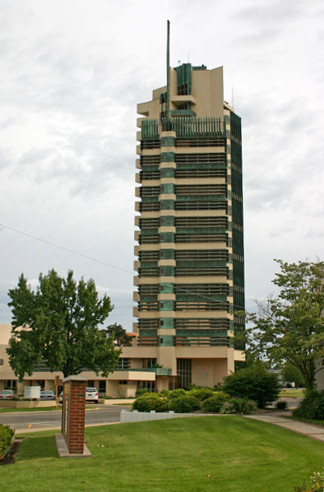


Design and architectural characteristics
Wright developed the Price Tower from a hexagonal planning system that produces distinctive angular rooms and long, narrow windows. The tower’s form emphasizes a vertical “trunk” with cantilevered floor slabs, giving it a sculptural, tree-like silhouette. Materials and details are arranged to reinforce geometric order: modular bays, triangular and hexagonal motifs, and a repeating pattern of facade elements. Interior spaces reflect Wright’s attention to integrated furnishings and built-in features designed to suit the tower’s unusual floor plates.
History and development
Commissioned in the early 1950s, the Price Tower was finished and opened to the public in February 1956. It was intended to house the offices and operations of a regional industrial firm and to provide rental apartments and retail space. Wright regarded the project as an opportunity to translate his organic architectural ideas into a vertical form; observers often note that the Price Tower is one of only two true vertical buildings by Wright, the other being the Research Tower at the Johnson Wax complex.
Uses, adaptations and public access
Over time the tower has been adapted for a range of uses while preserving significant original design elements. It has housed offices, residences, galleries and hospitality functions, and today parts of the building operate as a cultural and visitor facility that interprets Wright’s work and the site’s history. Adaptation has required careful conservation of distinctive interiors alongside contemporary upgrades for safety, accessibility and modern amenities.
Significance and notable facts
- It is widely regarded as Frank Lloyd Wright’s most prominent high-rise and a rare example of his vertical architecture.
- The building’s hexagonal planning system and sculptural profile make it an important example of Wright’s late-career experimentation.
- Its mixed-use program anticipated later ideas about combining living, working and cultural activities within a single tower.
The Price Tower remains a regional landmark and a point of study for architects and historians interested in how modernist ideas were adapted to local contexts and mixed-use programs. Visitors interested in Wright’s legacy can learn about the tower’s conception, materials and preservation through on-site exhibits and guided tours.
Related articles
Author
AlegsaOnline.com Price Tower: Frank Lloyd Wright’s Vertical Landmark in Bartlesville Leandro Alegsa
URL: https://en.alegsaonline.com/art/78995