
Phase change (changes of state of matter)
Transformation of matter between solid, liquid and gas driven by energy, temperature or pressure; includes melting, freezing, vaporization, condensation, sublimation and practical applications.
Overview
A phase change is the transformation of a substance between different states of matter. The best known transitions occur among solids, liquids and gases. Common names for these processes include melting (solid→liquid), evaporation or boiling (liquid→gas), condensation (gas→liquid), sublimation (solid→gas) and deposition (gas→solid). Phase changes are typically driven by the addition or removal of energy and are sensitive to both temperature and pressure.
Image gallery
3 Images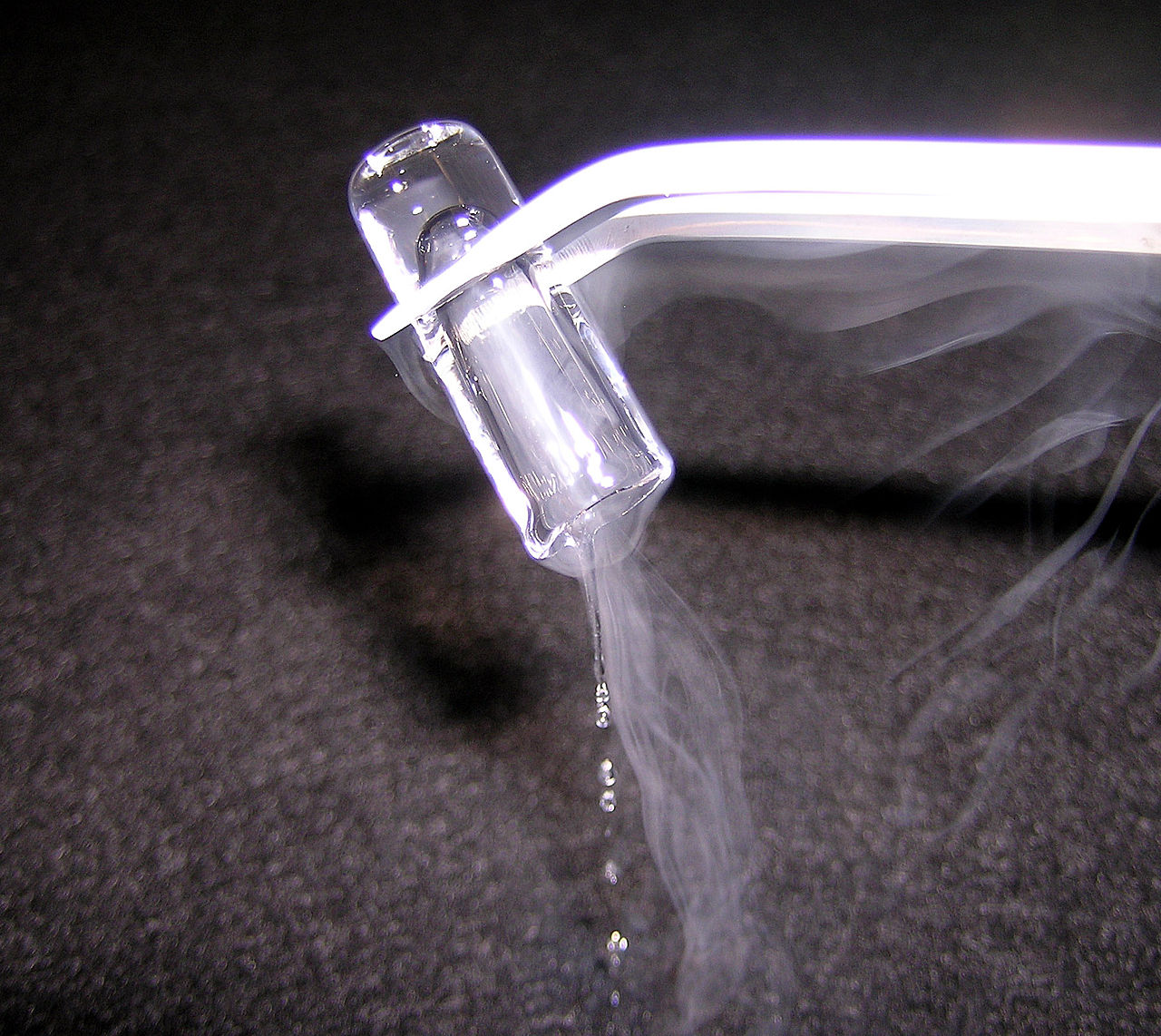


Characteristics and mechanisms
At the microscopic level a phase change reflects changes in how particles are arranged and how strongly they interact. In solids particles occupy fixed positions and are held by intermolecular bonds or crystal lattice forces; in liquids these interactions are weaker and permit flow; in gases particle interactions are rare and motion is largely independent. For example, water forms a solid ice lattice stabilized by hydrogen bonds, melts when enough thermal energy breaks some of those bonds, and becomes water vapor when energy is sufficient to overcome liquid cohesion.
Thermodynamics and phase diagrams
Phase changes involve energy transfer without necessarily changing temperature while the transition occurs; this energy per unit mass is called latent heat. The phase behaviour of a pure substance is summarized by a phase diagram, which maps regions of solid, liquid and gas as functions of temperature and pressure. Special points include the triple point (where three phases coexist) and the critical point (above which liquid and gas phases become indistinguishable).
Types and examples
- Melting/freezing: ice turning to water and back as heat is added or removed (melting).
- Evaporation/boiling and condensation: water evaporating from a pond or boiling in a kettle and then condensing on a cooler surface (evaporation, boiling, condensation).
- Sublimation and deposition: dry ice (solid CO2) subliming directly to gas is a practical example of sublimation.
Applications and natural importance
Phase changes are central to many natural cycles and technologies. The water cycle depends on evaporation and condensation; refrigeration and heat pumps exploit the latent heat of vaporization; metallurgy uses controlled melting and solidification to shape and strengthen metals; freeze-drying removes moisture by sublimation to preserve food and pharmaceuticals.
Notable phenomena and distinctions
Real systems can show effects such as supercooling (a liquid remaining liquid below its normal freezing point), superheating, nucleation-dependent transitions, metastable phases, and multiple solid forms (polymorphism). Beyond classical solid–liquid–gas transitions, matter can access other states (for example plasmas or Bose–Einstein condensates) under extreme conditions, but these are outside everyday phase-change behaviour.
For introductory diagrams and experimental data see broader resources on states of matter and phase behaviour; for practical examples including water processes and industry practices consult specialized texts or databases linked from educational portals (solid, liquid, gas, melting, sublimation, condensation, evaporation, boiling, temperature, pressure, intermolecular bonds, hydrogen bonds, water vapor).
Related articles
Author
AlegsaOnline.com Phase change (changes of state of matter) Leandro Alegsa
URL: https://en.alegsaonline.com/art/76350