
Pallas's Fish Eagle (Haliaeetus leucoryphus)
Large brownish sea-eagle of the east Palearctic and South Asia. Inhabits inland waters from Central Asia to India and Bangladesh; endangered due to habitat loss, declining fish stocks and human pressures.
Overview
Pallas's fish eagle (Haliaeetus leucoryphus) is a large, brownish sea-eagle known for its association with inland lakes, rivers and reservoirs rather than coastal waters. It is sometimes called Pallas's sea eagle or the band-tailed fish eagle. Although a true member of the sea-eagle group, its modern range is largely land-locked and concentrated across the east Palearctic and adjoining South Asian regions. Sea eagles are a distinct lineage of large raptors that specialize in capturing fish and other aquatic prey.
Image gallery
4 Images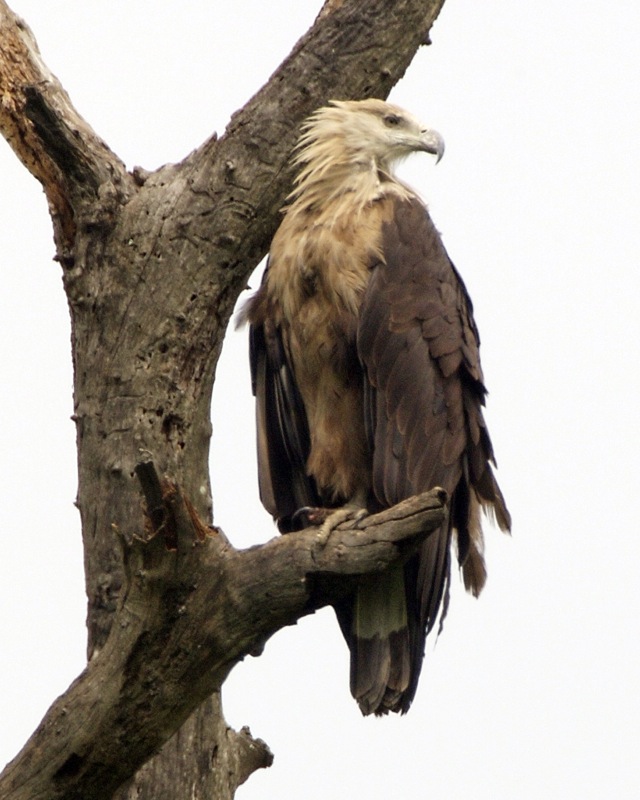


Identification and ecology
This species is characterized by a robust body, generally dark brown plumage with paler tones on the head and neck, and a relatively long, banded tail that gives rise to the alternative name "band-tailed". Juveniles and adults show differences in tone and tail patterning as they mature. Pallas's fish eagle feeds mainly on fish but will take other aquatic and terrestrial prey when available. It breeds in trees or on cliffs near open water and is known to nest near wetlands that provide reliable food supplies. In parts of its range the species is a seasonal migrant or nomadic, moving in response to water and food availability.
Distribution and habitat
The breeding and regular range of Pallas's fish eagle stretches from Central Asia into parts of East and South Asia. It occurs in the east Palearctic region (east Palearctic) and is recorded in several countries across a broad arc:
Within these countries it favors freshwater habitats with ample open water for fishing and adjacent perches and nesting sites. The species has been observed on large inland reservoirs, slow-flowing rivers and wetlands where fish populations support adult and juvenile survival.
Origins and palaeogeography
Biogeographic evidence suggests that Pallas's fish eagle's present inland distribution is a result of historical changes in geography and climate. The species is believed to be descended from coastal or near-coastal sea-eagles that occupied shoreline and shallow sea habitats when the configuration of land and sea in South and Southeast Asia differed from today. Geological events, including the collision and movement of the Indian Plate relative to Eurasia, altered coastlines and created new inland basins; this helped establish more continental distributions for some sea-eagle lineages. These ideas link the species' ancestry to coastal areas such as the northwestern Bay of Bengal when that region formed a shallow maritime connection between landmasses (Indian Plate collision, northwestern Bay of Bengal).
Conservation status and threats
Pallas's fish eagle is assessed as endangered by conservation authorities, reflecting small and declining populations across much of its range. The species is listed as endangered on the IUCN Red List. Major threats include loss and degradation of wetland habitat through drainage and reclamation, reductions in prey availability due to overfishing and pollution, disturbance at nesting sites, and direct persecution in some areas. Collision with power lines and accidental poisoning are additional concerns where birds forage near human activity.
Conservation measures and significance
Conservation responses emphasize protection and restoration of wetlands, management of fisheries to sustain prey populations, legal protection of nesting sites, and community engagement to reduce persecution. Monitoring and research on population size, movements and breeding success help guide action. The status of Pallas's fish eagle also serves as an indicator of wetland health in parts of Central and South Asia, making its conservation important for wider freshwater biodiversity and ecosystem services.
Key distinctions and notes
- Pallas's fish eagle is unusual among sea-eagles for its largely inland, continental range despite belonging to a group often associated with coasts.
- It is sometimes confused with other large eagles by non-specialists; careful attention to tail pattern and overall proportions helps identification.
- Because it occupies remote wetlands in several countries, international cooperation is important to conserve viable populations across its range.
Related articles
Author
AlegsaOnline.com Pallas's Fish Eagle (Haliaeetus leucoryphus) Leandro Alegsa
URL: https://en.alegsaonline.com/art/74199
Sources
- iucnredlist.org : "Haliaeetus leucoryphus"