
Tajikistan — Central Asian republic of mountains, languages, and rivers
Tajikistan is a mountainous republic in Central Asia with a Persian-speaking majority, a Soviet past, rich highland landscapes, hydropower potential and a distinct cultural heritage centered on Dushanbe.
Overview: Tajikistan is a landlocked country in Central Asia. It occupies a largely mountainous territory and is known for the high Pamir ranges and deep river valleys. The state is a presidential republic; its modern borders and institutions were shaped during the 20th century and after the collapse of the Soviet Union. For a regional introduction see Central Asia.
Image gallery
10 Images

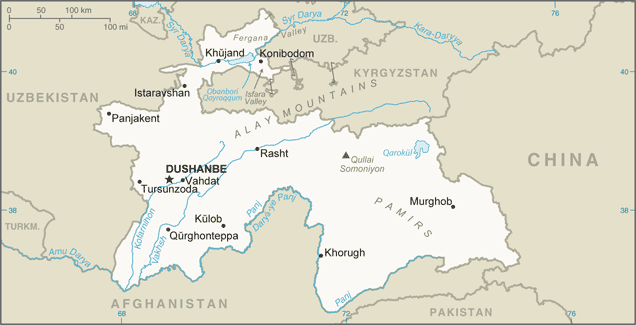


Geography and natural features
Tajikistan's landscape is dominated by high mountains with only a small share of lowland plains. The Pamir and Alay ranges produce dramatic elevation changes, glacial streams and seasonal river flows that feed larger Central Asian waterways. The country borders Afghanistan to the south, China to the east and the Central Asian states of Kyrgyzstan and Uzbekistan to the north and west.
- Topography: Mostly mountainous, with extensive high plateaus and peaks.
- Climate: Continental and alpine; cold winters and hot summers in lower valleys.
- Water and energy: Significant hydropower potential from mountain rivers.
History and political development
The area now called Tajikistan has a long history connected to ancient Persian-speaking cultures, Silk Road trade routes and medieval states. It became part of the Russian Empire and later the Soviet Union, an affiliation that shaped its 20th-century economy and infrastructure. After independence in 1991, Tajikistan experienced political instability and a civil conflict in the 1990s; the nation has since rebuilt its institutions. For context on the Soviet period see the Soviet Union.
Language, culture and society
The official language is Tajik, a variety of Persian closely related to Dari and Iranian Persian; Russian remains important for interethnic communication and government. Cultural life blends Persian literary traditions, Central Asian music and seasonal festivals such as Nowruz. The capital and largest city is Dushanbe, the political and cultural center where universities, museums and national institutions are concentrated.
Economy and contemporary issues
Tajikistan's economy relies on agriculture (notably cotton and fruit), mining, aluminium processing and large remittances from citizens working abroad. The country emphasizes hydropower as a strategic resource and export potential. Key challenges include limited arable land, environmental pressures, and the need for economic diversification.
Politically, Tajikistan is organized as a republic with a strong presidency; more on its governmental form is available via republic references. It participates in regional organizations and cooperative frameworks, including membership of the Commonwealth of Independent States (CIS) to maintain ties with neighbors and former Soviet partners.
Notable distinctions: Tajikistan's combination of Persian cultural roots and high mountain geography sets it apart from many of its Turkic-speaking neighbors. The country's river systems and elevation create both opportunities for hydropower development and challenges for transport and agricultural modernization. Further reading and regional resources: languages and culture, geography overview, Dushanbe guide.
Questions and answers
Q: What is Tajikistan?
A: Tajikistan is a country located in Central Asia.
Q: Was Tajikistan a part of any other country before?
A: Yes, Tajikistan used to be a part of the Soviet Union.
Q: What type of government does Tajikistan have?
A: Tajikistan is a republic.
Q: Which city is the capital of Tajikistan?
A: The capital city of Tajikistan is Dushanbe.
Q: What is the official language of Tajikistan?
A: The official language of Tajikistan is Tajik, which is a dialect of Farsi (Persian).
Q: What international organization is Tajikistan a member of?
A: Tajikistan is a member of the Commonwealth of Independent States, the CIS.
Q: What is the size ranking of Tajikistan among CIS countries?
A: Tajikistan is the eighth largest country among the CIS countries.
Related articles
Author
AlegsaOnline.com Tajikistan — Central Asian republic of mountains, languages, and rivers Leandro Alegsa
URL: https://en.alegsaonline.com/art/95965
Sources
- thoughtco.com : The Names of Nationalities · web.archive.org
- worldometers.info : worldometers.info/world-population/tajikistan-population/
- worldometers.info : worldometers.info/world-population/population-by-country/
- imf.org : "World Economic Outlook Database, October 2018"
- databank.worldbank.org : "GINI index (World Bank estimate)"
- hdr.undp.org : "2018 Human Development Report"
- earthobservatory.nasa.gov : "Kara-Kul Structure, Tajikistan"
- passc.net : Earth Impact Database
- wikidata.org : wikidata.org/wiki/Q863
- catalogo.bne.es : XX453273
- catalogue.bnf.fr : cb170790838
- data.bnf.fr : (data)
- ci.nii.ac.jp : DA13697137
- d-nb.info : 4058877-4