
Orbital revolution: motion of planets, moons and satellites
Orbital revolution describes the motion of one body around another under gravity. This article explains the mechanics, types of orbits, historical laws, examples, and distinctions from rotation.
Overview
Orbital revolution is the motion of one celestial body around another under the influence of gravity. Common examples include a planet circling a star, a moon orbiting a planet, or an artificial satellite around Earth. On our planet, the most familiar revolutions are the Earth moving around the Sun and the Moon moving about Earth. The time needed to complete one circuit is called the orbital period; for Earth this period defines the year.
Image gallery
7 Images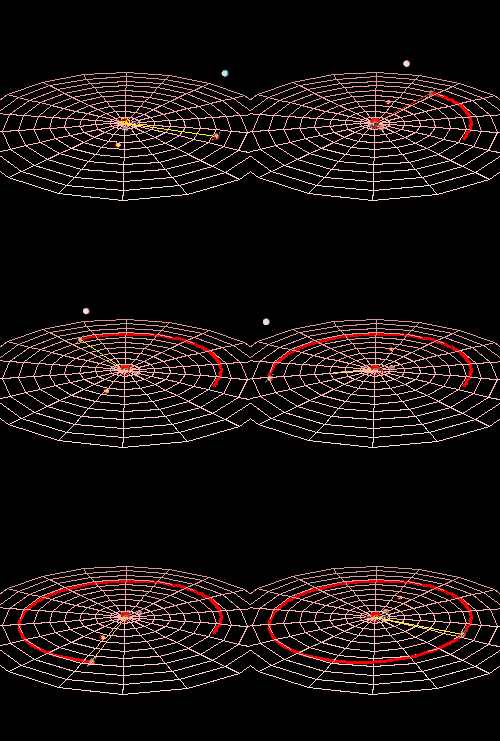



Characteristics of orbits
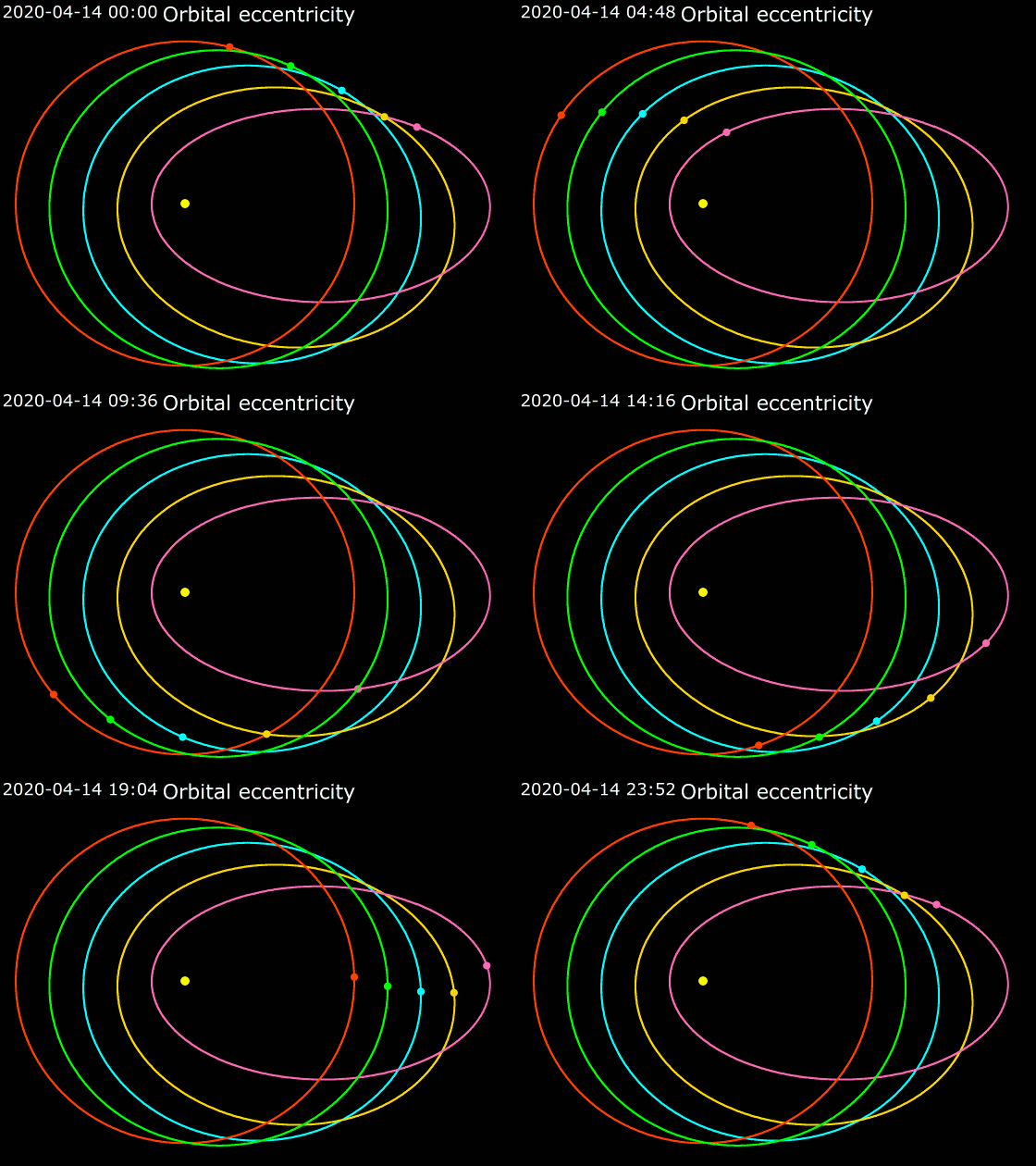
Real orbits are generally curved paths described by conic sections, most commonly ellipses. The shape and size of an orbit are defined by parameters such as semi-major axis and eccentricity. Kepler's laws summarize the basic geometric and temporal properties: bodies follow elliptical orbits, sweep out equal areas in equal times, and have periods related to orbit size. Newton later showed that these behaviors arise from gravitational attraction and the laws of motion. Orbital motion can be prograde or retrograde, circular or highly elongated, and may be perturbed by other masses.
History and scientific development
Understanding of orbital revolution developed from careful astronomical observation and the work of Copernicus, Kepler and Newton. Kepler derived empirical laws from detailed planetary records; Newton provided a physical explanation by proposing universal gravitation. Subsequent advances refined orbital models to include relativistic corrections near massive bodies and to treat non-gravitational forces for small satellites.
Examples and timescales
Orbital periods span a huge range. For example, Mercury requires about 88 days to orbit the Sun, while dwarf planets like Pluto take many decades. The Moon completes a sidereal circuit of Earth in roughly 27.3 days but returns to the same phase after about 29.5 days measured relative to the Sun. For Earth the orbital period is the basis of the year, and calendar systems such as the Gregorian calendar approximate that period with leap-year rules.
Uses, importance and examples in practice
Knowledge of orbital revolution is essential for navigation, satellite deployment, space missions and predicting celestial events. Spacecraft exploit orbital mechanics to transfer between paths, rendezvous, or escape a planet's gravity. Observational astronomy uses orbital periods to infer masses; binary star orbits, for instance, allow direct measurement of stellar masses from their revolution.
Key distinctions and notable facts
- Revolution vs rotation: Revolution refers to motion around another body; rotation describes spinning about an internal axis.
- Elliptical variety: Most planetary orbits are elliptical rather than perfect circles; eccentricity measures departure from circularity.
- Period differences: Orbital periods differ widely—Mercury (~88 days) and distant objects such as Mercury and Pluto illustrate the range of timescales for revolution.
- Terminology links: The concept connects to terms such as ellipse, orbit, and the astronomical definitions of year and calendar.
Understanding orbital revolution provides the framework for explaining seasons, tides (through moon–Earth interactions), eclipse prediction, and the planning of interplanetary travel. For more detailed technical treatments, academic texts and mission documentation explore perturbation theory, numerical orbit determination, and relativistic corrections in greater depth. Specific terms and examples used in this article may be explored further through linked resources.
Additional reference anchors: planet, star, Earth, Sun, Moon, elliptical, orbits, axis, year, Gregorian calendar, Mercury, Pluto
Related articles
Author
AlegsaOnline.com Orbital revolution: motion of planets, moons and satellites Leandro Alegsa
URL: https://en.alegsaonline.com/art/72982