
Gregorian calendar
International civil calendar introduced in 1582 to correct drift in the Julian calendar; defined modern leap-year rules and now used for civil purposes in most countries.
Overview
The Gregorian calendar is the internationally accepted civil calendar used in most of the world today. It was introduced in the late 16th century to correct a small but accumulating error in the older Julian system. Its rules determine the lengths of months, the occurrence of leap years, and the placement of important seasonal markers used by societies, religions and governments.
Image gallery
8 Images




Why it was introduced
The Julian calendar, devised earlier, assumed a year length of 365.25 days by adding an extra day every four years. Because the true tropical year — the average time for the Earth to complete one orbit of the Earth's path around the Sun from one equinox to the next — is slightly shorter than 365.25 days, the Julian year gained a few minutes each year relative to the seasons. Over centuries this discrepancy shifted the calendar date of the spring equinox and thus the date used to compute movable feasts such as Easter.
Reform and rules
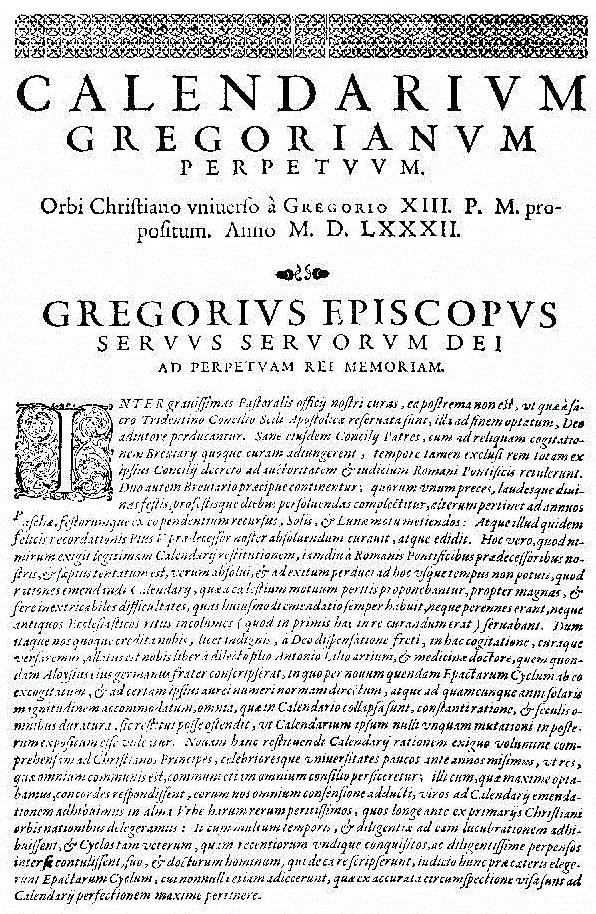
Pope Gregory XIII promulgated a reform that omitted ten days to realign the calendar with the seasons and introduced a refined leap-year rule to reduce future drift. The skip restored the equinox to its traditional date in church practice and set a simple rule for most civil calculations.
- Most years have 365 days.
- Ordinarily, a leap year occurs every 4 years, adding one extra day (February 29).
- To correct for the Julian overcount, years that are divisible by 100 are not leap years, unless they are also divisible by 400. This preserves long-term alignment of the calendar and the seasons.
Under these rules, years like 1700, 1800 and 1900 were common rather than leap years, while 1600 and 2000 were leap years because they are divisible by 400.
Adoption and historical effects
The initial adjustment took place in 1582: several Catholic countries advanced their dates by skipping ten days in October so that Thursday the 4th was followed by Friday the 15th. Adoption in other countries occurred more gradually. Protestant and Orthodox regions accepted the reform at different times, with some countries changing calendars only in the 18th or 20th centuries. The staggered adoption produced occasional confusion in international affairs, legal records and historical dating until the Gregorian calendar became globally predominant for civil purposes.
Structure, uses and distinctions
The Gregorian calendar preserves the familiar 12-month structure with months of 28–31 days. It is primarily a solar calendar designed to track the cycle of seasons and has been used for civil administration, commerce, timekeeping and the scheduling of religious observances. While it is the default civil calendar for most countries, other calendar systems continue to be used for religious or cultural purposes alongside it.
Notable facts
Because the civil reform was aimed at synchronizing the liturgical year with astronomical events, the Gregorian calendar is often discussed in contexts that reference the older Julian calendar, the notion of a global civil calendar, or the concept of common years. Its leap-year design offers a close approximation to the tropical year: the small residual discrepancy is only a few seconds per year on average, which accumulates much more slowly than with the Julian system.
Because of its balance of simplicity and improved accuracy, the Gregorian calendar remains the most widely used civil calendar in the contemporary world and provides the basis for international timekeeping, business calendars and most legal systems.
Questions and answers
Q: What calendar is used throughout the world?
A: The Gregorian calendar is used throughout most of the world.
Q: When did it begin being used?
A: It began being used in 1582.
Q: Why was it necessary to replace the Julian calendar?
A: The Julian calendar had an error, which caused the seasons to get out of track with the calendar over time. This was because it added a leap year (with an extra day every four years) with no exceptions and its length of 365.25 days was not exact enough for the Earth's orbit around the Sun.
Q: How much difference was there between the Julian and Gregorian calendars?
A: There was a difference of about eleven minutes each year between them.
Q: How did this affect farmers?
A: Farmers were not affected by this since they worked according to seasons rather than to the calendar.
Q: Why did Pope Gregory XIII declare that ten days must be skipped in 1582?
A: He declared this because Easter's date is calculated from March 21 equinox, which had shifted earlier due to errors in calculation in Julian Calendar, so he wanted to reset it back on track with Gregorian Calendar.
Q: What changes were made to prevent similar mistakes from happening again? A: To make sure that such mistake does not happen again, they revised 'leap year rule'. Until then, every fourth year had February 29 without exception but after revision, only those years ending in 00 would have February 29 unless they can be divided by 400.
Related articles
Author
AlegsaOnline.com Gregorian calendar Leandro Alegsa
URL: https://en.alegsaonline.com/art/40816
Sources
- timeanddate.com : "The Gregorian Calendar"
- timeanddate.com : "Year 1582 Calendar — Italy"
- timeanddate.com : "Year 1752 Calendar — United Kingdom"
- timeanddate.com : "Year 1918 Calendar — Russia"
- nationalarchives.gov.uk : Death warrant of Charles I
- nationalarchives.gov.uk : UK National Archives
- british-history.ac.uk : House of Commons Journal Volume 8, 9 June, 1660