
Orion (spacecraft)
Orion is NASA's crew-capable deep-space spacecraft, designed to carry astronauts beyond low Earth orbit to lunar orbit, support Gateway operations, and enable future missions to Mars.
Orion is a crewed spacecraft developed for NASA to carry astronauts beyond low Earth orbit. Built in partnership with industry and international agencies, Orion is intended to support missions to lunar orbit, to the planned lunar Gateway, and to serve as a human-capable element for eventual Mars expeditions. Program information and mission updates are published by the primary organizations involved: Orion program, Lockheed Martin as a principal integrator, and NASA.
Image gallery
10 Images
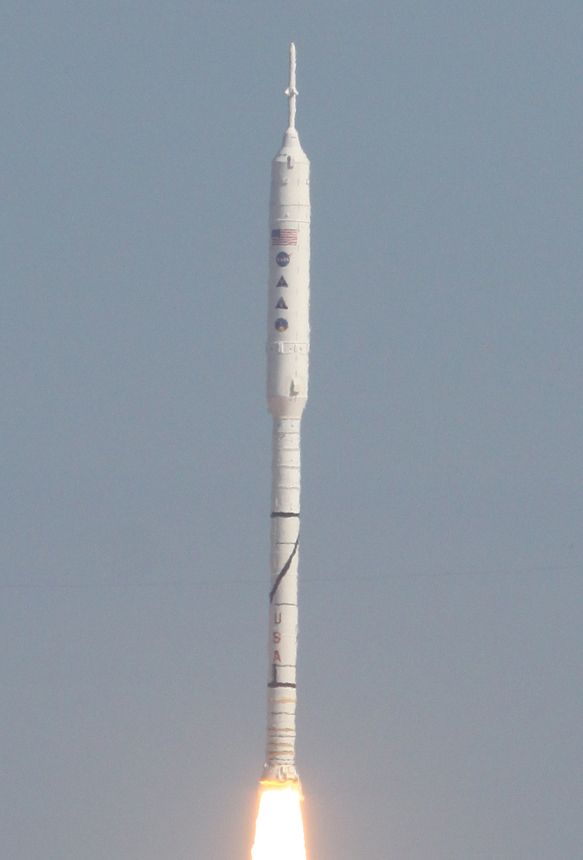


Design and components
The spacecraft is composed of a pressurized crew module that provides habitable volume and avionics, an unpressurized service module that supplies propulsion, electrical power and life-support consumables, and a forward launch-abort system for crew protection during ascent. Orion carries a robust thermal protection system and a heat shield sized for high-energy reentry from lunar or deep-space trajectories. The European Space Agency contributed a service-module design for major versions of the vehicle.
Capabilities and crew
Orion is optimized for deep-space operations rather than routine low-Earth flights. Configurations are intended to accommodate up to six astronauts for some mission profiles, while typical lunar missions use smaller crews and additional mission hardware. Orion supports long-duration habitation systems, rendezvous and docking with other spacecraft or stations, and a controlled return to Earth after high-velocity reentry from lunar or interplanetary trajectories. See references on crew accommodations and mission roles: crew capacity and related documentation.
Launch and operations
Orion is designed to launch on the Space Launch System (SLS) heavy-lift rocket for missions beyond low Earth orbit. Early test flights used alternate heavy-lift vehicles; the first orbital test (Exploration Flight Test-1) flew on a Delta IV Heavy to validate heat-shield and reentry systems. Operational missions are planned to lift off from historic pads such as Launch Complex 39B at Kennedy Space Center, the same complex used by the Space Shuttle and earlier Apollo missions that launched on the Saturn V.
Program context and future
Orion is a cornerstone of NASA's human exploration architecture and the Artemis program for returning humans to the Moon. It is intended to operate alongside infrastructure such as the Gateway lunar outpost and to demonstrate technologies needed for longer missions, including those to Mars. Continued flight tests, incremental upgrades, and international partnerships aim to mature Orion's systems for routine deep-space crewed operations.
- Safety: integrated launch-abort capability, redundant systems, and a heat shield for high-energy returns.
- Role: crew transfer, habitat and reentry vehicle for deep-space missions.
- Partnership: program includes multiple contractors and international contributors to the service module and other subsystems.
For official mission pages, technical specifications and planned flight manifest updates consult the program and agency resources: Orion program, Lockheed Martin, and NASA. Additional material on the launcher and destinations is available from SLS and exploration planning references: Space Launch System, Moon, and Mars.
Questions and answers
Q: Who built the Orion spacecraft?
A: Lockheed Martin built the Orion spacecraft for NASA.
Q: How many astronauts can each Orion spacecraft carry?
A: Each Orion spacecraft can carry up to six astronauts.
Q: What system will the Orion spacecraft be launched on?
A: The Orion spacecraft will be launched on the Space Launch System.
Q: What was the first launch of the Orion spacecraft called?
A: The first launch of the Orion spacecraft was called Exploration Flight Test-1.
Q: From which launch site will the Orion spacecraft be launched?
A: The Orion spacecraft will be launched from Launch Complex 39B at Kennedy Space Center, which was also used by the Space Shuttle and the Saturn V.
Q: What is the purpose of the Orion spacecraft?
A: The purpose of the Orion spacecraft is to take humans to the Moon and Mars.
Q: On which rocket was the first launch of the Orion spacecraft?
A: The first launch of the Orion spacecraft was launched on the Delta IV Heavy.
Related articles
Author
AlegsaOnline.com Orion (spacecraft) Leandro Alegsa
URL: https://en.alegsaonline.com/art/73163
Sources
- thomas.loc.gov : "NASA Authorization Act of 2010"
- nasaspaceflight.com : "NASA ESD set key Orion requirement based on Lunar missions"
- scientificamerican.com : "Deep Space or Bust"
- ui.adsabs.harvard.edu : 2014SciAm.311f..20M
- doi.org : 10.1038/scientificamerican1214-20
- nasa.gov : "Orion Quick facts"
- nasa.gov : "Preliminary Report Regarding NASA's Space Launch System and Multi-Purpose Crew Vehicle"
- nytimes.com : "NASA's Orion Spacecraft Splashes Down in Pacific After Test Flight"
- nasa.gov : "NASA Moon and Mars"