
Orion Arm (Local Spur) — the Solar System's region of the Milky Way
The Orion Arm, or Local Spur, is a minor spiral arm of the Milky Way that contains the Solar System. Overview, structure, notable objects, how it is mapped, and its significance are described.
Overview
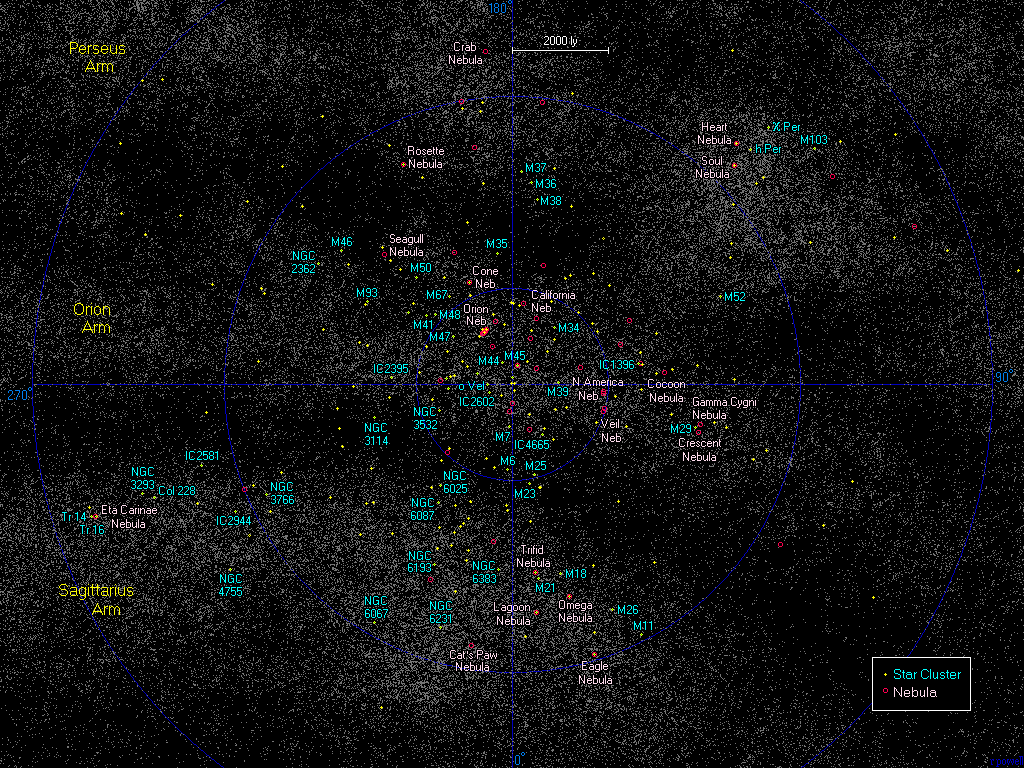
The Orion Arm, also called the Orion–Cygnus Arm or the Local Spur, is a relatively small spiral feature of the Milky Way galaxy. It is important because the Solar System, including the planet Earth, lies within it. Compared with the Milky Way's major arms, the Orion Arm is narrow and somewhat shorter: estimates often describe it as on the order of a few thousand light‑years across and roughly ten thousand light‑years long. The feature is best described as a spur or branch rather than a primary spiral arm.
Image gallery
6 Images



Structure and location
The Orion Arm sits between two larger arms: the Perseus Arm to the outside of the Galaxy and the Carina–Sagittarius Arm toward the Galactic center. It occupies a local region of interstellar material and star formation and is bounded by less dense interarm space. The Solar System lies relatively near the inner edge of the spur, embedded in a low‑density cavity known as the Local Bubble. From the Galactic center the Sun's radius is commonly given as about 8–9 kiloparsecs (approximately 25,000–30,000 light‑years), placing our location roughly halfway along the Orion spur's length.
Notable stars and nebulae
The Orion Arm contains many of the bright stars and familiar deep‑sky objects visible from Earth because of proximity. Prominent examples include the red supergiant Betelgeuse, the blue supergiant Rigel, the asterism of Orion's Belt, and the bright emission region of the Orion Nebula. The arm derives its informal name from the Orion constellation, one of the best known constellations, which contains many of these objects and is readily visible in the Northern Hemisphere winter sky (and southern summer).
How astronomers map the arm
Mapping the Orion Arm combines observations at radio, infrared and optical wavelengths. Surveys of atomic and molecular gas, measurements of maser sources, and precise distances derived from parallax and other methods allow astronomers to trace the arm's shape and star‑forming regions. These techniques show the Orion feature as a coherent spur of young stars and nebulae situated between the more massive spiral arms such as the Perseus Arm. Descriptions that refer to regions "outside" the major arms use that contrast to highlight the spur's intermediate position relative to the rest of the Galaxy's structure.
Significance and distinctions
- The Orion Arm is not one of the Milky Way's principal, long, high‑mass arms; it is a secondary spur, which affects how star formation and stellar populations are distributed locally.
- Because humanity's instruments and telescopes are located inside this spur, many of the sky objects we study in greatest detail belong to it; this can bias surveys toward nearby features.
- Studying the Orion Arm helps astronomers understand spiral‑arm dynamics, local star formation history, and the distribution of interstellar matter near the Sun.
Further reading
For more on the Milky Way's structure, the Solar System's place within it, and the observational methods used to define spiral arms, consult introductory resources and survey papers linked through reference libraries and educational portals. Representative entry points include pages on the Milky Way, the Solar System, the Local Bubble, and catalogues of nearby star‑forming regions. Additional materials elaborate the Orion Arm's relation to named stars such as Betelgeuse and Rigel, and to stellar groupings in the Orion constellation. Other useful links include pages on general galactic arms like the Perseus Arm and background descriptions of constellations and observational hemispheres (constellations, Northern Hemisphere), plus glossary items for distance units such as parsecs and broader notes on our galactic environment (cosmic context).
If you are exploring specific objects, star charts and nebula catalogues will point to features in Orion's belt and the nearby nebulae, while radio and infrared surveys reveal the colder gas and dust that define the arm's structure.
Questions and answers
Q: What is the Orion Arm?
A: The Orion Arm, or Orion–Cygnus Arm, is a minor spiral arm of the Milky Way galaxy. It is of interest because the Solar System (including the Earth) is inside it.
Q: How wide and long is the Orion Arm?
A: The spiral arm is some 3,500 light-years (1,100 parsecs) across and approximately 10,000 light-years (3,100 parsecs) in length.
Q: Where does its name come from?
A: The Orion Arm is named after the Orion constellation, one of the most prominent constellations. It is seen in the Northern Hemisphere during winter and in the Southern Hemisphere during summer.
Q: What stars and celestial objects are located in this arm?
A: Some of the brightest stars and most famous celestial objects are in the Orion Arm such as Betelgeuse, Rigel, stars of Orion's Belt and also the Orion nebula.
Q: Where does it lie relative to other arms of our Galaxy?
A: The Orion Arm lies between two major arms - Carina–Sagittarius Arm (toward Galactic centre) and Perseus Arm (toward outside Universe).
Q: How far away from Galactic Centre is Solar System located?
A: The Solar system lies on an 'Orion spur' between two longer adjacent arms Perseus and Carina-Sagittarius at about 8,000 parsecs (26,000 light-years) from Galactic centre.
Tags
Related articles
Author
AlegsaOnline.com Orion Arm (Local Spur) — the Solar System's region of the Milky Way Leandro Alegsa
URL: https://en.alegsaonline.com/art/73156
Sources
- planetquest.jpl.nasa.gov : See the "Spiral Arms" part of this NASA animation for details
- nrao.edu : Earth's Milky Way neighborhood gets more respect
- arxiv.org : 0709.3973
- ui.adsabs.harvard.edu : 2008ApJ...672..930V
- doi.org : 10.1086/524003