
Orion (constellation): stars, nebulae, mythology and visibility
Orion is a prominent constellation straddling the celestial equator, known for its Belt, bright stars (Rigel, Betelgeuse), the Orion Nebula, and a major star‑forming complex visible across many cultures.
Orion is one of the most conspicuous constellations visible from both hemispheres and has been widely recognised since antiquity. The pattern is commonly associated with the hunter or warrior Orion of Greek mythology, though comparable figures and practical uses for the grouping appear in many cultures; the pattern is even referred to under a Hebrew name in the Book of Job. The familiar hourglass outline and the straight line of three bright stars that form Orion's Belt make the constellation easy to locate on clear nights.
Image gallery
10 Images
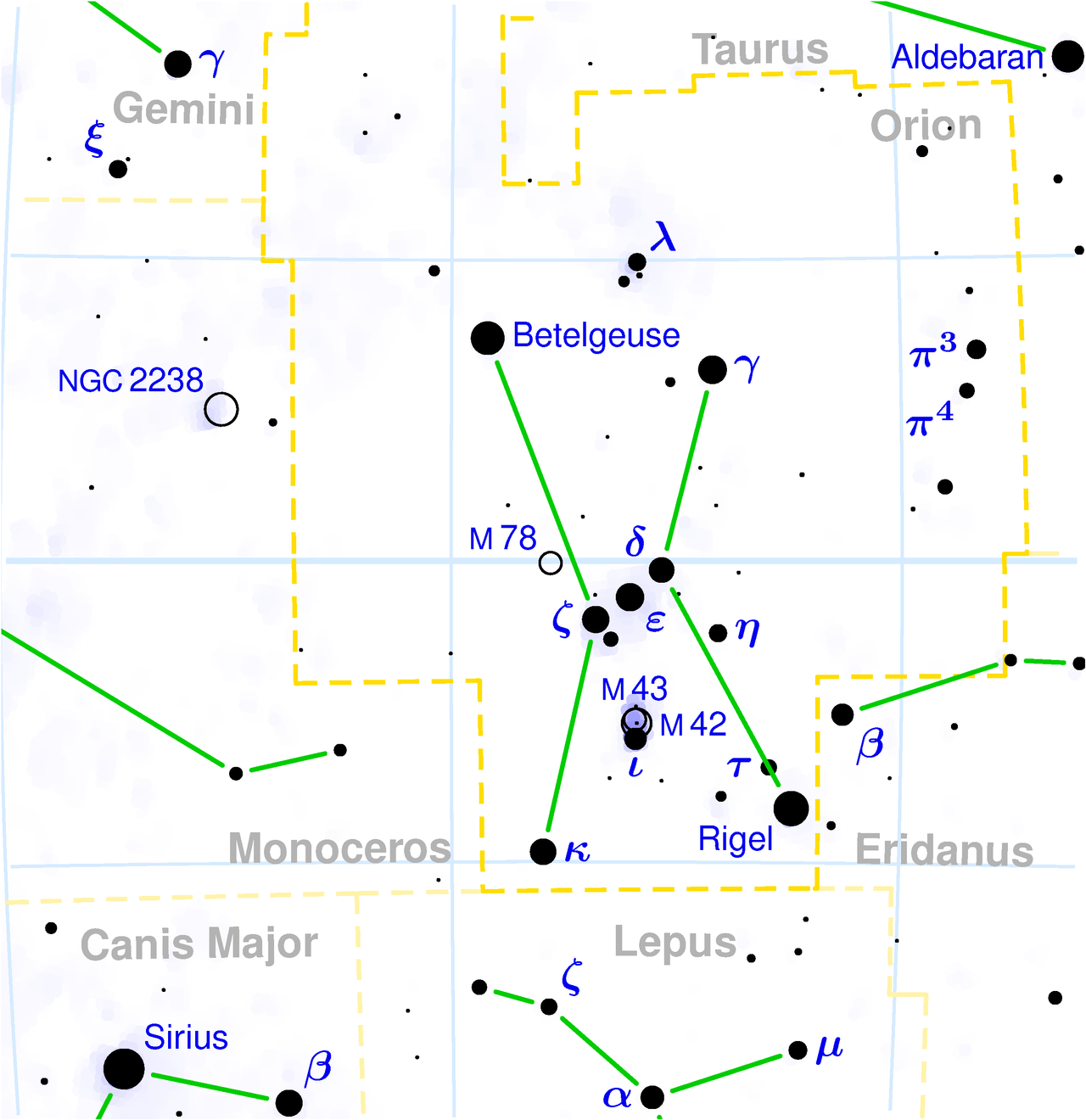





Principal stars and visual features
Orion contains several of the night sky's most luminous stars. The bright blue-white star Rigel marks one of Orion's feet and serves as a navigational reference. At the opposite shoulder sits Betelgeuse, a conspicuous red, somewhat variable supergiant noted for its large apparent size and slow brightness changes; as a red supergiant it represents a late stage of stellar evolution and will eventually end in a supernova at an uncertain future date. The three Belt stars — Alnitak, Alnilam and Mintaka — are useful pointers that help observers find adjacent constellations and deep-sky objects.
Structure and notable deep‑sky objects
Beneath the Belt hangs Orion's Sword, which contains the famous Orion Nebula (Messier 42), a bright emission nebula visible to the naked eye from dark sites and a rich target for telescopes. The Sword region also includes the Trapezium cluster and other reflection and emission nebulae. Nearby dark nebulae produce striking silhouettes such as the Horsehead Nebula, while the broader network of clouds and young clusters is part of the larger Orion complex. This complex of molecular clouds and stellar nurseries lies at roughly a distance measured in the low thousands of light‑years and spans hundreds of light‑years, making it one of the nearest regions of active star formation.
Stellar evolution illustrated
Observers of Orion can see stars at different evolutionary stages: hot, young massive stars that illuminate H II regions, protostars still embedded in dust, and evolved giants like Betelgeuse. The variety of objects in Orion makes it a natural laboratory for studying how stars form, evolve and interact with their surroundings. Surveys at many wavelengths — optical, infrared and radio — reveal details of accretion, outflows and the dispersal of proto-planetary material.
Visibility, seasonal notes and locating Orion
Straddling the celestial equator, Orion is visible from most inhabited latitudes. In the Northern Hemisphere it is most prominent in winter evenings, while observers in the Southern Hemisphere see it high in the sky during their summer. The Belt provides an easy starting point: follow the line of the Belt to find the bright star Rigel in one direction and the red shoulder Betelgeuse in the other. Extending the Belt southward points to the bright star Sirius in Canis Major, and other star‑hopping techniques use Orion as a reference to locate nearby constellations and objects.
Cultural and historical significance
Orion's strong visual signature secured it a place in cosmologies and calendars around the world. In addition to its role in Greek legend, the figure or its components were identified by ancient Egyptians, Mesopotamians and peoples of the Americas and Pacific regions, often with associations to hunters, deities or seasonal markers. The constellation's predictable seasonal rise and set helped ancient observers with navigation and agricultural timing.
Modern study and amateur observation
Astronomers use both professional observatories and amateur equipment to study Orion's components. The bright nebulae and clusters are popular targets for photography and public outreach because they display vivid structure and color in long exposures. Professional research focuses on the dynamics of the Orion complex, the initial mass function of forming stars, and the impact of massive stars on their natal clouds. For newcomers, binoculars and small telescopes reveal the Trapezium and details in M42, while larger instruments and multiwavelength data uncover protostars and molecular gas.
Key takeaways
- Orion is a visually striking constellation easily recognised by Orion's Belt and bright endpoint stars.
- It contains important astronomical targets including the Orion complex and the Orion Nebula (M42), sites of active star formation.
- Stars such as Rigel and Betelgeuse illustrate different evolutionary stages, from hot blue supergiants to red supergiants.
For more general context consult material on the concept of a constellation, the mythic figure Orion in Greek mythology, the Book of Job reference, focused descriptions of Orion's Belt, and detailed studies of individual stars and the Orion complex.
Questions and answers
Q: What is the Orion constellation?
A: The Orion constellation is one of the largest constellations in the sky and is said to look like a warrior from Greek mythology. It has 81 visible stars, including some of the brightest and most important stars in the night sky.
Q: What are some of the stars in it?
A: Some of the stars that make up Orion's constellation include Alnitak, Alnilam, Mintaka, Rigel (the brightest star), and Betelgeuse (a huge red supergiant).
Q: Does it have any other names?
A: Yes, it is mentioned under a Hebrew name in the Book of Job.
Q: What does Orion's Belt consist of?
A: Orion's Belt consists of three bright stars (Alnitak, Alnilam, Mintaka) that form a line across its center.
Q: What is known as the Orion complex?
A: The Orion complex refers to a series of starburst nebulae where new stars are forming within the constellation.
Q: How far away from Earth is it located?
A: The entire group of nebulae making up what is known as "The Orion Complex" is located 1,500 to 1,600 light-years away from Earth.
Related articles
Author
AlegsaOnline.com Orion (constellation): stars, nebulae, mythology and visibility Leandro Alegsa
URL: https://en.alegsaonline.com/art/73158