
Mercury: Smallest and Innermost Planet of the Solar System
Mercury is the smallest and innermost planet, notable for extreme temperature swings, a heavily cratered surface, a large iron core, a weak magnetic field, a very thin exosphere and limited spacecraft exploration.
Overview
Mercury is the smallest planet in the Solar System and the one nearest the Sun. It completes an orbit in about 88 Earth days and displays phases like the Moon when viewed from Earth. Because it lies so close to the Sun, Mercury is often visible only during morning or evening twilight and can be difficult to observe against the Sun’s glare. Observers since antiquity have noted its rapid motion across the sky and changing appearance, and modern planetary science studies its unusual composition, internal structure and extreme environment.
For concise context and comparative data see resources on size and rank and the Solar System overview. Orbital parameters and observational ephemerides are summarized in publications and databases such as orbital data. Observing guides discuss apparent brightness and the best times to see the planet (apparent magnitude, viewing windows) and eclipse sightings sometimes offer special opportunities (eclipse observations).
Image gallery
10 Images





Physical characteristics
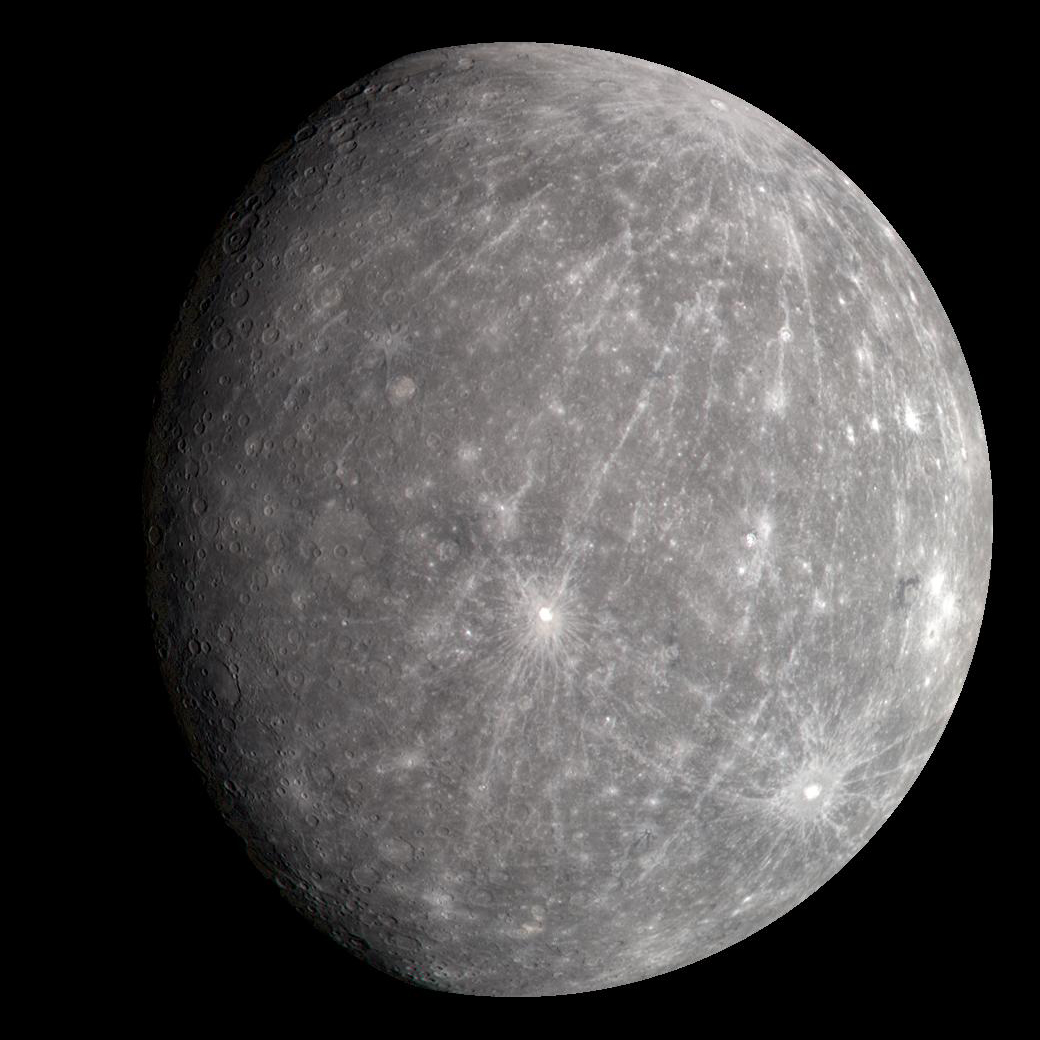
Mercury is a terrestrial planet with a solid, heavily cratered surface and a very large iron-rich core relative to its size. Its high mean density is one of the clues that a substantial metallic core makes up a large fraction of the planet’s mass. The planet has only an extremely tenuous atmosphere, better described as an exosphere composed of atoms and molecules released from the surface; typical constituents include sodium, potassium, oxygen and helium. Mercury also generates a weak intrinsic magnetic field, around one percent the strength of Earth’s, indicating a partially molten outer core and a dynamo process under conditions different from those of Earth.
Technical and observational summaries are available in literature on telescope observations and spacecraft instrumentation (telescope observations, satellite challenges). Mission pages provide detailed results from the probes that have visited the planet (mission summaries, Mariner 10, MESSENGER).
Surface and geology
The surface of Mercury resembles the Moon in many respects: extensive impact craters, broad smooth plains and large basins. The Caloris Basin is among the largest impact features and is surrounded by disrupted terrain and concentric structures. Data from orbital missions revealed features called "hollows," shallow irregular depressions that appear to form where volatile-bearing material is lost from the surface. High-reflectance and high-density materials exposed by impacts point to a complex formation and thermal history. Permanently shadowed polar craters host deposits of water ice and other volatiles despite the planet’s proximity to the Sun; these were inferred from radar observations and confirmed by spacecraft instruments.
Comparative studies of craters and plains help link Mercury’s geology to lunar and other planetary records (lunar comparisons, crater studies), while measurements of exospheric composition and surface-bound species are summarized in atmospheric and geochemical notes (exosphere composition). Internal structure models and the evidence for a large iron core are discussed in planetary interior literature (iron core evidence, internal structure), and magnetospheric measurements appear in magnetosphere research summaries (magnetic field).
Orbit, rotation and thermal environment
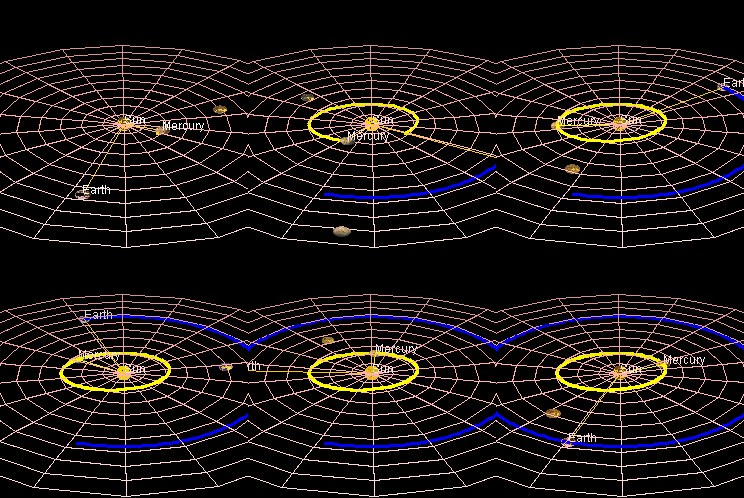
Mercury experiences extreme surface temperature variations because it has almost no atmosphere to retain heat and rotates slowly relative to its orbital period. Daytime temperatures near the subsolar point can exceed 700 K, while shadowed regions and some polar depressions can be colder than 100 K. The planet is locked in a 3:2 spin–orbit resonance: it rotates three times on its axis for every two revolutions around the Sun, so a solar day (noon-to-noon) lasts longer than its year. Mercury’s orbit is notably eccentric, and its proximity to the Sun makes it useful for testing gravitational theories and studying solar-planet interactions.
Thermal models and observational temperature maps illustrate how the combination of low thermal inertia, surface properties and insolation produce large diurnal contrasts (temperature data, subsolar heating). Cold traps in permanently shadowed craters and other polar phenomena are the subject of observational and theoretical study (polar craters).
Observation history and cultural significance
Mercury has been observed since ancient times. Different cultures recorded its two apparent modes of visibility—morning and evening—and early Greek astronomers at one time treated these sightings as separate objects, naming them Apollo (morning) and Hermes (evening) before recognizing they were the same planet. The Romans later named the planet Mercury, after their messenger god, and the astronomical symbol retains elements associated with that classical heritage.
Cultural and historical studies cover the classical identifications and the evolution of the planet’s name and symbol (Apollo/Hermes history, Greek traditions, Roman naming, mythological links, symbolism). Comparative climate notes explain why Mercury is not the hottest planet despite its proximity to the Sun—Venus is hotter because of a dense greenhouse atmosphere (greenhouse comparison, Venus contrast).
Exploration, scientific importance and future study
- Robotic exploration has been limited by the technical challenges of operating near the Sun. Mariner 10 provided the first close-up images in the 1970s and mapped a substantial portion of the surface (Mariner 10).
- The MESSENGER spacecraft later orbited Mercury and completed global mapping and many in situ measurements, expanding knowledge of surface composition, geology and the exosphere (MESSENGER).
- International follow-on efforts include the joint ESA–JAXA BepiColombo mission, launched to perform detailed compositional, geophysical and magnetospheric studies; its investigations will refine models of Mercury’s formation and evolution and continue to test aspects of planetary physics (mission science, satellite challenges).
Mercury remains scientifically important because its large core fraction, weak magnetic field, and proximity to the Sun provide natural laboratories for understanding planetary formation, interior dynamics and space environment interactions. Ongoing and future analyses of mission data, combined with laboratory experiments and theoretical models, aim to resolve open questions about the planet’s early history, volatile inventory and thermal evolution (interior studies, magnetospheric research, observational programs).
For general summaries, educational materials and detailed mission reports see linked resources and mission pages (planet overview, system context, orbital facts, observing tips, viewing windows, eclipse observations, comparative geology, impact studies, exosphere research, core research, thermal models, solar heating, polar ice studies, ancient records, classical texts, Roman sources, mythic connections, symbolism, atmospheric contrasts, planetary comparisons).
Questions and answers
Q: What is the name of the smallest planet in the Solar System?
A: The smallest planet in the Solar System is Mercury.
Q: How long does it take for Mercury to make one trip around the Sun?
A: It takes Mercury 87.969 days to make one trip around the Sun.
Q: What is the magnitude of Mercury when seen from Earth?
A: When seen from Earth, Mercury has an apparent magnitude ranging from −2.0 to 5.5.
Q: What kind of atmosphere does Mercury have?
A: Mercury has an extremely thin atmosphere known as an exosphere.
Q: Does Mercury have a magnetic field?
A: Yes, because of its large iron core, Mercury has a magnetic field about 1% as strong as that of the Earth's magnetic field.
Q: What are some temperatures at surface level on Mercury?
A: Temperatures at surface level on mercury can range anywhere from about 90 to 700 K (−183°C to 427°C, −297°F to 801°F).
Q: Who named and gave symbol for this planet?
A:The English name for this planet was given by Romans who named it after their god 'Mercury'. The symbol for this planet is based on Hermes' staff.
Related articles
Author
AlegsaOnline.com Mercury: Smallest and Innermost Planet of the Solar System Leandro Alegsa
URL: https://en.alegsaonline.com/art/63920
Sources
- en.oxforddictionaries.com : "Mercurian"
- nssdc.gsfc.nasa.gov : "Mercury Fact Sheet"
- home.comcast.net : "The MeanPlane (Invariable plane) of the Solar System passing through the barycenter"
- chemistry.unina.it : Solex 10
- ssd.jpl.nasa.gov : "HORIZONS System"
- solarsystem.nasa.gov : "Mercury: Facts & Figures"
- adsabs.harvard.edu : "Report of the IAU/IAGWorking Group on cartographic coordinates and rotational elements: 2006"
- doi.org : 10.1007/s10569-007-9072-y
- adsabs.harvard.edu : "Large Longitude Libration of Mercury Reveals a Molten Core"
- doi.org : 10.1126/science.1140514
- pubmed.ncbi.nlm.nih.gov : 17478713
- nineplanets.org : "Mercury l Mercury facts, pictures and information"
- bbc.co.uk : "BBC Solar System - Mercury: A tortured world close to our blazing Sun"
- image.gsfc.nasa.gov : image.gsfc.nasa.gov
- nssdc.gsfc.nasa.gov : nssdc.gsfc.nasa.gov/nmc/masterCatalog.do?sc=1973-085A