
Orion Molecular Cloud Complex
A vast, nearby star-forming region in the constellation Orion comprising emission, reflection and dark nebulae, young clusters and H II regions visible from Earth in optical and infrared wavelengths.
Overview
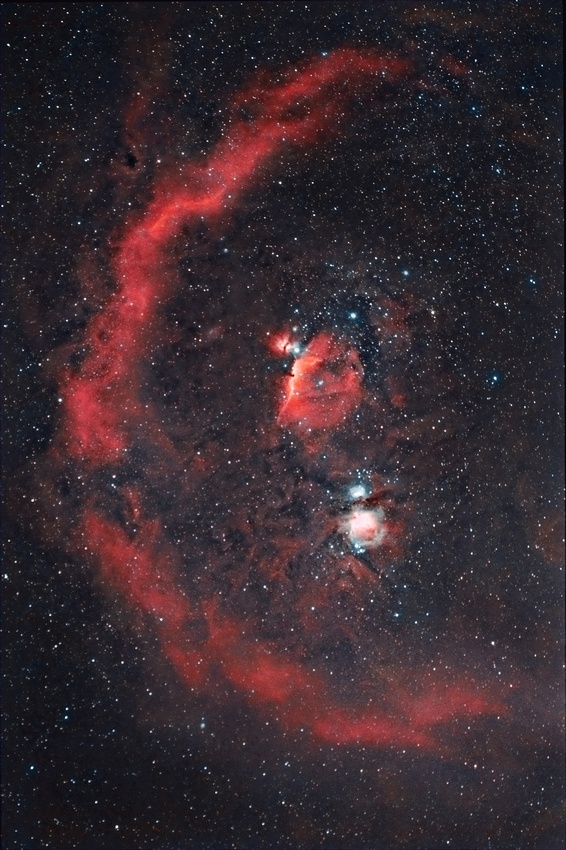
The Orion molecular cloud complex, commonly called the Orion complex, is one of the nearest and most extensively studied regions of ongoing star formation. Located in the constellation Orion, it spans hundreds of light‑years and lies roughly between 1,300 and 1,600 light‑years from Earth. The complex is a mixture of glowing gas, obscuring dust, compact young star clusters and large H II regions, and it is bright at optical and particularly infrared wavelengths because of the heat generated during stellar birth.
Image gallery
10 Images



Structure and principal components
The region is not a single cloud but a family of interrelated structures. Two of the best known molecular clouds are called Orion A and Orion B; embedded within them and nearby are numerous named objects. Major components include:
- The Orion Nebula (M42) and its neighbor M43, a luminous H II region where a dense cluster of massive young stars ionizes surrounding gas.
- The emission nebulae and compact star‑forming knots along Orion A, visible as bright, colorful patches in long‑exposure images.
- Dark lanes and obscuring dust such as the dark clouds that silhouette against brighter gas and hide new stars from optical view.
- Reflection nebulae — faint clouds that shine by scattering starlight — represented across the complex as reflection nebulae.
- Large scale features like Barnard’s Loop and the Horsehead Nebula, plus multiple young star clusters and associations.
Star formation and astrophysical importance
Orion is a laboratory for studying how stars and planetary systems form. Within dense cores and filaments, gas collapses to make protostars and protoplanetary disks (proplyds) around newborn stars. The complex contains many very young stars and massive O‑ and B‑type stars whose radiation and winds shape surrounding material, triggering or quenching further collapse. Because it is relatively close and bright, astronomers use Orion to test theories of cluster formation, disk evolution and feedback from massive stars.
Observation, history and discovery
Parts of the complex are visible to the unaided eye: the Orion Nebula can be seen as the middle 'star' in Orion’s sword. Other features become apparent through binoculars or small telescopes (binoculars) and much more detail is revealed with large telescopes and space observatories at infrared and radio wavelengths. The area has been observed for centuries; modern studies using spectroscopy, infrared imaging and radio mapping have clarified its distance and internal structure and revealed abundant cold molecular gas and young stellar objects.
Notable facts and distinctions
The Orion complex is one of the closest regions of massive star formation to the Sun, making it a cornerstone of observational star‑formation research. It contains multiple types of nebulae — bright nebulae, emission nebulae, reflection nebulae and dark clouds — and manifests a range of physical conditions from cold molecular cores to hot ionized gas. Researchers studying chemical evolution, protostellar jets, and early planetary disk properties often point to Orion as a primary reference region for testing models of how stars and planetary systems originate.
For general introductions and observing guides, see resources on the Orion region or materials that explain star formation processes. Further technical information and surveys of the complex are available through astronomical catalogs and specialist reviews (dark cloud surveys, cluster studies, M42 observations and infrared mapping projects linked to IR research).
Questions and answers
Q: What is the Orion complex?
A: The Orion complex, also known as the Orion molecular cloud complex, is a large star-forming area in the constellation of Orion that comprises bright nebulae, dark clouds, and young star clusters.
Q: How far away is the Orion complex?
A: The Orion complex is 1,500 to 1,600 light-years away.
Q: What is the size of the Orion complex?
A: The Orion complex is hundreds of light-years across.
Q: Can parts of the Orion complex be seen with the naked eye?
A: Yes, some parts of the Orion complex, such as the Orion nebula, can be seen with the naked eye.
Q: Why is the Orion complex important?
A: The Orion complex is important because of its sheer size and because it is one of the most active regions of stellar formation that can be seen in the night sky.
Q: What can be found in the Orion complex?
A: The Orion complex contains protoplanetary discs and many very young stars, as well as dark nebulae, emission nebulae, reflection nebulae, and HII regions.
Q: Why is the nebula in the Orion complex very bright in the infrared wavelengths?
A: The nebula in the Orion complex is very bright in the infrared wavelengths due to the heat-intensive processes involved in star formation.
Related articles
Author
AlegsaOnline.com Orion Molecular Cloud Complex Leandro Alegsa
URL: https://en.alegsaonline.com/art/73157